The Influencer Economy in 2026: Is Social Media a Real Career or a Digital Lottery Ticket?
The Influencer Economy in 2026: Is Social Media a Real Career or a Digital Lottery Ticket?

Scroll through any social media feed today and you’ll see them: the polished lifestyle shots, the “day in my life” vlogs, the unboxing videos, the finance tips delivered in 60-second bursts. Behind every one of those posts is someone who has decided — or is dreaming of deciding — to make social media their career. And in 2026, that dream has never been more seductive, or more complicated.
The creator economy is now a $313.95 billion global industry. Influencer marketing alone is projected to surpass $32 billion this year. There are an estimated 207 million content creators worldwide, with roughly 45 million Americans identifying as professional creators. These are not small numbers. This is not a fad. But here’s the question that Your Career Place wants you to sit with before you quit your day job: Is the influencer economy a genuine career path, or is it the world’s most elaborate lottery?
The answer, as with most things in the modern job market, is complicated. Let’s dig in.
The State of the Creator Economy in 2026
The numbers are staggering on the surface. The global creator economy has grown from a niche corner of the internet into a full-blown industry with a projected compound annual growth rate of 23.41% through 2035 — potentially reaching $2 trillion within a decade. Full-time digital creator jobs in the United States grew from approximately 200,000 in 2020 to 1.5 million by 2024, a trend that has continued accelerating into 2026. Today, 34% of creators identify as full-time professionals, and corporations are building entire internal departments around creator partnerships.
The job titles that didn’t exist a decade ago are now standard on LinkedIn: Influencer Marketing Manager ($65,000–$150,000/year), Creator Partnerships Director ($110,000–$250,000/year), UGC Strategist, AI Content and Commerce Strategist. Brands that invest more than $250,000 annually in creator partnerships now routinely maintain dedicated influencer marketing teams. The industry has professionalized — and that professionalization has created real, stable, well-paying jobs for people who work around creators, not just for the creators themselves.
On the platform side, the landscape has matured significantly. YouTube remains the gold standard for direct ad revenue, paying creators 55% of ad revenue with a median RPM (revenue per thousand views) of around $2.30. TikTok has pivoted from its controversial Creator Fund to the Creator Rewards Program and TikTok Shop, where commission rates average 13.1% — often outperforming view-based payouts. Instagram, meanwhile, has largely abandoned direct creator payouts and functions primarily as a brand deal and sales platform.
And AI has become table stakes. Between 86% and 91% of professional creators in the U.S. and U.K. now use AI tools in their workflows — from Opus Clip and CapCut for video editing to Adobe Sensei and RunwayML for production automation. The creator who isn’t using AI in 2026 is working twice as hard for half the output.
At Your Career Place, we’ve watched this industry evolve from a curiosity into a legitimate career category. But legitimacy doesn’t mean easy — and the data tells a more sobering story beneath the surface.
The Hard Truth: A Winner-Take-All Market
Here’s the statistic that should give every aspiring influencer pause: 48.7% of U.S. creators earn less than $10,000 per year. Only 5.8% clear six figures. The St. Louis Federal Reserve has described the influencer labor market as a “winner-take-all” structure — similar to professional athletics, where a tiny elite captures the vast majority of income while the rest struggle to break even.
The visibility problem is real. A staggering 76% of TikTok videos and 59% of long-form YouTube videos receive fewer than 1,000 views. On average, it takes 6.5 months for a new creator to earn their first dollar — and more than 17 months to become self-supporting. Meanwhile, 65% of creators report experiencing work-related anxiety or depression, and 62% say they’ve felt burned out. The “always-on” nature of content creation — where the algorithm rewards consistency above almost everything else — takes a measurable toll.
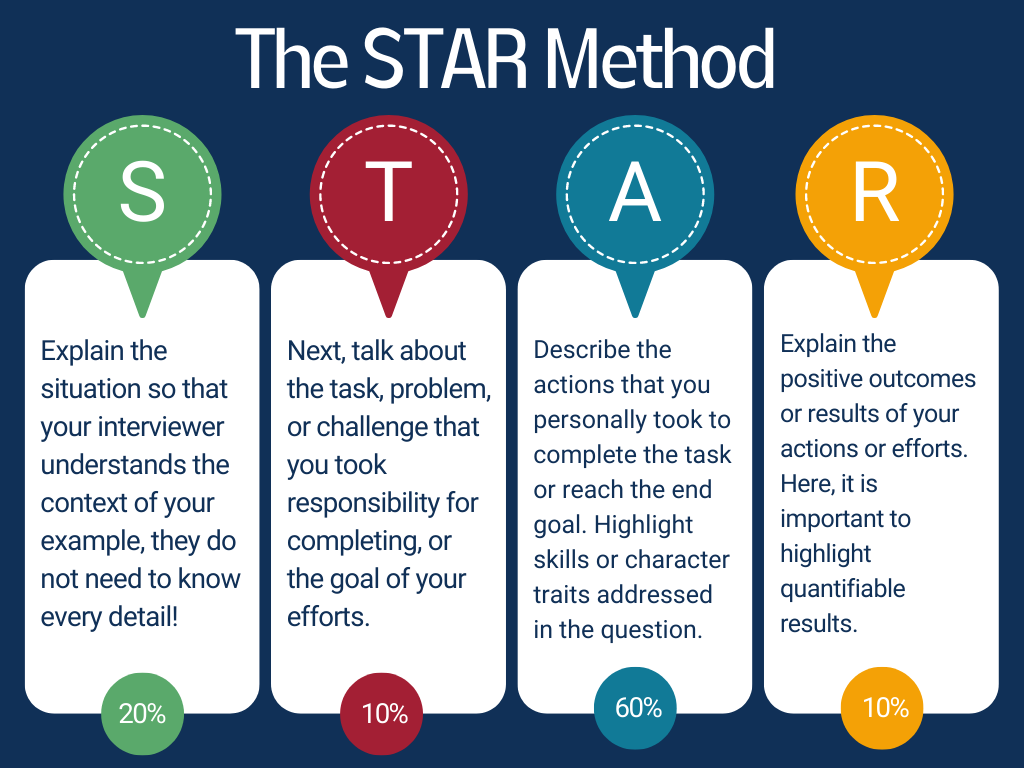
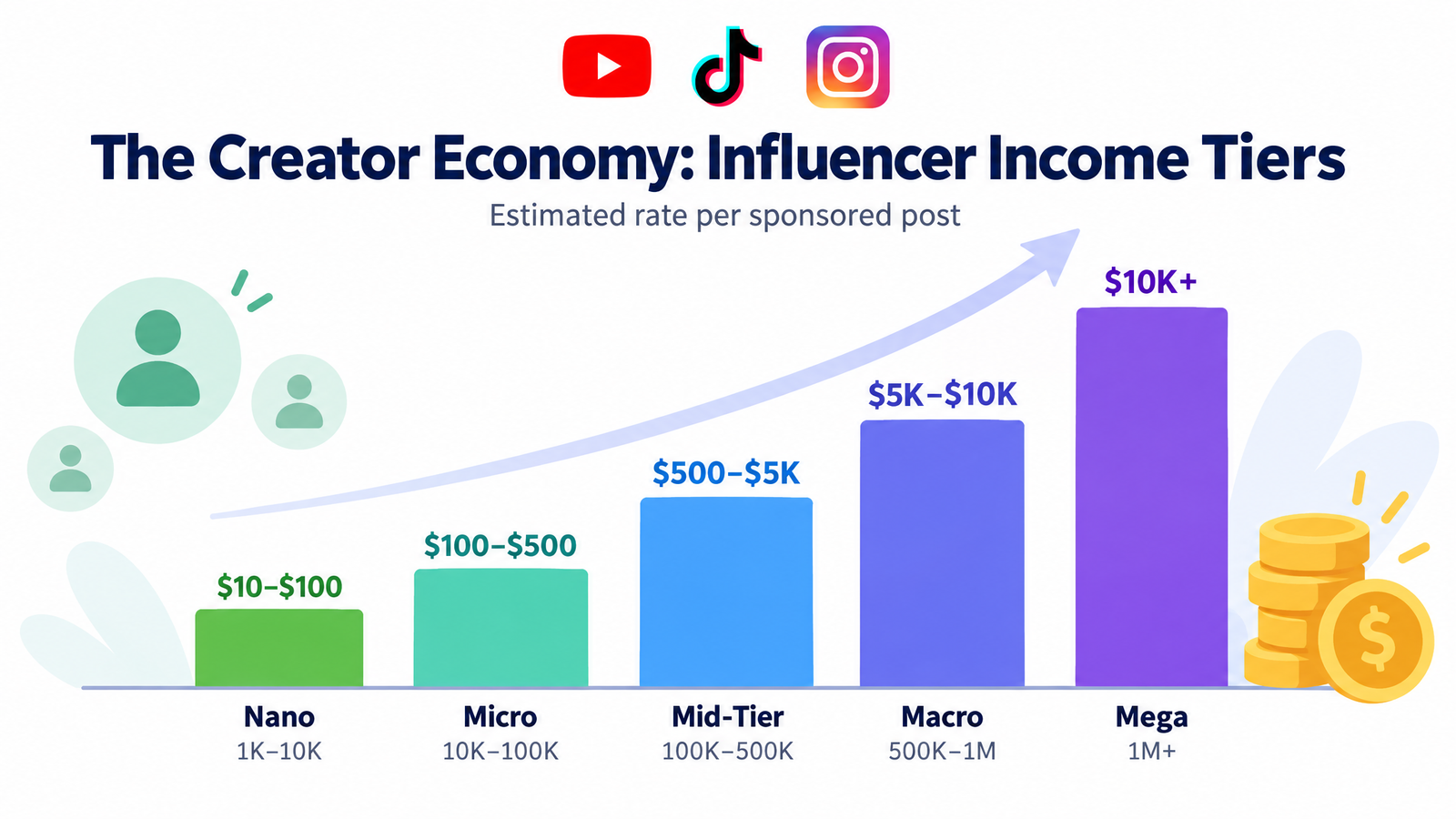
The income structure is also deeply unequal by tier. Nano-influencers (1,000–10,000 followers) earn an average of $195 per sponsored post. Micro-influencers (10,000–100,000 followers) average $1,211. Macro-influencers (100,000–1 million followers) average $1,804. And mega-influencers with over a million followers can command $5,000 to $100,000 or more per post. The gap between the bottom and the top is not a ladder — it’s a cliff.
Brand deals currently account for 59–70% of creator income, which means most creators are deeply dependent on relationships with brands that can pull the plug at any time. Platform algorithm changes — which happen constantly and without warning — can wipe out months of audience-building overnight. This is not a stable employment model for most people.
The Boomer’s Perspective: This Is the Most Exciting Career Frontier in a Generation
Let’s be honest: every generation has had its skeptics about new career paths. People said the same things about becoming a radio personality in the 1930s, a TV host in the 1950s, or a web developer in the 1990s. The creator economy is simply the latest evolution of media and entertainment — and the opportunity it presents is genuinely historic.
Consider the corporate side of this industry. Influencer Marketing Managers, Creator Operations Leads, UGC Strategists — these are real jobs with real salaries, real benefits, and real career ladders. The influencer marketing industry is growing at a pace that outstrips most traditional sectors, and companies are scrambling to hire people who understand how this ecosystem works. If you have a background in marketing, communications, data analytics, or even contract law, there is a legitimate, well-compensated career path waiting for you in the creator economy — even if you never post a single video yourself.
For those who do want to create, the tools have never been more democratized. AI has leveled the playing field in production quality. Platforms like Substack and LinkedIn allow creators to build owned audiences that aren’t subject to algorithmic whims. The top earners in 2026 are running what are essentially small media companies — diversifying across seven or more revenue streams, including digital products, courses, memberships, affiliate marketing, and brand partnerships. That’s entrepreneurship. That’s business ownership. And it’s available to anyone with a smartphone and a point of view.
The Federal Reserve’s own research acknowledges that the influencer labor market, while unequal, is also genuinely meritocratic in ways that traditional employment often isn’t. Your audience doesn’t care about your degree, your zip code, or who you know. They care about whether you deliver value. For people who have been locked out of traditional career advancement, that’s not a bug — it’s a feature.
Your Career Place sees this as a moment of genuine opportunity, particularly for people willing to approach content creation with the same professionalism they’d bring to any other business venture. The winners in this space aren’t lucky — they’re strategic, consistent, and relentlessly focused on building something that lasts.
The Doomer’s Perspective: It’s a Lottery Dressed Up as a Career
The optimistic framing of the creator economy conveniently glosses over some uncomfortable realities. Yes, the market is worth hundreds of billions of dollars. But that money is not distributed like a job market — it’s distributed like a casino. And in a casino, the house always wins.
The math is brutal. If 48.7% of creators earn under $10,000 a year, and only 5.8% earn six figures, then the vast majority of people pouring their time, energy, and often their savings into content creation are effectively working for poverty wages — or less. The average time to self-sufficiency is 17 months. That’s 17 months of unpaid or underpaid labor before you can even consider replacing a real income. Most people can’t afford that runway.
And the mental health toll is not a side effect — it’s a structural feature of the business model. Platforms are designed to maximize engagement, which means they reward creators who post constantly, respond to every comment, and keep their audience in a state of perpetual anticipation. The 65% of creators who experience work-related anxiety aren’t weak — they’re responding rationally to a system that demands infinite output for uncertain reward.
The “professionalization” of the industry is also worth scrutinizing. Yes, there are now corporate jobs in influencer marketing. But those jobs exist to serve brands, not creators. The creator is still the raw material — the product being bought and sold. And as AI-generated content becomes more sophisticated, the question of whether brands will continue to pay human creators at current rates becomes increasingly urgent. Why pay a micro-influencer $1,200 per post when an AI avatar can produce similar content at a fraction of the cost?
The platform dependency problem is existential. TikTok has already faced bans and regulatory threats in multiple countries. Algorithm changes on Instagram have repeatedly devastated creator incomes overnight. YouTube’s monetization policies shift constantly. Building a career on infrastructure you don’t own and can’t control is not a career strategy — it’s a gamble. And 57% of Gen Z wanting to become influencers means the competition for a shrinking slice of attention is only going to intensify.
The creator economy is real. The jobs are real. But for most people who enter it hoping to replace a traditional income, the outcome is more likely to resemble an expensive hobby than a sustainable career.
Key Takeaways: What This Means for Your Career

Whether you’re drawn to the creator economy as a creator or as a professional working within it, here’s what the data tells us about navigating this space wisely:
- The corporate side is where the stability is. Influencer Marketing Managers, Creator Operations Leads, and UGC Strategists are in high demand and command strong salaries. If you want to work in this industry without the income volatility of being a creator, these roles offer a genuine career path.
- Diversification is survival. The creators who thrive long-term are those who build multiple revenue streams — brand deals, digital products, memberships, affiliate income, and owned platforms like newsletters. Dependence on any single platform or income source is a vulnerability.
- AI fluency is non-negotiable. Whether you’re a creator or a marketing professional, understanding how to use AI tools to increase output and efficiency is now a baseline expectation. The 86–91% of professional creators already using AI aren’t early adopters — they’re the mainstream.
- Treat it like a business, not a hobby. The creators who make it are the ones who approach content creation with the discipline of an entrepreneur: tracking metrics, managing finances, building systems, and thinking long-term. Passion is necessary but not sufficient.
- Know your runway before you leap. If you’re considering going full-time as a creator, plan for at least 17–24 months of financial runway before expecting self-sustaining income. Going in undercapitalized is the most common reason creators fail.
- Build what you own. Email lists, newsletters, digital products, and communities on owned platforms are assets that can’t be algorithm-ed away. The most resilient creators in 2026 are the ones who’ve built audiences they control.
At Your Career Place, we believe the creator economy is neither the golden ticket its most enthusiastic advocates claim nor the dead end its harshest critics suggest. Like any career path, it rewards preparation, strategy, and realistic expectations. The question isn’t whether the opportunity is real — it is. The question is whether you’re approaching it with the tools and mindset to actually capture it.
The influencer economy is a legitimate industry. But it’s also a competitive one, with a steep learning curve and a long road to financial stability for most participants. Go in with your eyes open, your finances in order, and a plan that doesn’t depend on going viral. That’s not pessimism — that’s the kind of career advice that actually helps.
Want more honest, data-driven career insights? Your Career Place is here every week with the analysis you need to make smarter decisions about your professional future. Subscribe, share, and keep building.