

Behavioral Interviews Just Got Way More Intense
Behavioral Interviews Just Got Way More Intense in 2026: Here Is What Job Seekers Need to Know
Published by Your Career Place — June 19, 2026
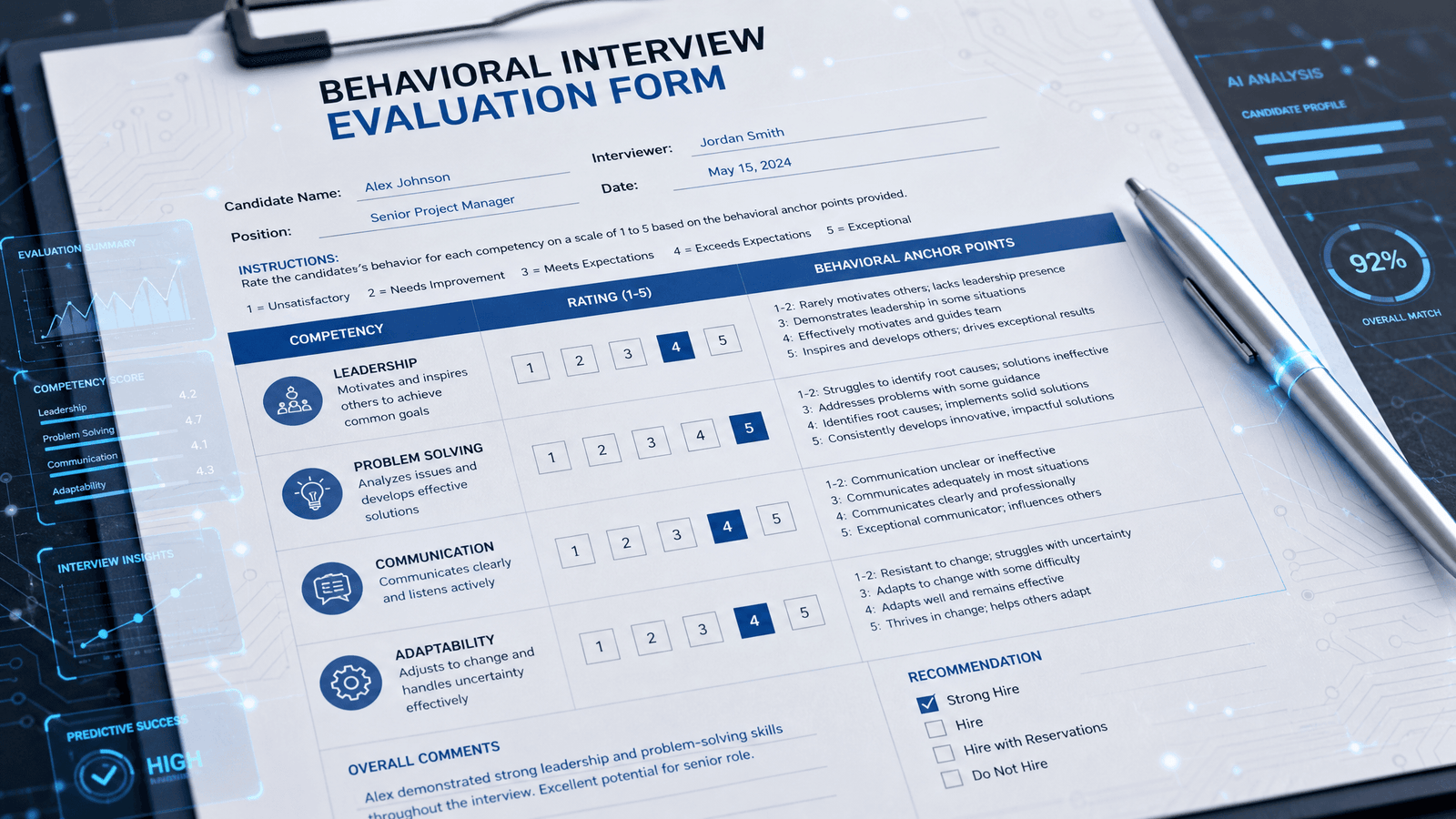
Let us be honest for a second. If you have been on the job market lately, you have probably noticed something weird. The questions are not getting easier. They are getting weirder. You walk into an interview expecting the old “Tell me about a time you faced a challenge” routine, and instead you are hit with a panel of five people, each holding a clipboard with a rubric, silently rating your every word on a scale of one to five. Welcome to the hyper-structured behavioral interview revolution.
At Your Career Place, we talk to job seekers every single day, and the number one complaint we are hearing right now is not about resumes or cover letters. It is about interviews that feel less like conversations and more like standardized tests. If you have walked out of a recent interview wondering whether you just sat for the SATs in a blazer, you are not alone. Something big is shifting in how employers evaluate candidates, and it is happening fast.
What Is Actually Happening Right Now
Here is the backstory. Generative AI has completely flooded the hiring funnel. Candidates are using AI to polish resumes, write cover letters, and even practice interview answers. Some estimates suggest that anywhere from 40% to 80% of applicants are now using AI to assist with their applications. Employers, naturally, are freaking out. How do you trust a resume when it might have been written by ChatGPT? How do you trust a polished interview answer when the candidate might have rehearsed it with an AI coach?
The result? Employers are running back to one of the oldest tools in the hiring playbook — the behavioral interview — but they are arming it with a level of rigor we have never seen before. We are talking about Behaviorally Anchored Rating Scales (BARS), structured panel interviews with independent scoring, and AI-assisted transcript analysis to map every answer back to specific competencies. If that sounds intense, it is because it is.
Research from mid-2026 shows that structured behavioral interviews with BARS scoring now have a predictive validity of approximately 0.57, compared to just 0.38 for unstructured interviews. In plain English? The new approach actually works better at predicting who will succeed on the job. That is why companies from startups to Fortune 500s are investing heavily in interviewer training, calibration sessions, and scoring rubrics that would make a college professor jealous.
At Your Career Place, we have been tracking this trend closely, and the message is clear: the days of winging it in an interview are officially over. If you want to land a job in 2026, you need to understand how these new hyper-structured interviews work and how to prepare for them.
The Boomer’s Perspective: “Finally, Hiring Is Getting Fair Again”
Let us start with the optimists. The Boomer viewpoint — and no, we do not mean literal baby boomers here, we mean the glass-half-full crowd — sees this trend as one of the best things to happen to hiring in decades.
The argument goes like this. For years, hiring has been broken. Unstructured interviews where the interviewer asks whatever pops into their head? Those are basically coin flips. Studies have shown that unstructured interviews have roughly the same predictive power as flipping a coin. The “gut feeling” that so many hiring managers brag about? Research says it is usually just unconscious bias dressed up as intuition. Affinity bias, halo effect, the tendency to hire people who remind us of ourselves — these are real problems that have been costing qualified candidates jobs for generations.
Hyper-structured behavioral interviews with BARS scoring change the game entirely. Every candidate gets asked the same questions. Every answer gets scored against the same rubric. Interviewers are trained, calibrated, and held accountable. Independent scoring means one loud voice in the room cannot bulldoze everyone else’s opinion. When a panel convenes to debrief, they are not trading vague impressions like “I just liked their energy.” They are pointing to specific evidence, anchored to behavioral criteria, with scores to back it up.
From the Boomer perspective, this is meritocracy making a comeback. The best candidate wins, not the best networker or the most charismatic talker. Companies are reporting that structured processes can reduce bias effects by over 50% and improve inter-rater reliability from a weak 0.37 to a robust 0.67. That means different interviewers are actually agreeing on who the best candidate is, which was never the case before.
Plus, there is a transparency angle. With AI-assisted transcript analysis, companies can document exactly why they made a hiring decision. In an era where candidates are increasingly skeptical of AI-driven hiring, being able to point to a structured, evidence-based process is a powerful trust-builder. Some forward-thinking companies are even disclosing their interview rubrics upfront, giving candidates a fair shot at preparing properly.
At Your Career Place, we have heard from candidates who actually prefer the new structured format. As one job seeker told us, “I used to hate interviews because I never knew what the interviewer wanted. Now I know exactly what they are looking for, and I can prepare for it.” That is the Boomer dream right there: a fair fight, clearly defined rules, and the best person wins.
The Doomer’s Perspective: “We Are Turning Interviews Into soulless Auditions”
Now let us flip the coin. The Doomer viewpoint sees this trend as the final nail in the coffin of human connection during the hiring process. And honestly? They have some valid points.
Think about what is actually happening here. A candidate walks into a room, sits in front of a panel, and tells a deeply personal story about a time they failed, or a conflict they navigated, or a team they led through a crisis. And while they are speaking, five people are silently ticking boxes on a rubric, independently scoring them on a one-to-five scale. It is not a conversation. It is an evaluation. And that difference matters.
The critics argue that we are systematically stripping humanity out of hiring. Behavioral interviews were already stressful enough, forcing candidates to perform vulnerability on demand. Now we have added scoring rubrics, calibration sessions, and AI transcript analysis to the mix. A candidate’s authentic emotional response gets reduced to “Level 3: Meets Expectations for Emotional Intelligence.” It feels clinical, cold, and frankly dehumanizing.
There is also a very real concern about performative authenticity. The whole point of hyper-structured interviews is to detect scripted, AI-polished answers. But here is the irony: the only way to pass a hyper-structured interview is to have a perfectly structured, pre-rehearsed story bank mapped to specific competencies. In other words, the system designed to detect fakes is forcing everyone to become equally polished performers. The candidate who shows up genuinely unprepared because they believe in “being themselves” gets destroyed by the candidate who spent forty hours building a STAR-method story library and practicing with an AI mock interview tool.
And let us not ignore the accessibility issues. Neurodivergent candidates, introverts, non-native speakers, and anyone who struggles with high-pressure performance situations is now facing an even steeper hill. A structured rubric might reduce certain biases, but it also rewards a very specific type of verbal fluency and narrative performance that not everyone possesses. Are we really measuring job competence, or are we measuring who is best at telling structured stories under pressure?
Another Doomer concern: the arms race. Candidates will inevitably train AI tools specifically to beat BARS rubrics. We have already seen this with AI resume screeners, where candidates learned to keyword-stuff their resumes to beat the bots. It is only a matter of time before someone releases a “BARS Optimizer” that analyzes scoring rubrics and generates perfectly calibrated behavioral stories. When that happens, employers will add yet another layer of complexity, and the cycle will continue until interviews are indistinguishable from Turing tests.
At Your Career Place, we talk to candidates who are exhausted by this arms race. One person told us, “I spent more time preparing for my behavioral interview than I did for my actual job. I had twenty stories mapped to fifteen competencies, and I still got a 3.2 average. It feels like the system is designed to filter people out, not find the best fit.” That is the Doomer fear in a nutshell: an increasingly impersonal, gamified hiring process that treats human beings as data points to be scored and sorted.

Key Takeaways: What This Means for You
So where does that leave us? At Your Career Place, we believe the truth is somewhere in between the Boomer optimism and the Doomer pessimism. Hyper-structured behavioral interviews are here to stay, and they are changing the rules of the game. Here is what you need to do about it:
1. Build a Story Bank, Not a Script
Stop memorizing generic answers. Instead, create a library of 15 to 25 real experiences from your career, each structured with the STAR method. Focus on your personal contribution — use “I,” not “we” — and quantify results whenever possible. Tag each story with the competencies it demonstrates. One strong story about resolving a team conflict can answer questions about leadership, communication, and adaptability if you frame it right.
2. Practice Out Loud
Written preparation is not enough. You need to tell your stories verbally, naturally, and concisely. Aim for 60 to 90 seconds per story. If you sound rehearsed, interviewers will notice. If you sound unprepared, the rubric will punish you. The sweet spot is confident, conversational delivery of well-prepared material.
3. Use AI as a Sparring Partner, Not a Crutch
AI mock interview tools are genuinely useful for practice. Use them to test your stories, get feedback on structure, and practice handling follow-up questions. But do not, under any circumstances, use a real-time AI assistant during an actual interview. Detection is getting better, and the reputational damage of getting caught is career-ending.
4. Understand the Rubric
If a company shares its interview rubric or competencies beforehand, study them like your job depends on it — because it does. If they do not share it, research common BARS-style rubrics for your industry. Knowing what “Level 5” looks like for teamwork or problem-solving gives you a massive advantage.
5. Remember That You Are More Than a Score
Even the most structured interview is still a human interaction. Enthusiasm, curiosity, and genuine interest in the role still matter. A candidate with slightly lower BARS scores but stronger cultural alignment often wins the tiebreaker. Do not let the structure make you forget to be a person.
Bottom Line
The hyper-structured behavioral interview revolution of 2026 is neither pure salvation nor pure dystopia. It is a response to a real problem — AI has eroded the reliability of traditional hiring signals — and it comes with real trade-offs. For candidates who adapt, it is an opportunity to compete on substance rather than polish. For those who refuse to engage with the new system, it is a wall that keeps getting higher.
At Your Career Place, our mission is to help you navigate exactly these kinds of shifts. Whether you are a Boomer who sees structure as fairness or a Doomer who sees it as dehumanization, the reality is the same: the game has changed, and you need new strategies to win. Start building your story bank today, practice your delivery, and walk into your next interview knowing exactly what the panel is scoring — because they are definitely scoring something.
What do you think? Are hyper-structured behavioral interviews a step forward or a step backward? Drop your thoughts in the comments or reach out to Your Career Place for personalized interview coaching.