
AI Content Creation in 2026
The Small Business Superpower You’re Probably Underusing
By Your Career Place | May 26, 2026 | AI & Small Business
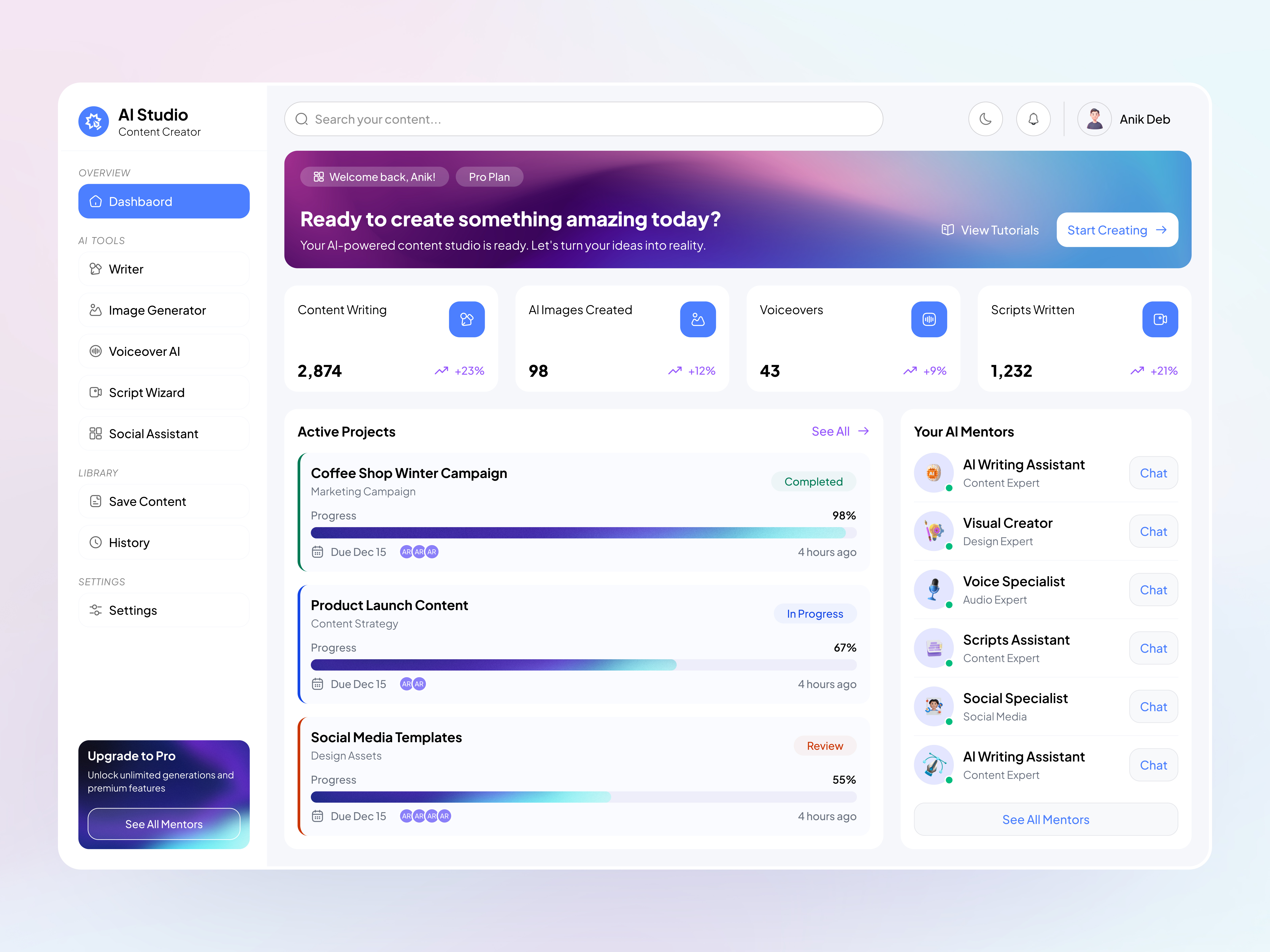
Modern AI writing tool dashboards are now intuitive enough for any small business owner to use.
What’s Actually Happening Right Now
Let’s be honest — a year ago, a lot of small business owners were still treating AI content tools as a novelty. Something to play with, maybe generate a social media caption or two, and then go back to doing things the old way. That era is officially over.
In 2026, between 58% and 68% of U.S. small businesses now use AI tools regularly, according to recent surveys. And the tools themselves have made a quantum leap. We’re no longer talking about clunky chatbots that spit out generic paragraphs. We’re talking about sophisticated, agentic AI systems that can plan, reason, and execute entire content workflows — from brainstorming a blog topic to publishing a finished article — with minimal human input.
Here’s a quick look at what the major players are offering in 2026:
| Tool | Best For | Standout 2026 Feature |
|---|---|---|
| ChatGPT (OpenAI) | Versatile writing & automation | Codex agent; deep Gmail & Excel integration |
| Claude (Anthropic) | Complex reasoning & long-form content | Claude Cowork desktop agent for autonomous tasks |
| Google Gemini | Google Workspace users | Gemini Spark — an always-on proactive agent |
| Jasper | Marketing copy & brand consistency | Brand Voice & multi-touch campaign orchestration |
| Canva AI | Social media graphics & design | Magic Studio — instant design repurposing |
| Adobe Firefly | Professional visuals & video editing | Prompt-based video editing; 4K upscaling |
The shift that matters most? These tools have moved from being “copilots” — assistants that help with one task at a time — to agentic AI that can handle entire workflows. Think of it like going from hiring a part-time helper to having a full-time content team that never sleeps.
How Small Businesses Are Actually Using These Tools
At Your Career Place, we talk to small business owners every week, and the use cases we’re hearing about are genuinely impressive. Here’s where AI content creation is making the biggest difference:
- Blog & SEO Content: Tools like ChatGPT, Claude, and Jasper are being used to brainstorm topics, research keywords, and generate first drafts. Pair them with SEO tools like Surfer SEO, and you’ve got a content machine that can rank in both traditional search and AI-powered answer engines.
- Social Media: Canva AI’s Magic Studio lets non-designers create professional graphics in minutes. Copy.ai and Buffer’s AI Assistant can generate dozens of platform-specific captions from a single prompt. One tool, Opus Clip, can take a single long video and automatically cut it into multiple short-form clips for TikTok, Instagram Reels, and YouTube Shorts.
- Video Marketing: Platforms like HeyGen and Synthesia create realistic AI avatars for explainer videos — no camera, no actor, no studio required. Adobe Firefly now lets you edit video with simple text prompts, like “remove the background” or “change the lighting to golden hour.”
- Email Marketing: HubSpot AI and Mailchimp AI can write subject lines, A/B test copy, and even determine the optimal send time for each individual subscriber based on their past behavior.

Small business owners are increasingly turning to AI tools to manage content creation, marketing, and operations.
The numbers back this up. One study found that automating social media content creation alone saves a small business an average of 175 hours per year. An HVAC company that adopted AI marketing tools decreased its marketing time by 70% while increasing annual revenue by $120,000. The average marketing ROI for AI tools? $3.50 for every $1 invested.
🌟 Boomer’s Perspective: “This Is the Great Equalizer”
Let’s call our optimist “Boomer” — a small business owner who’s been around long enough to remember when a professional website cost $10,000 and a marketing agency was only for companies with deep pockets. Boomer is genuinely excited about what AI content creation means for the little guy.
“For the first time in my career,” Boomer says, “I can compete with companies ten times my size on content. I can publish a well-researched blog post every week, have professional-looking social media graphics every day, and send personalized email campaigns — all without hiring a full marketing team.”
And Boomer isn’t wrong. The data is compelling. Small businesses using AI tools are reporting 21% average revenue increases post-adoption, and a 30-50% boost in customer engagement. The playing field isn’t just leveling — it’s tilting in favor of the agile, tech-savvy small business owner.
Boomer’s favorite use case? Repurposing content. “I record one 20-minute video about my business, and AI tools turn it into a blog post, five social media clips, three email newsletters, and a podcast transcript. That’s a week’s worth of content from one afternoon of work.”
From Boomer’s perspective, the message from Your Career Place is clear: the tools are here, they’re affordable, and the businesses that adopt them now will have a significant head start on those that wait. The barrier to entry has never been lower. A solopreneur with a $50/month AI subscription can now produce content that rivals a company with a full marketing department.
Boomer’s advice? Start small. Pick one tool, learn it well, and build from there. The ROI will speak for itself.

AI is transforming digital content marketing — but the human touch remains essential for authentic storytelling.
⚠️ Doomer’s Perspective: “We’re Racing Toward a Content Wasteland”
Now let’s hear from “Doomer” — not a pessimist for the sake of it, but a cautious realist who’s seen enough tech hype cycles to know that every silver lining has a cloud. Doomer has real concerns about where the AI content creation rush is heading.
“Everyone’s so excited about how much content they can produce,” Doomer says, “but nobody’s asking whether any of it is actually good. The internet is already drowning in AI-generated slop. Generic articles, robotic social media posts, stock-photo-looking AI images — audiences can smell it, and they’re tuning it out.”
This is what researchers are calling the “Trust Paradox.” As AI floods the internet with content, authentic human perspectives and genuine expertise become more valuable — not less. The businesses that win won’t be the ones producing the most content; they’ll be the ones producing the most trustworthy content. And that still requires a human.
Doomer’s other big concern? Copyright and legal liability. The legal landscape around AI-generated content is still a minefield. If your AI tool was trained on copyrighted material — and many are — you could be unknowingly publishing content that exposes your business to legal risk. Adobe Firefly is one of the few tools that trains exclusively on licensed content and offers commercial indemnification, but most tools don’t offer that protection.
Then there’s the data privacy problem. Agentic AI tools that connect to your email, CRM, and internal systems are incredibly powerful — but they also create new security vulnerabilities. If an employee uses a personal AI account for work tasks (what security experts call “Shadow AI”), sensitive business data could end up in a third-party system with no oversight or protection.
And finally, Doomer worries about over-reliance. “AI can hallucinate — it confidently makes things up. If you’re publishing AI-generated content without a human fact-checking it, you’re one bad article away from a credibility crisis.”
The team at Your Career Place takes Doomer’s concerns seriously. The risks are real, and ignoring them in the rush to adopt AI is a mistake. A human-in-the-loop isn’t optional — it’s essential.
🔑 Key Takeaways: What Should You Actually Do?
At Your Career Place, we believe the truth lies somewhere between Boomer’s enthusiasm and Doomer’s caution. Here’s our practical advice for small business owners navigating AI content creation in 2026:
- Start with one tool, not ten. Pick the platform that fits your biggest content need — Canva AI for visuals, ChatGPT for writing, HeyGen for video — and master it before expanding.
- Always have a human review AI-generated content. AI is a drafting assistant, not a publisher. Fact-check everything, especially statistics and claims, before it goes live.
- Protect your brand voice. Use tools like Jasper that allow you to define and lock in your brand’s tone and style. Generic AI content is worse than no content at all.
- Check your legal exposure. If you’re using AI for commercial content, prioritize tools that are trained on licensed data (like Adobe Firefly) or that offer commercial indemnification.
- Set clear data policies. Decide which AI tools are approved for business use and make sure your team knows not to input sensitive client or business data into personal AI accounts.
- Repurpose, don’t just create. The biggest ROI from AI content tools comes from repurposing — turning one piece of content into many. Build that workflow first.
The Bottom Line
AI content creation tools in 2026 represent a genuine opportunity for small businesses — perhaps the biggest productivity opportunity in a generation. The businesses that figure out how to use these tools strategically, with human oversight and a clear brand voice, will have a significant competitive advantage over those that don’t.
But “use AI” is not a strategy. Dumping AI-generated content onto your website and social media without a plan, a review process, or a human touch is a recipe for mediocrity at best and a legal or reputational crisis at worst.
The winning formula? Let AI handle the scale. Let humans handle the soul.
Here at Your Career Place, we’ll keep tracking these developments every week so you don’t have to. Whether you’re just starting to explore AI tools or you’re already deep in the weeds, we’re here to help you make sense of it all — and make the smartest moves for your business.
Have questions about AI content tools for your small business? Drop them in the comments below — we read every one.