

The Great Office Standoff of 2026: Is Remote Work Dead or Just Evolving?
The Great Office Standoff of 2026: Is Remote Work Dead or Just Evolving?

Picture this: You commute 45 minutes to the office, grab your coffee, settle into your desk — and spend the next eight hours on Zoom calls with colleagues who are working from home. Sound familiar? Welcome to one of the strangest workplace paradoxes of 2026, where “going to the office” increasingly means doing remote work from a different zip code.
The battle between remote work and return-to-office (RTO) mandates has been simmering since the pandemic reshuffled everything we thought we knew about work. But in 2026, the debate has reached a boiling point — and the data tells a story that’s far more complicated than either side wants to admit. At Your Career Place, we’ve been tracking this shift closely, and what we’re seeing is a workforce caught between employer demands, personal preferences, and a labor market that’s rapidly rewriting its own rulebook.
So where do things actually stand? Let’s dig into the numbers, the nuance, and what it all means for your career.
The State of the Office in 2026: By the Numbers
The data is striking. According to Robert Half’s November 2026 research, fully in-office job postings have surged to 85% of all listings — up from just 65% in the final quarter of 2025. Meanwhile, fully remote job postings have cratered to a mere 4%. If you’re job hunting and hoping to land a fully remote role, the odds are increasingly stacked against you.
Employers have gotten serious about enforcement, too. A CBRE survey found that 89% of employers now require at least three days of on-site attendance per week, and 30% have gone all the way to a full five-day mandate. Among Fortune 500 companies, 55% operate on a fixed hybrid model, while 27% have gone fully office-first.
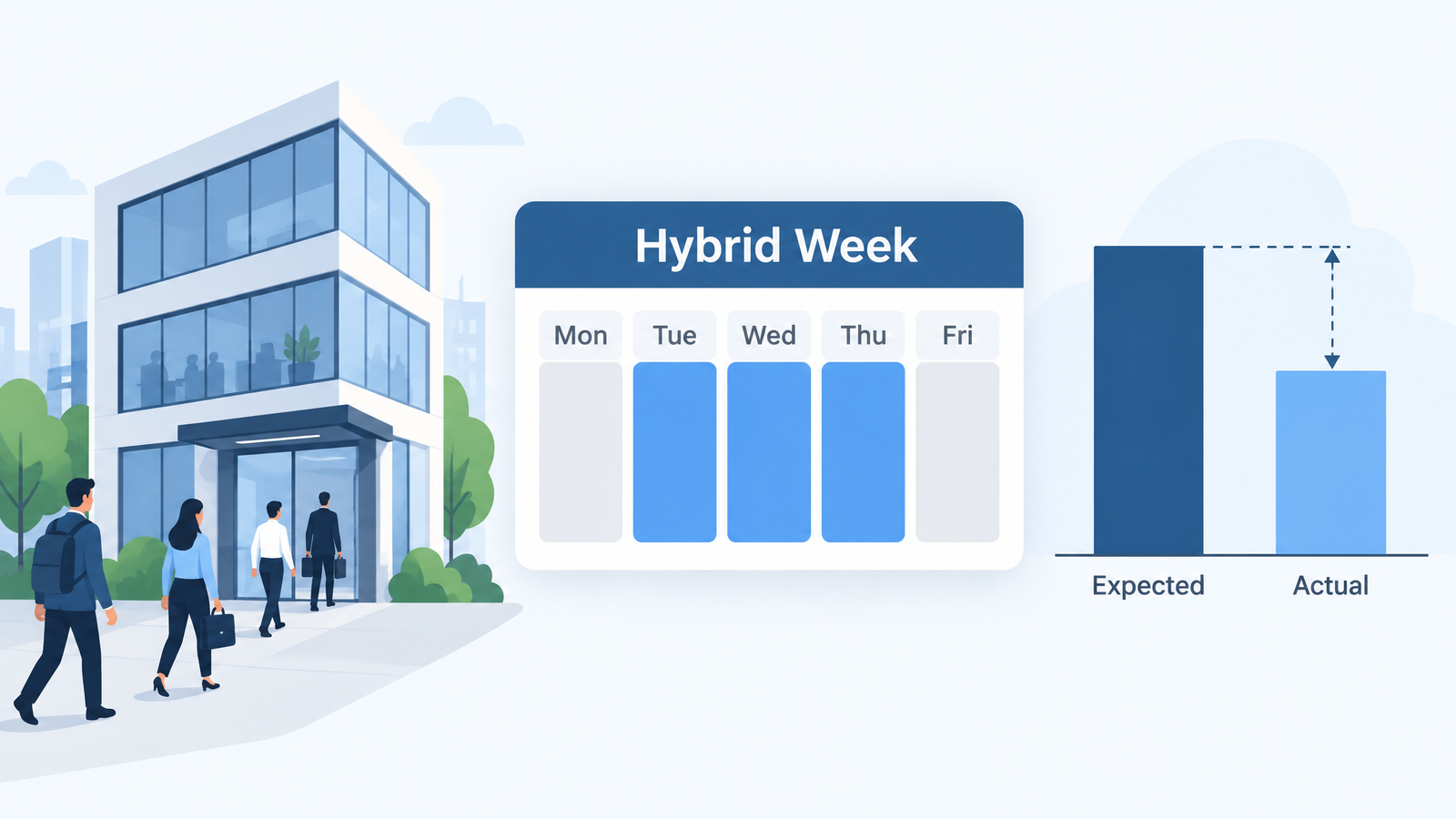
But here’s where it gets interesting: mandates and reality don’t always match. Employers are targeting an average of 3.2 in-office days per week, but actual attendance hovers around 2.9 days. One Fortune 500 retailer implemented a three-day-a-week mandate only to find employees averaging just 1.9 days. And as of October 2026, nationwide office visits are still 33% below 2019 levels, according to Placer.ai’s office index.
The most fascinating — and frankly bizarre — trend of 2026? The Federal Reserve Bank of New York found that nearly 48.8% of workers reported having zero in-person meetings on days they were physically in the office. They’re commuting to sit on Zoom calls. Researchers call this “organizational sprawl” — teams are so geographically dispersed that even when some members show up to the office, their direct colleagues are scattered across different cities and time zones. The office becomes a very expensive backdrop for video calls.
Why Companies Are Pushing Back to the Office
To understand the RTO wave, you have to understand what executives believe they’re solving. The core argument is what researchers call the “proximity effect” — the idea that physical presence sparks innovation, mentorship, and the kind of spontaneous collaboration that can’t be replicated on a screen.
There’s some evidence to support this. A Columbia Law School study found that in-office work improved earnings forecast accuracy by 14.9% for younger analysts, particularly those who benefited from in-person mentoring. Harvard researchers have pointed to examples like Pixar, where office design intentionally creates “random collisions” between employees from different departments — the kind of serendipitous encounters that can spark creative breakthroughs.
There’s also a less flattering explanation making the rounds: some executives are using RTO mandates as a quiet workforce reduction tool. Rather than announcing layoffs, they implement strict in-office requirements knowing that a percentage of employees — particularly those who’ve relocated or have caregiving responsibilities — will voluntarily resign. It’s a cost-cutting strategy dressed up as a culture initiative.
At Your Career Place, we think it’s important to name that dynamic honestly, because it affects how you should think about your own employer’s RTO policies.
The Human Cost: Turnover, Talent, and the Brain Drain
Whatever the motivation behind RTO mandates, the talent consequences are real and measurable. Research from Baylor University and Forbes found that RTO mandates trigger an average 13-14% increase in abnormal employee turnover. And it’s not the employees companies can most afford to lose who are walking out the door.
Female employees leave at nearly three times the rate of their male counterparts following mandate announcements. High-skilled workers, mid-level managers, and senior talent are disproportionately likely to exit. These are exactly the people organizations need most — experienced, capable, and hard to replace.
The hiring pipeline suffers too. Firms with strict RTO policies have seen job vacancy durations increase by 23% (from 51 to 63 days on average) and hire rates decline by 17%. More than a third of employers — 37% — say their RTO policies have made recruiting new talent harder. You can mandate your current employees back to the office, but you can’t mandate job seekers to apply.
Geographic variations add another layer of complexity. Cities like Miami, Dallas, and Atlanta have seen stronger office recovery, partly driven by corporate relocations and a culture that never fully embraced remote work. Meanwhile, San Francisco and Los Angeles are seeing fast year-over-year growth driven by AI-sector leasing, while Denver, Chicago, and Washington D.C. continue to lag behind their 2019 baselines.
Boomer’s Perspective: The Office Is Where Careers Are Built
Let’s be honest about something that often gets lost in the remote work debate: the office is where careers actually happen. Not just work — careers. There’s a reason the most successful professionals in every field spent years showing up, being visible, building relationships face-to-face, and learning by osmosis from the people around them.
The productivity research is more nuanced than remote work advocates admit. Yes, individual task completion might be slightly higher at home. But career development, mentorship, and the kind of institutional knowledge that takes years to accumulate? Those happen in hallways, at lunch tables, and in the five-minute conversations before a meeting starts. The Columbia study showing a 14.9% improvement in analyst performance for in-office workers isn’t a fluke — it’s a signal.
The RTO trend is also a market correction that was overdue. The pandemic forced a massive, unplanned experiment in remote work, and many organizations adopted it wholesale without thinking through the long-term implications for culture, collaboration, and talent development. Now they’re recalibrating — and that’s healthy. The fact that 70% of companies plan to maintain or increase RTO requirements suggests this isn’t a temporary blip. It’s the new normal.
For workers who are serious about advancing their careers, the smart move is to embrace the office strategically. Show up on the days that matter. Be visible to decision-makers. Build the relationships that remote workers simply can’t build through a screen. Your Career Place has always believed that career success is about more than just doing your job well — it’s about being known, trusted, and present. The office is still the best place to make that happen.
Doomer’s Perspective: RTO Is a Power Play That’s Backfiring
Let’s call the RTO wave what it increasingly appears to be: a power play by executives who want to reassert control over a workforce that discovered it didn’t need to be physically present to be productive. And the data suggests it’s backfiring spectacularly.
Think about what we’re actually seeing. Companies mandate three days in the office. Employees show up and spend those days on Zoom calls with remote colleagues. Nearly half report having zero in-person meetings on their office days. The commute costs them time, money, and energy — and delivers none of the promised collaboration benefits. This isn’t a return to office. It’s theater.
Meanwhile, the talent consequences are devastating. The best employees — the ones with options — are leaving. Female workers are exiting at three times the rate of men, which means RTO mandates are quietly undoing years of diversity progress. High-skilled workers are taking lateral moves or even pay cuts to find employers who respect their autonomy. And companies are spending 23% longer trying to fill the vacancies left behind.
The productivity argument doesn’t hold up under scrutiny either. A 2026 meta-analysis found that remote work has a small but positive effect on productivity. A University of Iowa study found hybrid workers were more productive on remote days, experiencing fewer distractions and more stable energy levels. Managers themselves report losing more than 15 hours per week to office-based interruptions and off-topic conversations.
The uncomfortable truth is that some executives are using RTO mandates as a stealth layoff tool — a way to reduce headcount without the PR nightmare of formal layoffs. If that’s what’s happening at your company, you deserve to know it. At Your Career Place, we believe workers should make career decisions with clear eyes, not corporate spin. If your employer’s RTO policy feels punitive rather than purposeful, trust that instinct.

Key Takeaways: What This Means for Your Career
Whether you’re a remote work advocate or an office enthusiast, the 2026 landscape demands a strategic approach. Here’s what Your Career Place recommends:
- Know your employer’s real motivation. Is the RTO policy about collaboration and culture, or is it about control and cost-cutting? The answer should inform your career decisions. Ask about the specific goals of in-office days and whether they’re being measured.
- Negotiate before you accept. With 85% of job postings now requiring in-office presence, flexibility has become a premium benefit. If you’re job hunting, negotiate your work arrangement upfront — it’s far easier to establish expectations before you start than to fight for them after.
- Make your in-office days count. If you’re going to commute, make it worth it. Schedule face-to-face meetings, grab coffee with your manager, attend team lunches. Don’t commute to sit on Zoom calls — that’s the worst of both worlds.
- Watch the “promotion penalty.” Research suggests remote workers may face disadvantages in career advancement due to lower visibility. If you’re working remotely, be intentional about staying visible — regular check-ins, proactive communication, and strategic in-office appearances on high-visibility days.
- Know your market value. The talent market is shifting. Companies with strict RTO policies are struggling to hire and retain top talent. If your skills are in demand, you have more leverage than you might think — use it.
- The sweet spot is coordination, not just presence. Academic research consistently points to 2-3 coordinated in-office days as the optimal hybrid model. If your team isn’t coordinating which days to come in, advocate for it. Showing up when your colleagues aren’t there defeats the purpose.
The remote work debate isn’t going away — it’s evolving. The companies that will win the talent wars of the next decade are the ones that figure out how to make the office genuinely worth showing up for, not just mandatory. And the workers who will thrive are the ones who navigate this landscape strategically, with clear eyes and a strong sense of their own value.
At Your Career Place, we’re here to help you do exactly that. Whether you’re negotiating a hybrid arrangement, evaluating a new job offer, or trying to figure out how to stay visible in a remote-first team, the tools and insights you need are right here. The office standoff of 2026 is far from over — but with the right strategy, you can come out ahead no matter which side wins.
Sources: Robert Half Remote Work Statistics (Nov 2026), Kelly Services Remote Work Trends (Nov 2026), CBRE 2026 Americas Office Occupier Sentiment Survey, NY Fed Staff Report (Nov 2026), Placer.ai October 2026 Office Index, Forbes (July 2026), Baylor University Research, SAGE Journals Meta-Analysis (July 2026), University of Iowa/Tippie Study (Sept 2026), Harvard Gazette (Nov 2026), CNBC (Nov 2026)