
Workplace Culture in 2026: What’s Working, What’s Broken, and How to Fix It
Workplace Culture in 2026: What’s Working, What’s Broken, and How to Fix It
If you’ve ever walked into a job and immediately felt something was off — or, on the flip side, felt instantly at home — you’ve experienced the power of workplace culture firsthand. Culture isn’t just a buzzword on a company’s “About Us” page. It’s the invisible force that shapes how people treat each other, how decisions get made, and ultimately, whether talented people stay or walk out the door. Here at Your Career Place, we’ve been watching workplace culture trends closely, and 2026 has brought some eye-opening developments that every professional — whether you’re job hunting, managing a team, or trying to survive a toxic environment — needs to understand.

The State of Workplace Culture Right Now
The numbers tell a sobering story. According to the DHR Global Workforce Trends Report 2026, employee engagement has dropped sharply — from 88% in 2025 to just 64% in 2026. That’s not a small dip; that’s a crisis. Burnout is affecting 83% of the workforce, and its influence on disengagement has grown from 34% to 52% in just one year.
Meanwhile, a SHRM Global Workplace Culture Report surveying over 27,000 workers across 25 countries found a glaring “culture disconnect”: while 53% of professionals say culture is very important to their experience at work, only 36% believe their company’s culture is well-defined and performance-driven. Nearly half (46%) describe their workplace culture as “reactive and inconsistent.”
The Eagle Hill Retention Index reported in October 2026 that culture sentiment fell to its lowest level since 2024, erasing nearly a year of gains — particularly among Baby Boomers and Gen X employees who carry the most institutional knowledge.
And perhaps most alarming: trust in leadership has eroded significantly. According to The Center for Sales Strategy’s Culture Report, employee trust in leadership dropped from 70% in 2023 to just 56% in 2026. When trust goes, everything else follows.
The Hybrid Work Culture Challenge
One of the biggest culture stories of 2026 is the ongoing evolution of hybrid work. According to Gallup, 52% of remote-capable U.S. employees now work in a hybrid capacity, spending roughly 2.3 days per week in the office. This isn’t a temporary experiment anymore — it’s the new normal.

But hybrid work creates real cultural risks. Research from Circles warns of “parallel cultures” — where remote and in-office employees experience fundamentally different versions of the same organization. Remote workers can feel like observers rather than participants, and proximity bias (where managers unconsciously favor those physically present) can quietly derail careers.
The good news? Teams with a formal hybrid collaboration plan are 66% more likely to be engaged and 29% less likely to experience burnout. The key is intentionality — not just letting hybrid work happen, but actively designing how it works.
What Makes a Toxic Culture — and Why It Matters
Researchers have identified what they call the “Toxic Five” — the five core elements that define a poisonous workplace: being disrespectful, non-inclusive, unethical, cutthroat, and abusive. According to Rework, toxic culture is 10.4 times more predictive of employee turnover than compensation. That’s right — people aren’t leaving for more money nearly as often as they’re leaving to escape a bad environment.
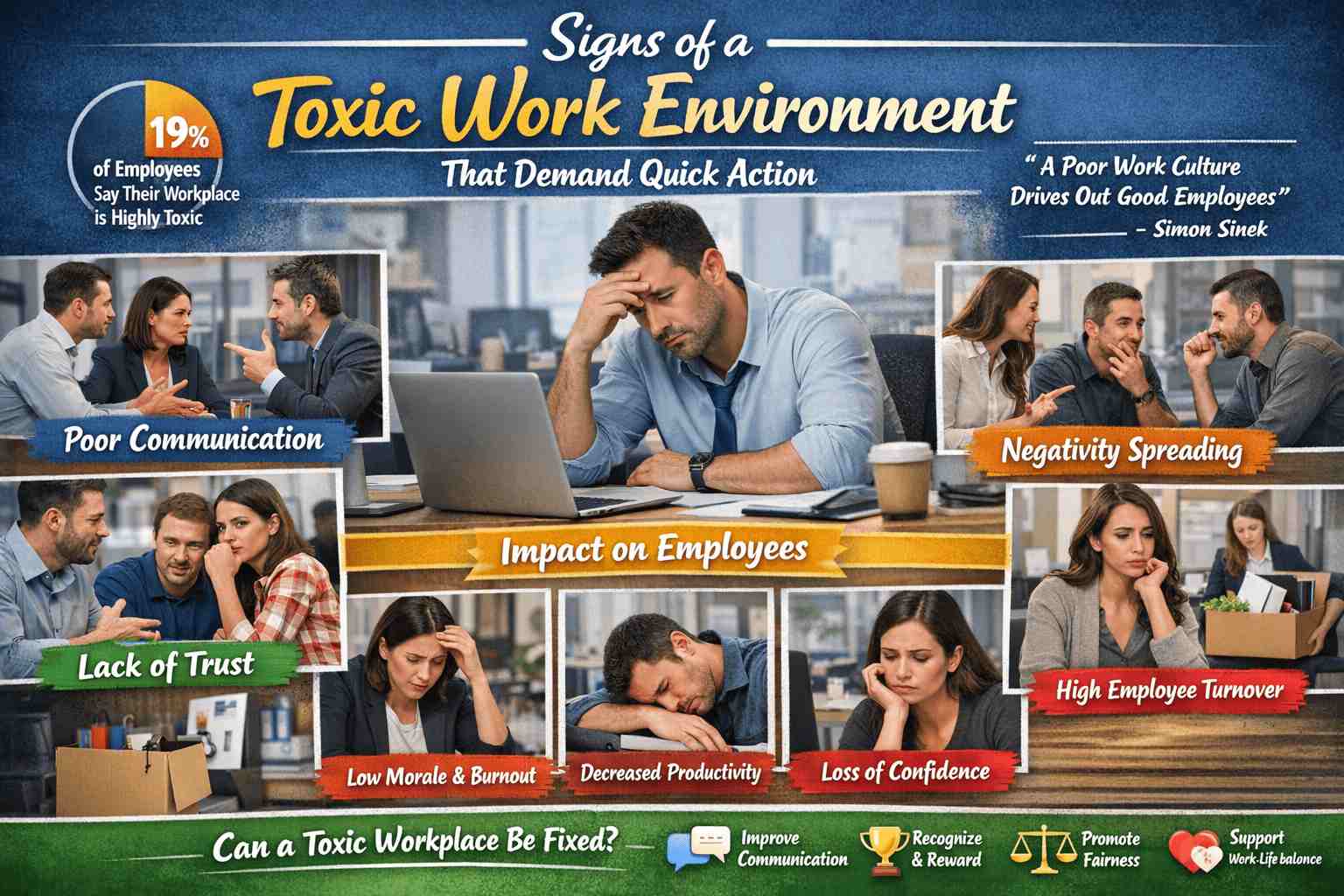
Warning signs include communication collapse (employees stop speaking up for fear of retaliation), management failures (about 79% of employees cite poor leadership as a major toxic factor), favoritism, normalized burnout, and a leadership-employee gap where executives think the culture is “intense and high-performing” while employees experience it as demoralizing.
At Your Career Place, we hear from job seekers regularly who left good-paying positions because the culture was simply unbearable. The data backs them up — no paycheck is worth your mental health.
🌟 The Boomer Perspective: Culture Is Built on Accountability and Earned Trust
From a more optimistic, experience-driven viewpoint, the current culture crisis is actually an opportunity — a long-overdue reckoning that will ultimately make workplaces stronger. For decades, many organizations operated on the assumption that culture would take care of itself if you hired good people and paid them fairly. The data of 2026 is proving that assumption wrong, and that’s a good thing.
The Boomer perspective sees this moment as a return to fundamentals. Strong workplace cultures have always been built on the same timeless principles: accountability, integrity, clear expectations, and leaders who model the values they preach. The fact that 94% of workers now say culture directly impacts their decision to stay with an employer isn’t a new phenomenon — it’s just finally being measured and taken seriously.
The optimistic view holds that organizations willing to do the hard work — coaching managers, establishing clear norms, recognizing employees consistently, and holding leaders accountable — will emerge from this period with cultures that are genuinely resilient. The SHRM research showing that belonging is the single most statistically significant predictor of engagement and retention is encouraging: belonging is something every organization can cultivate, regardless of budget or size.
The hybrid work challenge, too, has a silver lining. Companies that invest in intentional culture design — anchor days, structured collaboration plans, outcome-based management — are seeing real results. The 66% engagement boost for teams with formal hybrid plans shows that structure and intentionality work. This is the Boomer perspective at its best: trust the process, do the work, and the results will follow.
⚠️ The Doomer Perspective: The Culture Crisis Is Deeper Than Most Leaders Admit
The pessimistic view of workplace culture in 2026 is harder to dismiss. The numbers are genuinely alarming, and the structural problems driving them aren’t going away anytime soon.
Consider this: 100% of organizations agree that culture is essential to success, yet the “knowing-doing gap” remains enormous. Leaders tolerate behaviors that contradict stated values. High performers who exhibit toxic behavior are often protected because they deliver results. And when employees see that the rules don’t apply equally, trust evaporates — and it’s very hard to rebuild.
The middle management crisis is particularly troubling. In 2026, 57% of middle managers have actively considered leaving their organizations. These are the people who translate strategy into daily reality, who set the tone for their teams, who are the primary drivers of employee experience. If they’re burned out and disengaged, no amount of executive culture initiatives will trickle down effectively.
The AI communication gap adds another layer of concern. While most C-suite leaders claim they’ve clearly communicated how AI will affect job roles, only 12% of entry-level employees agree. That’s not a communication problem — that’s a trust problem. And when employees don’t trust that leadership is being straight with them about something as consequential as AI’s impact on their jobs, disengagement and anxiety follow.
The Doomer perspective warns that without genuine structural change — not just culture workshops and values posters — the engagement decline will continue. And in a tight labor market, organizations that can’t retain talent will find themselves in a very difficult position.
Key Takeaways: What You Can Do Right Now

Whether you’re a job seeker evaluating a potential employer, a manager trying to improve your team’s culture, or an executive looking at the big picture, here are the most important takeaways from the 2026 workplace culture landscape:
- Belonging is the #1 retention driver. According to SHRM, it’s the only workplace characteristic that is a statistically significant predictor of engagement, retention, and turnover intent. If you’re a leader, ask yourself: does every person on your team feel like they genuinely belong?
- Toxic culture costs more than you think. It’s 10.4 times more predictive of turnover than pay. The cost of replacing an employee is typically 50-200% of their annual salary. Fixing culture is almost always cheaper than ignoring it.
- Hybrid work needs a plan, not just a policy. Teams with formal hybrid collaboration plans are 66% more likely to be engaged. If your organization is winging it, that’s a problem.
- Recognition is structural, not optional. Culture leaders are nearly 16 times more likely to provide meaningful recognition on a daily or weekly basis. This isn’t about pizza parties — it’s about consistent, genuine acknowledgment of people’s contributions.
- Middle managers need support. With 57% considering leaving, this is a five-alarm fire. Invest in coaching, reduce their administrative burden, and give them the tools to lead effectively.
- Transparency about AI is non-negotiable. If your employees don’t know how AI will affect their roles, they’ll assume the worst. Clear, honest communication is the antidote to anxiety and disengagement.
- Job seekers: culture-check before you accept. Ask about turnover rates, how the company handled the last major challenge, and what recognition looks like day-to-day. The answers will tell you everything.
Conclusion: Culture Is a Choice — Make It Intentionally
Workplace culture in 2026 is at a crossroads. The data is clear: engagement is down, burnout is up, trust is eroding, and the hybrid work experiment has created new cultural fault lines that organizations are still learning to navigate. But the research is equally clear that organizations willing to invest in intentional culture-building — through transparency, recognition, belonging, and leadership accountability — are seeing real, measurable results.
Here at Your Career Place, we believe that understanding workplace culture isn’t just an HR concern — it’s a career survival skill. Whether you’re deciding where to work, how to lead, or how to advocate for yourself in a difficult environment, knowing what healthy culture looks like (and what toxic culture costs) gives you a real advantage.
The best workplaces in 2026 aren’t the ones with the fanciest perks or the highest salaries. They’re the ones where people feel safe, valued, and connected to something meaningful. That’s the culture worth fighting for — and worth seeking out.
Want more career insights like this? Visit Your Career Place for weekly articles, tools, and resources to help you navigate your career with confidence.