

AI and Your Job in 2026: Are the Robots Really Coming for Your Career?
AI and Your Job in 2026: Are the Robots Really Coming for Your Career?

If you’ve spent any time scrolling through job boards, sitting in a company all-hands meeting, or just chatting with coworkers lately, you’ve probably felt it — that low-grade hum of anxiety about artificial intelligence and what it means for your paycheck. You’re not imagining it. According to a September 2026 Gallup survey, 27% of U.S. workers now fear that technology could make their jobs obsolete — more than double the 13% who felt that way back in 2017. That’s a seismic shift in how Americans think about their careers.
But here’s the thing: the reality of AI’s impact on the job market is far more complicated — and far more interesting — than the doomsday headlines suggest. At Your Career Place, we dig into the data so you don’t have to panic-scroll at 2 a.m. wondering if a chatbot is going to steal your desk. Let’s break down what’s actually happening, who’s winning, who’s struggling, and what you can do about it.
What’s Actually Happening in the AI Job Market Right Now
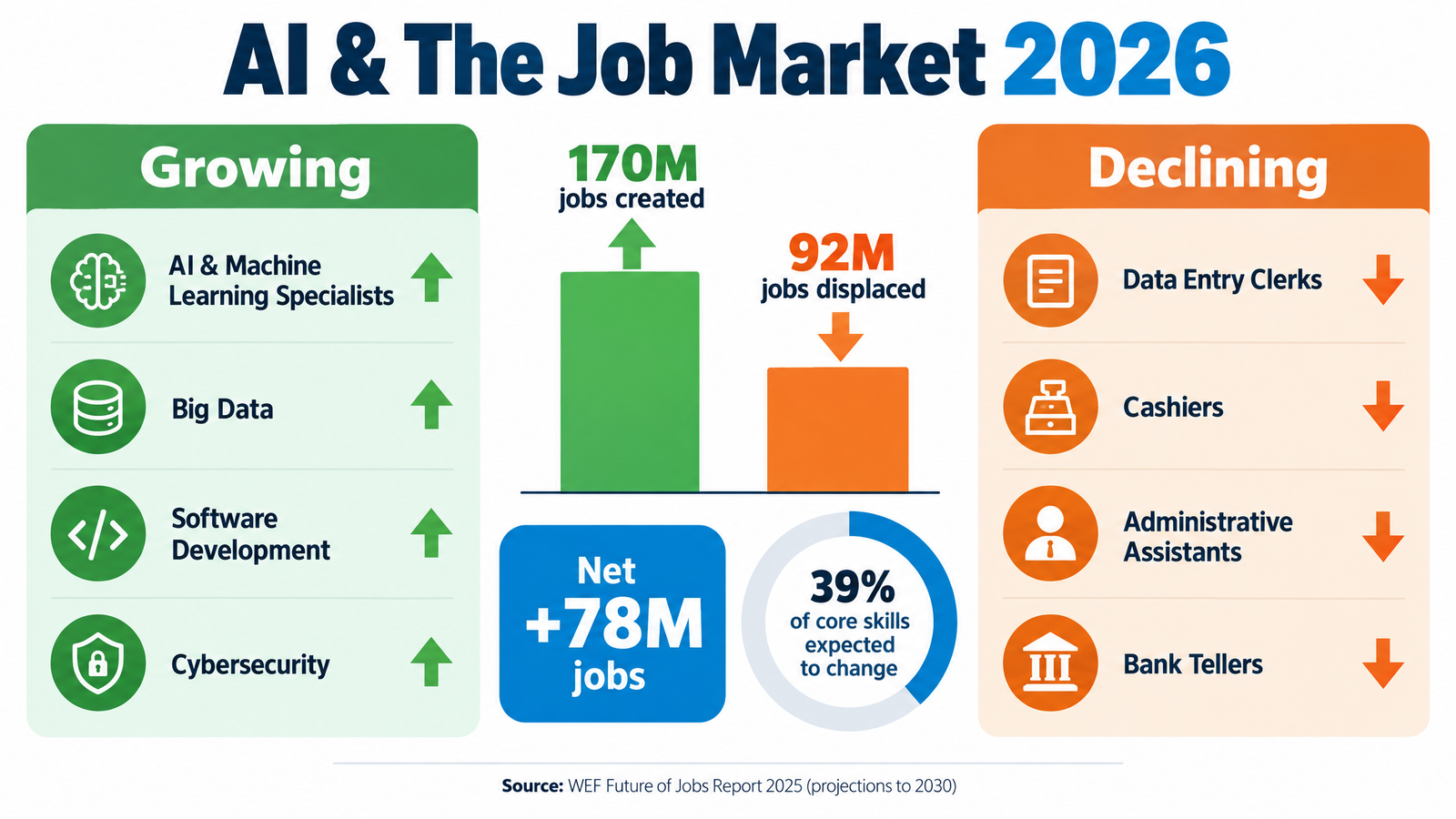
The numbers tell a nuanced story. A landmark November 2026 Gartner report projects that AI will drive a net increase of 1.7 million jobs worldwide by 2030 — with 10.6 million new positions created against 8.9 million eliminated. On paper, that sounds like good news. But the devil, as always, is in the details.
The most striking finding from 2026 research isn’t mass layoffs — it’s what Stanford’s Human-Centered AI Institute calls “silent firing.” Companies aren’t dramatically cutting existing workers en masse. Instead, they’re quietly not hiring for entry-level and junior roles. By June 2026, employment for workers aged 22–25 in AI-exposed occupations — think software development, customer service, data entry — stood a staggering 19% below where it would have been without AI adoption. That’s not a rounding error. That’s a generation of young workers hitting a wall they didn’t see coming.
Meanwhile, the SHRM estimates that roughly 5.1% of U.S. wage and salary jobs — about 7.9 million positions — face high displacement risk with few protective barriers. But here’s the flip side: approximately 60.4% of U.S. employment is shielded by what researchers call “non-technical barriers” — things like regulatory requirements, the need for human judgment, client preferences, and institutional settings that AI simply can’t replicate. Your plumber, your therapist, your kindergarten teacher? They’re not going anywhere.
The sectors feeling the most heat include administrative support, basic coding and QA testing, customer service, and back-office financial roles. The sectors seeing growth? Healthcare, construction management, AI oversight and training, and roles requiring complex interpersonal skills. McKinsey’s September 2026 workforce report estimates that over 70% of U.S. workers may need to reinvent how they work by 2035 — and that roughly 11 million Americans will need to switch occupations entirely over the next decade.
One more data point worth sitting with: executives deferred the creation of 1.3 million positions in 2026 alone because of AI — a number expected to balloon to 5 million by 2030. These aren’t jobs that were eliminated. They’re jobs that were never posted. That’s the invisible hand of automation at work.
The Anxiety Is Real — And It’s Getting Weird
Perhaps the most fascinating — and slightly alarming — finding from 2026 research is what’s being called the “AI Skills Bubble.” A 2026 report found that approximately 63% of U.S. workers admitted to lying or exaggerating their AI skills to appear more competitive. Among Gen Z workers, that number jumps to 80%. Meanwhile, 64% of workers say their employers have never formally assessed their AI skills. So we have a workforce pretending to know AI, working for companies that aren’t checking — a recipe for a credibility crisis that could get very messy, very fast.
The training gap is equally troubling. As of early 2026, only about one-third of workers reported that their employers provided the training or guidance needed to actually use AI effectively — a 10-percentage-point drop from the previous year. And 56% of workers say their employers haven’t even consulted them about how AI is being implemented in their roles. That’s not transformation. That’s being dragged along for the ride.
The Federal Reserve Bank of Cleveland’s November 2026 analysis adds another layer: unemployment is rising in AI-exposed occupations not because people are being fired faster, but because unemployed workers in these fields are taking significantly longer to find new jobs. The door isn’t slamming shut — it’s just getting harder to open.
The Boomer’s Perspective: This Is the Greatest Career Opportunity in a Generation
Let’s be honest — every major technological revolution in history has triggered the same fear. The printing press was going to destroy scribes. The industrial revolution was going to end farming. Computers were going to eliminate office workers. And yet, here we are, with more jobs than ever before — just different ones.
The optimistic case for AI in the job market is genuinely compelling. Gartner’s forecast of 1.7 million net new jobs by 2030 isn’t wishful thinking — it’s based on the same economic logic that has held true through every prior wave of automation: productivity gains lower costs, expand markets, and ultimately create more demand for human labor, just in different forms.
Consider the wage premium data. Workers who have genuinely mastered AI tools are commanding a 62% wage premium over their peers, according to PwC’s 2026 Global AI Jobs Barometer. Demand for AI fluency has surged 11-fold since 2022. The workers who lean into this technology — who become the people who know how to use, manage, and oversee AI systems — are positioning themselves for some of the most lucrative careers of the next decade.
At Your Career Place, we’ve seen this pattern play out before. The workers who thrived during the internet revolution weren’t the ones who resisted email — they were the ones who figured out how to use the web before their colleagues did. The same principle applies today. AI isn’t your enemy. Your reluctance to learn it might be.
The research also shows that companies with the highest AI exposure are seeing productivity increases 40% higher than their less-exposed competitors. That productivity translates to growth, and growth translates to hiring. The sectors expanding fastest — healthcare, green energy, AI infrastructure, advanced manufacturing — are all creating roles that require human judgment, creativity, and interpersonal skills that no algorithm can replicate.
And let’s not overlook the quality-of-life angle. If AI handles the tedious, repetitive parts of your job — the data entry, the scheduling, the basic report generation — you get to spend more of your workday on the interesting stuff. The creative problem-solving. The client relationships. The strategic thinking. That’s not a threat. That’s a gift.
The Doomer’s Perspective: The Math Doesn’t Add Up for Everyone

Now for the cold water. The optimistic narrative about AI creating more jobs than it destroys is true in aggregate — but aggregates hide a lot of pain. And for a significant portion of the workforce, the transition is going to be brutal.
Start with the entry-level crisis. That 19% employment gap for young workers in AI-exposed fields isn’t just a statistic — it represents hundreds of thousands of people who can’t get their foot in the door. The traditional career ladder assumed you’d start at the bottom, learn the ropes, and work your way up. AI is quietly sawing off the bottom rungs. If junior roles in coding, data analysis, customer service, and administrative support disappear, where do the next generation of senior professionals come from? Nobody has a good answer to that yet.
Then there’s the wage paradox. Yes, AI skills command a 62% premium — but 70% of workers who have upskilled in AI report no change in their pay. The gap between what executives promise (“we’ll pay more for AI skills!”) and what employees experience is staggering: 83% of executives claim their organizations plan to pay more for AI expertise, but only 16% of employees have actually seen those increases. Someone is lying, and it’s probably not the workers.
The “AI Skills Bubble” is a ticking time bomb. When 63% of workers are exaggerating their AI capabilities and employers aren’t verifying those claims, you have a workforce built on a foundation of bluff. When that bubble pops — and it will — the fallout could be significant, particularly for workers who inflated their credentials to land roles they’re not equipped to perform.
And the training gap is a systemic failure, not an individual one. Only a third of workers are getting meaningful AI training from their employers. The workers who can afford to upskill on their own — who have the time, money, and educational background to take courses and earn certifications — will be fine. The workers who can’t? They’re being left behind by the very companies that are benefiting from AI’s productivity gains. That’s not disruption. That’s abandonment.
The Cleveland Fed’s finding about job-finding rates is perhaps the most sobering of all. If you lose a job in an AI-exposed field, you’re not just competing with other humans for the next one — you’re competing in a market where the number of available roles is quietly shrinking. The longer you’re unemployed, the harder it gets. For workers in their 40s and 50s who’ve built careers in vulnerable sectors, the runway to reinvention may simply not be long enough.
Key Takeaways: What You Should Actually Do Right Now
Whether you’re feeling optimistic or anxious about AI’s impact on your career, the research points to some clear, actionable steps. Here’s what the team at Your Career Place recommends based on the latest data:
- Audit your AI exposure honestly. Look at your current role and ask: what percentage of my daily tasks could be automated? If the answer is “a lot,” that’s not a reason to panic — it’s a reason to plan. The workers who get blindsided are the ones who never asked the question.
- Learn AI tools for real, not for show. The “AI Skills Bubble” is real, and it will pop. Don’t be one of the 63% who exaggerated their skills. Pick two or three AI tools relevant to your field and actually learn them — deeply, practically, demonstrably. Genuine competence is the only credential that holds up under scrutiny.
- Demand training from your employer. If your company is benefiting from AI productivity gains, you have every right to ask for a share of that investment in the form of training and development. Only a third of workers are getting it. Be in that third.
- Identify your non-technical barriers. What aspects of your job require human judgment, regulatory knowledge, client trust, or physical presence? Those are your moats. Lean into them. Develop them. They’re what makes you irreplaceable.
- Think about the next role, not just the current one. McKinsey estimates 11 million Americans will need to switch occupations in the next decade. The workers who navigate that transition successfully will be the ones who started thinking about it early. What adjacent roles could your skills transfer to? What growing sectors align with your experience?
- Don’t let anxiety drive bad decisions. The fear of AI is real, but the data shows that mass, immediate displacement isn’t happening. The workers who panic and make rash career moves — abandoning solid positions for trendy pivots — often fare worse than those who adapt thoughtfully and strategically.
The AI revolution is real, it’s accelerating, and it will reshape every career in America over the next decade. But “reshape” is not the same as “destroy.” The workers who come out ahead will be the ones who stay curious, stay honest about their skills, and stay proactive about their development.
At Your Career Place, we’re here to help you navigate every twist and turn of this transformation. Because the future of work isn’t something that happens to you — it’s something you can prepare for, adapt to, and ultimately thrive in.
What’s your biggest concern about AI and your career? Drop it in the comments — we read every one.