

Navigating the Great Reshuffling with Confidence
Career Transitions in 2026
Published by Your Career Place | May 21, 2026
Introduction
If you’ve been feeling the itch to do something different with your career lately, you’re in very good company. Here at Your Career Place, we’ve been watching a remarkable shift unfold across the workforce — one that’s reshaping how people think about their professional lives, their skills, and what they truly want from work.
Welcome to the era of the Great Reshuffling. Unlike the “Great Resignation” that preceded it, this isn’t just about quitting — it’s about strategically reimagining what comes next. Millions of professionals are pivoting, pivoting again, and discovering that a career change isn’t a failure or a detour. It’s often the smartest move they’ve ever made.
Whether you’re a seasoned professional wondering if there’s still time to try something new, or a mid-career worker feeling the pressure of AI and automation breathing down your neck, this post is for you. We’ll dig into the latest trends, share some hard truths, and give you the tools to think clearly about your next move.
What’s Happening Right Now: The Latest in Career Transitions

The numbers tell a compelling story. According to recent data, 59% of U.S. professionals were actively looking for new employment in 2024, and median job tenure has dropped to just 3.9 years — the lowest since 2002. The average American worker now changes jobs 12 times over the course of their career. For Gen Z, that number could be as high as 17 jobs across 7 different careers.
Here are some of the most important trends shaping career transitions right now:
- Skills-Based Hiring Is Taking Over: Employers are increasingly prioritizing what you can do over where you went to school or how long you’ve been in a role. The World Economic Forum estimates that 39% of core job-market skills will transform by 2030, making adaptability and continuous learning more valuable than ever.
- AI Is Both the Threat and the Opportunity: By 2025, an estimated 92 million jobs globally may be displaced by automation — but 170 million new roles are expected to emerge, resulting in a net gain of 78 million jobs. Roles in AI ethics, data analysis, cybersecurity, and AI oversight are among the fastest-growing.
- Purpose Over Paychecks: For the first time, 83% of workers rank work-life balance above compensation (82%) when evaluating career moves. People are leaving high-stress industries in search of meaning, flexibility, and alignment with their personal values.
- The Mid-Career Pivot Is Mainstream: Professionals aged 30–50 are leading the reshuffling charge, bringing valuable experience and a willingness to take calculated risks. The average age for a career change is now 39 years old.
- Remote Work Has Dissolved Geographic Barriers: The normalization of remote and hybrid work has opened up opportunities that were previously inaccessible, allowing career changers to target roles and industries that once seemed out of reach.
- Financial Pressure Remains a Real Barrier: Despite the desire for change, 90% of Americans stay in jobs longer than they’d like due to financial pressure. 56% cite financial security as the primary barrier to making a move.
Sources: Adria Solutions – Career Switching Trends 2025 | Jobera – Career Change Statistics | Acedit – AI Trends Shaping Career Transitions | Cogent – Mid-Career Pivot Strategies | CareerFoundry – Successful Career Change | HIGH5 Test – Career Change Statistics
🌟 The Boomer Perspective: “This Is the Best Time in History to Reinvent Yourself”

Let’s start with the optimistic view — and there’s genuinely a lot to be optimistic about.
If you’re someone who believes in hard work, accumulated wisdom, and the power of reinvention, the current career landscape is practically a gift. Never before in history have professionals had so many tools, resources, and pathways available to them when making a career change.
Experience is currency. One of the most underappreciated advantages of a mid-career or late-career transition is the sheer volume of transferable skills you’ve built up. Communication, leadership, project management, stakeholder relationships, budget ownership — these are gold in virtually any industry. Employers who are smart enough to look past a job title will see a seasoned professional who can hit the ground running.
The job market is genuinely rewarding changers. The average salary increase when changing jobs is 14.8%, compared to just 3–5% for staying put. Companies offering upskilling programs achieve 54% higher retention rates, and 87% of professionals believe reskilling will help them switch careers successfully. The infrastructure for career change has never been better — online courses, micro-credentials, boot camps, and even federal grants for community colleges are making skill acquisition more accessible than ever.
New industries are booming. Healthcare is projected to add 2.3 million jobs by 2033. Solar electric power generation employment is expected to grow by 275.9%, and wind energy by 115.1% between 2023 and 2033. Green tech, AI oversight, cybersecurity, and data analytics are all fields hungry for talent — and many of them actively value the kind of mature judgment and real-world experience that comes with years in the workforce.
Age is not the barrier it once was. Sectors like consultancy, academia, content creation, and thought leadership actively seek professionals with depth and perspective. The idea that career reinvention is only for the young is simply outdated. Here at Your Career Place, we’ve seen professionals in their 40s, 50s, and beyond make some of the most successful and fulfilling career transitions of anyone we’ve worked with.
The Boomer perspective says: You’ve earned your experience. Now leverage it. The tools are there, the demand is real, and it’s never too late to build the career you actually want.
⚠️ The Doomer Perspective: “The Deck Is Stacked Against Career Changers”
Now let’s be honest about the harder side of this picture — because at Your Career Place, we believe in giving you the full story, not just the highlight reel.
AI isn’t just creating jobs — it’s destroying them, fast. A 2025 McKinsey report suggests up to 30% of current tech tasks could be automated by 2030. The relevance of technical skills is diminishing faster than ever, with many losing currency within just 5–8 years. If you’re in a role that involves routine, repeatable tasks, the clock may already be ticking. And the new jobs being created? Many require skills that take years to develop — meaning the transition isn’t as simple as “just reskill.”
Financial reality is brutal. 90% of Americans stay in jobs they dislike because they can’t afford not to. A career change often means starting at a lower salary, taking time off for education, or navigating an income gap. For people with mortgages, families, and financial obligations, the math simply doesn’t work for many would-be career changers. The 14.8% salary bump sounds great — but that’s an average, and plenty of career changers take a significant pay cut, at least initially.
Ageism is real and persistent. Despite all the talk about valuing experience, 31% of employees worry they’re too old to change careers — and that fear isn’t entirely unfounded. Hiring bias against older workers remains a documented problem in many industries, particularly in tech. The “culture fit” conversation can be code for age discrimination, and career changers over 45 often face longer job searches and more rejections than their younger counterparts.
The skills gap is wider than it looks. 60% of people feel they lack the qualifications for in-demand STEM careers. 75% of those seeking a career change in the UK don’t have the right qualifications. 40% of employees are uncertain about what field to enter next. And even when people do upskill, there’s no guarantee the new skills will translate into a job offer — especially in a market where AI-generated applications are flooding recruiters’ inboxes and making it harder than ever to stand out.
Networking gaps are a real obstacle. Nearly half of workers feel they lack the professional connections needed to break into a new field. And 70% of jobs are never publicly posted — they’re filled through networks and referrals. If you’re pivoting into a new industry, you’re starting from scratch in terms of relationships, reputation, and insider knowledge.
The Doomer perspective says: Career transitions are harder, riskier, and more expensive than the success stories suggest. The structural barriers are real, and not everyone has the financial cushion, the network, or the time to make it work.
Key Takeaways: What You Should Actually Do
Here at Your Career Place, we sit somewhere between the Boomer optimism and the Doomer caution — because the truth, as always, is in the middle. Career transitions are genuinely possible and often transformative, but they require clear-eyed planning, not wishful thinking.
Here’s what the research and our experience tell us actually works:
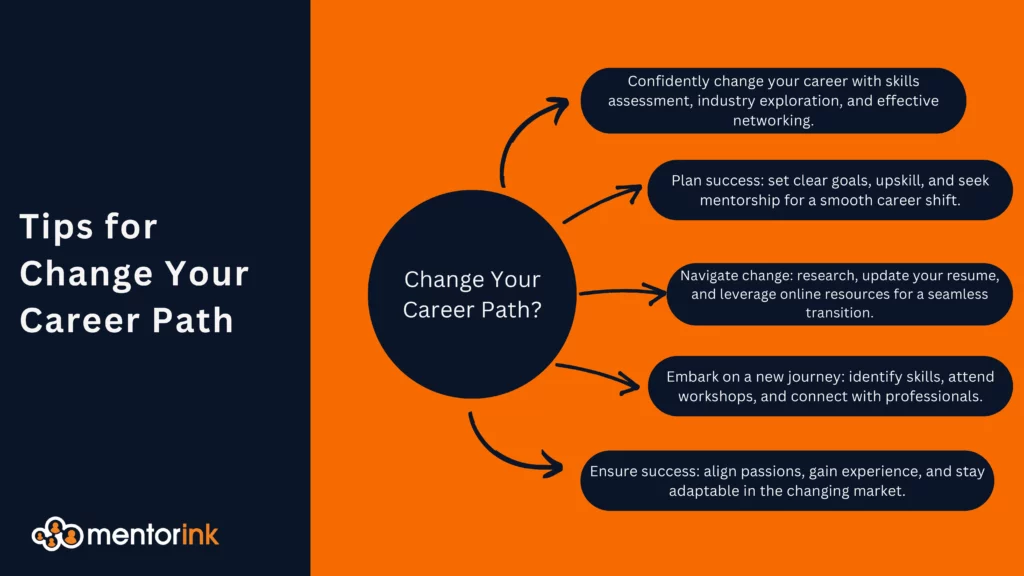
- Start with honest self-assessment. Before you do anything else, get clear on why you want to change. Is it the role, the industry, the manager, or something deeper? Clarity here prevents costly mistakes. Identify your transferable skills — communication, leadership, problem-solving, project management — and understand how they map to your target field.
- Research before you leap. Become a “mini-expert” in your target field. Talk to people who are already doing the job you want. Use informational interviews to understand real hiring criteria, common transition paths, and what actually matters to employers in that space. Don’t rely on job postings alone — 70% of jobs are filled through networks.
- Build your financial runway first. Experts recommend having 6–12 months of savings before making a major career change. If that’s not possible, consider a gradual transition — side projects, freelance work, or internal moves — that let you test the waters without going all-in financially.
- Upskill strategically, not randomly. Don’t just take courses for the sake of it. Identify the specific skills that are in demand in your target field and pursue micro-credentials, certifications, or practical projects that demonstrate those skills. Employers want proof of capability, not just a certificate.
- Build your pivot story. You need a compelling narrative that connects your past experience to your future direction. This isn’t spin — it’s helping employers understand the logic of your transition and the unique value you bring. Practice it until it feels natural.
- Network into the new field. Start building relationships in your target industry before you need a job. Attend events, join professional groups, engage on LinkedIn, and ask for informational interviews. The goal is to become a known quantity before you’re a candidate.
- Be patient and resilient. Career transitions take time — often longer than people expect. Setbacks are normal. The professionals who succeed are the ones who treat each rejection as data, adjust their approach, and keep moving forward.
Final Thoughts from Your Career Place
Career transitions are one of the most human things we do. They reflect our growth, our changing values, and our refusal to be defined by a single chapter of our professional lives. The data is clear: the workforce is more mobile than ever, the tools for reinvention are more accessible than ever, and the demand for adaptable, skilled professionals is real and growing.
But it’s also true that the path isn’t easy, the barriers are real, and success requires more than just enthusiasm. It requires strategy, preparation, and honest self-knowledge.
Here at Your Career Place, we’re committed to helping you navigate every stage of that journey — from the first moment of “I need a change” to the day you land in a role that actually fits who you are and where you want to go. Whether you’re a Boomer who believes in the power of reinvention or a Doomer who needs to see the risks clearly before taking a step, we’ve got you covered.
The Great Reshuffling is happening. The only question is whether you’re going to be intentional about where you land.
Ready to take the next step? Explore our resources at Your Career Place and start building your career transition plan today.