

Case Study Interviews in 2026: Are They Still the Best Way to Prove You Can Think?
Case Study Interviews in 2026: Are They Still the Best Way to Prove You Can Think?
Let me set the scene: you have spent six weeks locked in your apartment, practicing case interviews until your roommate thinks you have developed a bizarre obsession with market-sizing pizza chains. You have memorized frameworks, drilled mental math, and consumed enough coffee to make a small town jittery. Then, on interview day, the recruiter hands you a problem about a pharmaceutical company entering a new market, and your brain defaults to the same four-square framework you used for the coffee shop case last week. The interviewer gives you that look. You know the one. It is the look that says, “We have seen this a hundred times today.”
Welcome to the case study interview in 2026. It is still the gold standard for consulting and increasingly common in data, product, and strategy roles. But it is also changing faster than ever, and candidates who do not keep up are getting left behind. At Your Career Place, we help job seekers navigate these exact moments. Let us break down what is actually happening, why employers are so obsessed with this format, and whether it is a fair way to hire or just a ritual that rewards the best-prepared test-takers.
What Is Actually Happening With Case Study Interviews Right Now
Case study interviews are not new. McKinsey, BCG, and Bain have been using them for decades. But in 2026, the format has evolved into something far more sophisticated than the classic “how many tennis balls fit in a 747” brain teasers of the past.
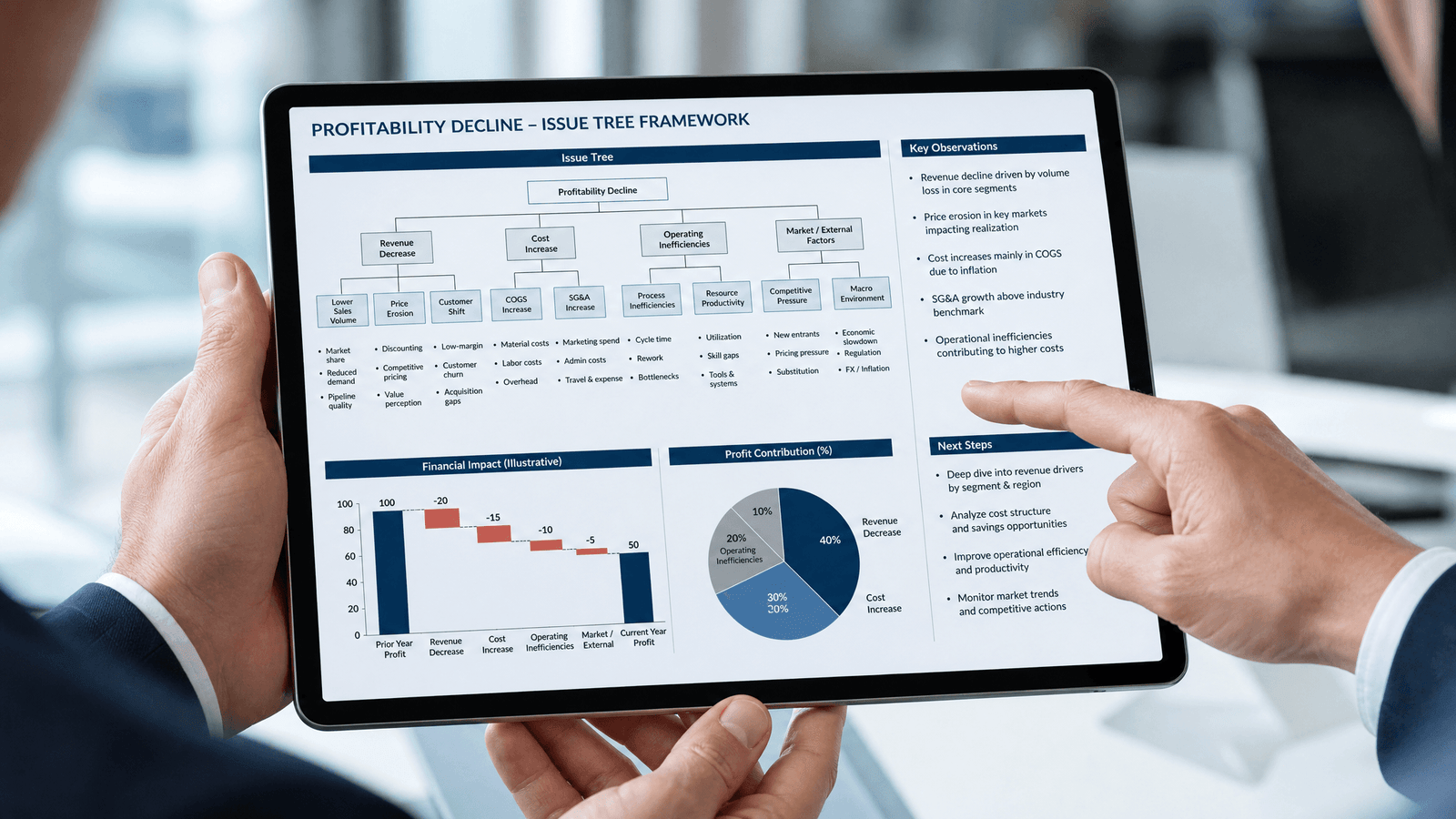
First, the biggest shift: memorized frameworks are dead. Top firms now explicitly penalize candidates who force-fit generic templates like Porter’s Five Forces or the 3 Cs onto every problem. Interviewers are trained to spot rehearsed responses from a mile away. What they want instead is a custom, MECE issue tree built specifically for the problem in front of you. If you can not think on your feet, they will know.
Second, AI and digital assessments have become gatekeepers. Many firms now use online case studies, chatbot-delivered scenarios, or AI-driven platforms before you ever speak to a human. McKinsey’s “Solve” assessment is a prime example. It is a 60-minute gamified test that evaluates your problem-solving instincts without a live interviewer in the room. Candidates who breeze through traditional case prep but panic in a digital assessment are getting filtered out before the real interview even begins.
Third, take-home case studies are exploding, especially for data and analytics roles. Companies like Shopify, Uber, and Capital One now routinely hand candidates a dataset, give them four to seven days, and ask for a full presentation with recommendations. This tests not just your analytical skills but your ability to manage ambiguity, work without supervision, and tell a compelling story with data.
Fourth, the format itself is diverging. McKinsey still favors interviewer-led cases, where the recruiter controls the flow and feeds you data in chunks. BCG and Bain lean toward candidate-led cases, where you drive the investigation. If you walk into a BCG interview with a McKinsey mindset, you will come across as passive. The reverse is also true. Preparation must be calibrated to the firm’s style, and at Your Career Place, we see candidates stumble on this every week.
Finally, there is growing pressure on the format itself. Critics argue that case study interviews reward preparation over raw talent. If you have the time and money for 50+ mock cases, you will outperform someone with better instincts but fewer resources. Some firms are supplementing case interviews with digital assessments and standardized rubrics to reduce bias. But the case study is not going anywhere. It is too deeply embedded in consulting culture to disappear.
The Boomer’s Perspective: Case Studies Are the Purest Form of Talent Assessment
The Boomer loves case study interviews. To them, this is the closest thing to a meritocratic filter in hiring. You can not fake your way through a well-structured case. You either have the analytical rigor, the quantitative fluency, and the communication skills, or you do not. Resumes are padded. LinkedIn profiles are curated. Behavioral interviews are rehearsed. But a live business problem? That separates the thinkers from the pretenders.
The Boomer points to the structured thinking requirement as the core value. When a candidate breaks down a complex, ambiguous problem into logical components on the fly, that is exactly what consultants do on day one. The case study is not a test. It is a simulation. It is the job, compressed into 45 minutes.
They also love the transparency. Unlike opaque behavioral interviews where the “right” answer depends on the interviewer’s mood, case studies have clear evaluation criteria. Did you structure the problem well? Did you do the math correctly? Did you synthesize your findings into a concise, actionable recommendation? These are objective measures. Yes, there is some subjectivity in communication style, but the core competencies are measurable.
And the data supports this. Top firms that use case studies consistently report that their best performers are the ones who excelled in the case round. It predicts job performance better than GPA, school prestige, or internship brand names. The Boomer sees case studies as the great equalizer. It does not matter where you went to school. It matters whether you can think.
The Boomer also defends the preparation requirement. Yes, it takes 30 to 80 mock cases to get good. But so what? Becoming a doctor takes years. Becoming a lawyer takes years. Why should consulting or strategy be any different? If you are not willing to invest six weeks of intense preparation, maybe you are not that serious about the role. The Boomer would rather hire someone who demonstrated grit and discipline through preparation than someone who winged it and got lucky.
At Your Career Place, we hear this argument a lot from hiring managers. They genuinely believe case studies surface talent that resumes and traditional interviews miss. And in an era where AI-written cover letters are flooding recruiters, the case study is one of the last formats that is hard to fake.

The Doomer’s Perspective: Case Studies Are Just an Expensive Lottery Ticket
The Doomer is not buying it. To them, case study interviews are a rigged game that rewards access to coaching, practice partners, and time. If you are working two jobs to pay rent, you do not have six weeks to drill 50 mock cases. If you went to a school without a consulting club, you do not have peers to practice with. If you can not afford a $200-an-hour interview coach, you are at a structural disadvantage before you even walk into the room.
The Doomer points to the research on predictive validity. While case studies correlate with some aspects of job performance, they are not the silver bullet the Boomer claims. Structured behavioral interviews, work sample tests, and cognitive ability assessments often predict long-term success just as well. Case studies are flashy and feel rigorous, but they may be testing preparation as much as raw talent.
The Doomer also hates the arbitrariness of the format. A candidate can solve the problem perfectly but get dinged for “not showing enough executive presence.” Another can botch the math but get passed because they “had good energy.” The evaluation criteria are supposed to be objective, but in practice, they are subjective. Two candidates with identical analytical skills can receive completely different outcomes based on the mood and biases of the person across the table.
The Doomer is also deeply skeptical of the take-home case trend. A four-day assignment is not an interview. It is unpaid labor. If you are applying to ten companies, and three of them give you take-home cases, that is twelve days of work for zero guaranteed return. The Doomer sees this as a power imbalance. Employers are extracting free analysis from candidates, and only one person gets the job. It is exploitation dressed up as “assessment.”
And let us talk about the AI factor. The Boomer says case studies are hard to fake. The Doomer says AI is already making them easier to game. Candidates are using AI-powered case prep tools to simulate thousands of scenarios. They are getting real-time feedback on their frameworks and math. The preparation gap is widening, not narrowing. The people with the best AI tools and the most time to practice are the ones who win. That is not meritocracy. That is a resource arms race.
At Your Career Place, we see the Doomer’s point clearly. The candidates who struggle most are often the ones with the least access to preparation resources. They are not less talented. They are less prepared. And that is not the same thing.
Key Takeaways: How to Actually Win at Case Study Interviews in 2026
Whether you are a Boomer or a Doomer, you still have to play the game if you want the job. Here is what actually works in 2026:
Build custom frameworks, not canned ones. Forget Porter’s Five Forces. Forget the 3 Cs. Look at the specific problem in front of you and build a structure from scratch. Use the TRIM test: is your framework Tailored, Relevant, Insight-driven, and MECE? If not, rebuild it. Your interviewer has seen every generic framework a hundred times. Surprise them with something original.
Practice out loud, not in your head. Quiet study is insufficient. You need 30 to 50 full verbal case practices to build the muscle memory. Record yourself. Watch the playback. You will cringe at your filler words, your long pauses, and your tendency to ramble. Good. That is the point. Fix it before the interview.
Calibrate your prep to the firm’s style. McKinsey interviews are interviewer-led. BCG and Bain are candidate-led. Do not treat them as the same. Adjust your approach based on who is hiring. If you are applying to multiple firms, you need multiple prep strategies. One size does not fit all.
Get comfortable with AI-driven assessments. McKinsey’s Solve, HireVue’s game-based tests, and other digital gatekeepers are now standard. If you only practice live cases, you will get blindsided by the pre-screen. Use AI-powered case prep tools to simulate the digital assessment format, not just the in-person case.
Master the Pyramid Principle. Start with your recommendation. Then support it with evidence. Most candidates bury their conclusion at the end, hoping the interviewer will follow their journey. The interviewer will not. They are busy. Lead with the answer. Fill in the details after.
Embrace the pushback. Second-round interviews with Partners are often designed to stress-test your reasoning. They will play devil’s advocate. They will challenge your assumptions. Do not collapse. Defend your logic, but show you can adapt when presented with new information. Confidence without arrogance is the sweet spot.
Consider the opportunity cost of take-home cases. If you get a four-day assignment, ask yourself whether this company is a top priority. Your Career Place recommends treating take-home cases as portfolio pieces. Even if you do not get the job, a strong case study can be repurposed for your next application.
Use feedback loops ruthlessly. Solo practice is necessary but not sufficient. Get a coach, a peer, or a mentor to give you live, critical feedback. It is painful, but it is the fastest path to competence.
Do not ignore the data storytelling. For data and analytics roles, the case study is not about getting the numbers right. It is about what the numbers mean. Can you translate a regression output into a recommendation that a non-technical executive can act on? That is the skill that separates good candidates from great ones.
Case study interviews in 2026 are harder and more competitive than ever. But they are also more transparent. The candidates who prepare smartly, think originally, and communicate clearly will still win. The ones who rely on memorized frameworks and hope for the best will not. At Your Career Place, we are here to help you be in the first group.