

The Education Job Market in 2026: Is Teaching a Career Worth Pursuing — or a Profession in Crisis?
The Education Job Market in 2026: Is Teaching a Career Worth Pursuing — or a Profession in Crisis?

If you’ve ever thought about a career in education — or you’re already in one — 2026 is giving you a lot to think about. On one hand, there are nearly half a million teaching positions sitting empty or filled by under-qualified staff across the country. On the other hand, universities are laying off thousands of workers, shuttering academic programs, and bracing for a demographic cliff that could reshape higher education for decades. It’s a tale of two crises happening at the same time, in the same sector.
At Your Career Place, we dig into the real numbers behind the headlines so you can make smarter decisions about your career. This week, we’re taking a hard look at the education sector — what’s happening, who’s hiring, who’s cutting, and what it all means for job seekers in 2026.
What’s Actually Happening in Education Employment Right Now
The education job market in 2026 is best described as a paradox: a sector simultaneously starving for workers and shedding them at the same time.
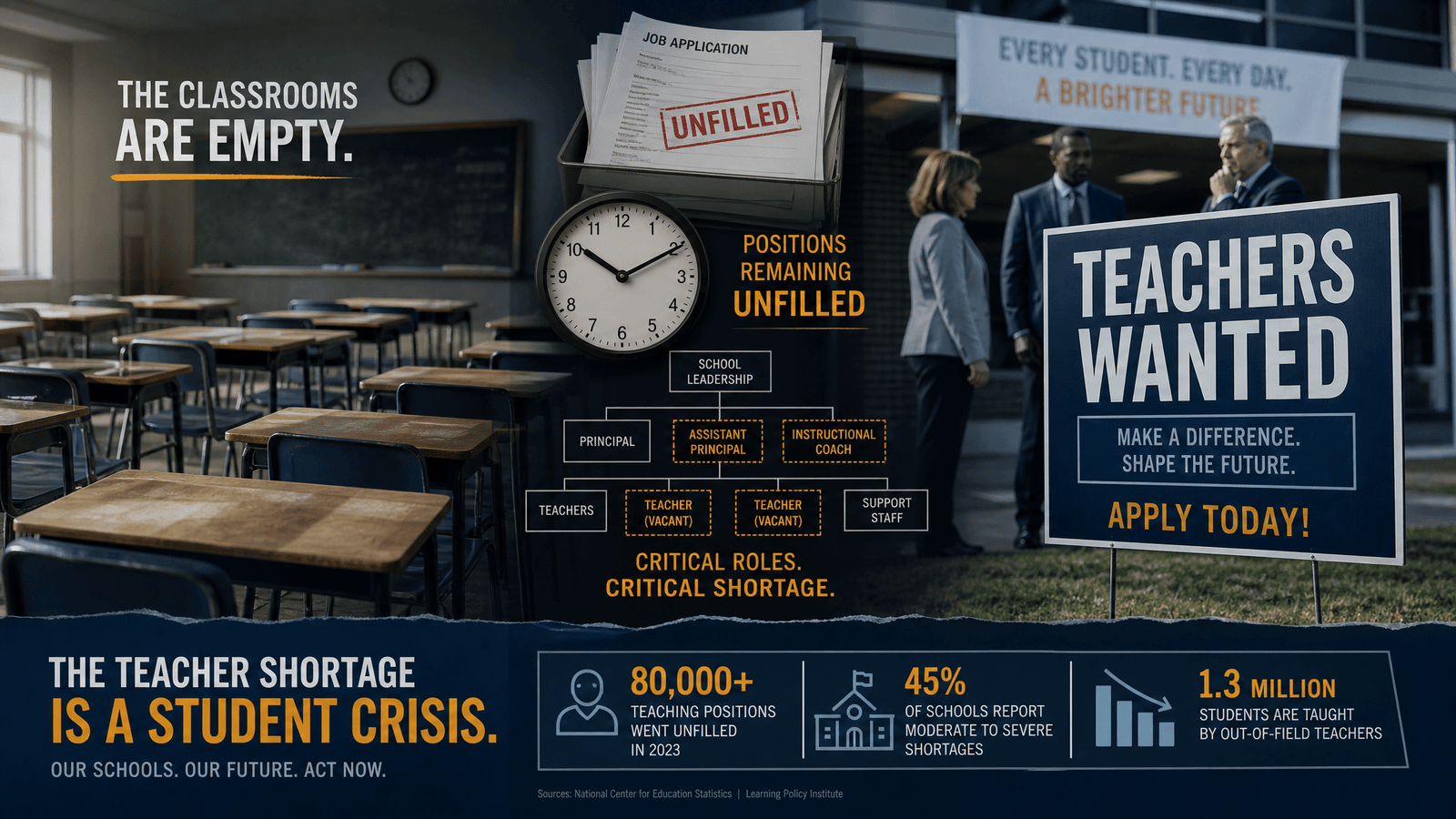
According to the Learning Policy Institute’s 2026 State Teacher Shortages Factsheet, approximately 425,412 teaching positions across the U.S. are either vacant or filled by educators who lack full certification. That’s roughly 1 in every 8 teaching jobs in the country. And this isn’t a new problem — 2026 marks the third consecutive year of growth in the national teacher shortage, with an estimated 4% increase over 2025 figures.
The shortages are most severe in specialized fields: special education (a shortage area in 45 states), science (41 states), and mathematics (40 states). Districts are scrambling to fill these gaps with signing bonuses, alternative certification pathways, and “grow your own” programs that train paraprofessionals to become licensed teachers.
Meanwhile, in higher education, the picture looks dramatically different. By early 2026, over 9,000 positions had been eliminated at colleges and universities across the country, with hundreds more announced monthly. Major institutions — including the University of Minnesota (230 jobs), Johns Hopkins University (110 jobs), and The New School (87 jobs) — have all made significant cuts. Credit rating agencies Fitch, Moody’s, and S&P Global have all issued negative outlooks for the higher education sector, citing declining enrollment, reduced federal research funding, and rising operational costs.
The root causes of higher education’s struggles are structural. A “demographic cliff” — a shrinking pool of college-aged Americans — is expected to persist through 2041. Add in the expiration of pandemic-era federal relief funds (ESSER), declining state support, and new federal policy changes affecting research grants, and you have a sector under enormous financial pressure.
Even K-12 districts are caught in a bizarre double bind: they’re simultaneously facing teacher shortages and laying off staff. How? Because many districts used temporary federal pandemic relief money to hire permanent positions — counselors, academic interventionists, paraprofessionals — that they can no longer afford now that the funding has dried up. Major urban districts like Los Angeles, Chicago, and Philadelphia are seeing significant enrollment declines, which directly reduces their state funding and forces painful cuts.
The Bureau of Labor Statistics projects that overall education employment will grow slower than average for all occupations through 2034, though the sector will still generate roughly 890,300 annual job openings — mostly driven by the need to replace workers who retire or leave the profession.
The Boomer’s Perspective: Education Is Still One of America’s Most Stable Career Paths
Let’s be real: the headlines about teacher shortages and university layoffs can feel alarming. But step back and look at the full picture, and there’s a genuinely optimistic case to be made for education careers in 2026.
First, consider the sheer volume of opportunity. Nearly 900,000 education job openings per year is not a sector in collapse — it’s a sector with enormous, ongoing demand. Yes, much of that demand comes from replacing people who leave, but that’s true of virtually every major industry. The difference in education is that the pipeline of new teachers has shrunk, which means qualified candidates have more leverage than ever.
If you’re willing to teach in a high-need subject area — special education, STEM, ESL — you’re entering a market where districts are competing aggressively for your skills. Signing bonuses, student loan forgiveness programs, housing assistance, and accelerated certification pathways are all on the table. The federal Public Service Loan Forgiveness (PSLF) program remains one of the most powerful financial benefits available to any professional, and teachers in qualifying districts can have tens of thousands of dollars in student debt wiped out after 10 years of service.
In higher education, the contraction is real — but it’s not uniform. Postsecondary teachers are actually projected to see 7% job growth through 2034, which the BLS classifies as “much faster than average.” Universities are cutting low-enrollment humanities programs while simultaneously investing in enrollment management, career services, data analytics, instructional design, and cybersecurity roles. If you have a hybrid skill set that bridges technology and human-centered services, higher education institutions are actively recruiting for you.
The median annual wage for education occupations is $59,220 — well above the national median of $49,500 for all occupations. Postsecondary teachers earn a median of $83,980. Add in job security, summers off (for K-12), pension benefits in many states, and the genuine satisfaction of shaping the next generation, and education remains one of the most compelling career choices available.
At Your Career Place, we’ve seen firsthand how career changers who pivot into education — especially those with STEM backgrounds or specialized expertise — often find it to be one of the most rewarding moves they’ve ever made. The demand is there. The benefits are real. And the impact is undeniable.
The Doomer’s Perspective: The Education Sector Is Broken, and It’s Getting Worse
Now for the harder truth. The optimistic framing above glosses over some deeply troubling structural problems that aren’t going away anytime soon.
Start with the teacher shortage itself. The fact that 1 in 8 teaching positions is either vacant or filled by someone who isn’t fully certified isn’t just a staffing inconvenience — it’s a systemic failure that’s been building for years. And the primary driver isn’t a lack of job openings. It’s that people are leaving the profession faster than new teachers can be trained to replace them. Teacher turnover accounts for 90% of annual demand for new educators. That means the pipeline isn’t broken — the bucket has a hole in it.
Why are teachers leaving? The data is grim. A staggering 60% of the international teaching workforce has considered leaving the profession due to administrative burdens and burnout. In the U.S., teachers face overcrowded classrooms, inadequate support for students with special needs, relentless standardized testing pressure, and — in many states — salaries that haven’t kept pace with the cost of living. When a district loses a teacher, it costs between $12,000 and $25,000 to replace them. That money comes out of budgets already stretched to the breaking point.
The equity dimension is particularly troubling. Schools serving high concentrations of students of color and low-income students are disproportionately affected by shortages and under-certified staff. The communities that most need experienced, qualified teachers are the ones least likely to have them. This isn’t a new problem, but it’s getting worse.
In higher education, the “demographic cliff” is not a metaphor — it’s a mathematical reality. The number of 18-year-olds in the U.S. is projected to decline significantly through 2041. Fewer students means less tuition revenue, which means more cuts. The institutions most at risk are small private colleges that depend heavily on tuition and lack the endowment cushion of elite universities. Some of these schools will not survive the decade. For faculty and staff at vulnerable institutions, job security is genuinely precarious.
And then there’s the AI wildcard. Artificial intelligence is already reshaping what education looks like — from AI tutoring tools to automated grading systems to personalized learning platforms. While AI won’t replace teachers wholesale, it will almost certainly reduce the number of certain types of instructional and administrative roles over time. The education sector is not immune to the automation pressures reshaping every other industry.
Key Takeaways: What This Means for Your Career

Whether you’re considering a move into education or you’re already working in the sector, here’s what the data tells us about navigating this complex landscape:
- Specialize in high-demand areas. If you’re entering K-12 teaching, focus on special education, STEM subjects, ESL, or bilingual education. These are shortage areas in 40+ states, which means more job security, better negotiating power, and often additional financial incentives.
- Explore alternative certification pathways. Many states have dramatically expanded alternative routes to teacher certification, making it easier for career changers with subject-matter expertise to enter the classroom. If you have a background in engineering, healthcare, or technology, districts are actively recruiting people like you.
- In higher education, follow the money. Universities are cutting academic departments but investing in enrollment management, student retention, data analytics, instructional design, and career services. If you’re pursuing a higher ed career, align your skills with institutional survival priorities.
- Don’t overlook the financial benefits. Public Service Loan Forgiveness, state pension systems, and comprehensive health benefits make education careers financially competitive even when base salaries seem modest. Run the full numbers before comparing education to private-sector alternatives.
- Build AI literacy now. About 10.5% of entry-level education job postings already require specific AI skills. Educators who can leverage AI tools while maintaining the human-centered skills that technology can’t replicate — empathy, judgment, mentorship — will be the most valuable professionals in the sector.
- Research institutional health before accepting a higher ed offer. With credit agencies issuing negative outlooks for the sector, it’s worth investigating the financial stability of any college or university before committing to a role. Look at enrollment trends, endowment size, and recent news about budget cuts.
The education sector in 2026 is genuinely complicated — full of real opportunity and real risk at the same time. The teacher shortage is creating openings that didn’t exist a decade ago, while higher education is contracting in ways that will reshape the landscape for years to come. The professionals who will thrive are those who understand the nuances, position themselves in high-demand niches, and go in with clear eyes about both the rewards and the challenges.
At Your Career Place, we’re here to help you make sense of it all. Whether you’re a first-year teacher wondering if you made the right choice, a higher ed administrator navigating budget cuts, or a career changer considering a move into education, the most important thing you can do is stay informed — and keep asking the right questions.
What’s your experience with the education job market in 2026? Drop your thoughts in the comments below — we’d love to hear from educators, administrators, and career changers navigating this landscape.