

Work Sample and Portfolio Review Interviews
The New Gatekeepers Keeping Job Seekers Out (and Sometimes In)
You have spent three years honing your craft, whether in design, engineering, marketing, or data analysis. You have built real projects, shipped real results, and solved real problems. Yet when you apply for a job in 2026, your polished resume barely gets a 5-second glance from an AI-powered Applicant Tracking System before it gets buried under 250 other applications. The old rules no longer apply. The new rules? Prove it on the spot.
Welcome to the era of work sample and portfolio review interviews, the new gatekeepers of the 2026 hiring landscape. At Your Career Place, we have watched this shift accelerate over the past eighteen months, and one thing is clear: candidates who master the art of the work sample have a massive edge. Those who do not are left wondering why their resume never gets a callback.
What Is Actually Happening Right Now
The hiring world has turned upside down. In 2026, recruiters are openly admitting that resumes have become unreliable. AI-generated CVs are so polished and keyword-optimized that a human can barely tell the difference between a candidate who built a product and one who built a prompt to describe a product. The result? Companies are bypassing the resume entirely and asking candidates to prove their skills before they ever sit down for a traditional interview.
Here is what the data tells us. Corporate job postings now receive an average of 250 to 340 resumes, yet only 2% to 4% of applicants ever reach the interview stage. Recruiters spend roughly five to seven seconds on an initial resume scan, and about 75% of resumes are filtered out by Applicant Tracking Systems before a human even sees them. That means your perfectly crafted resume has worse odds than a lottery ticket.
In response, companies are shifting to what they call “competency-based hiring.” Approximately 73% of employers now prioritize demonstrated abilities over job titles or university degrees. Work samples, portfolios, live coding sessions, and real-time problem-solving demonstrations are becoming the standard front door. Hiring managers are requesting portfolios at the application stage itself, making the portfolio a primary filter before any human conversation happens.
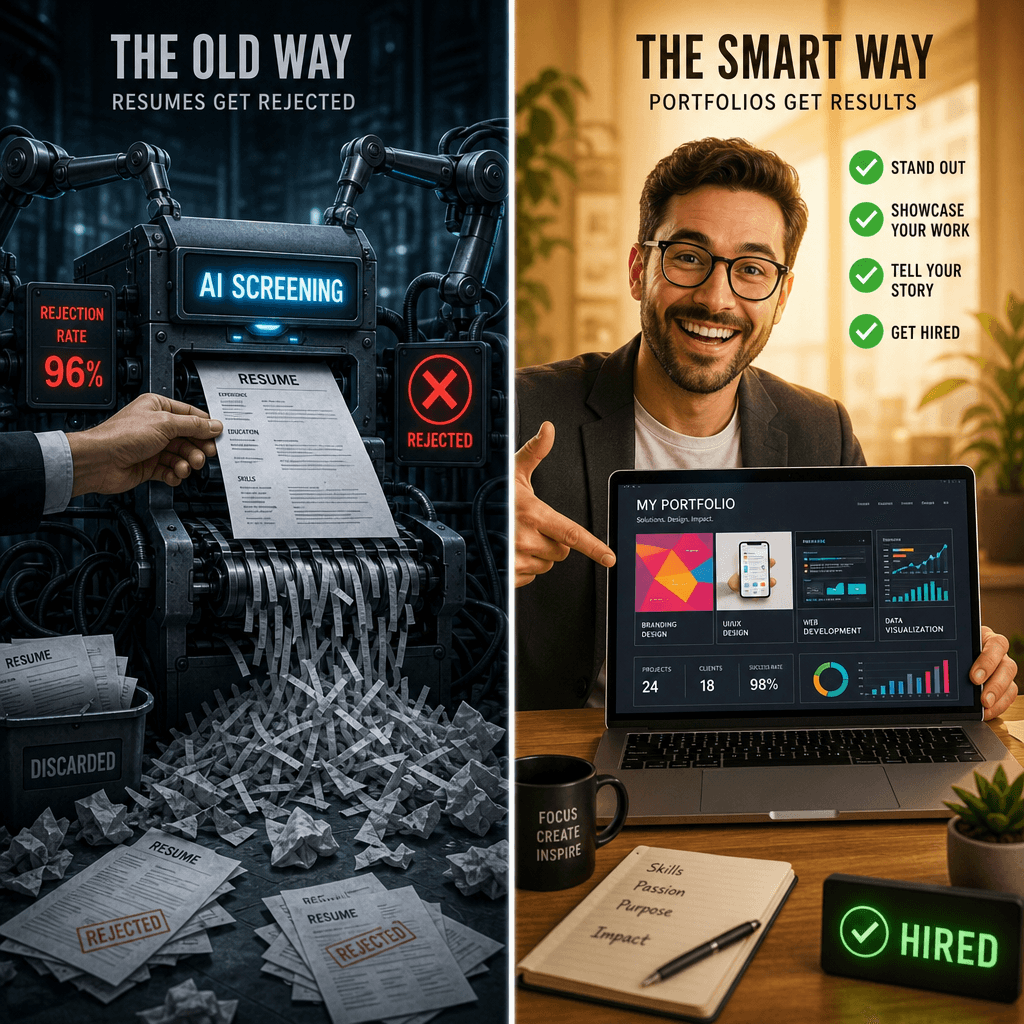
Portfolio reviews have evolved dramatically. They are no longer just galleries of final screenshots. In 2026, a portfolio review is a narrative test. Hiring managers want to see your product thinking, your communication skills, and how you handle constraints. They expect you to present 1-2 deep-dive case studies using the STAR framework (Situation, Task, Action, Result). They want to see the mess, the compromises, the dead ends, not just a sanitized highlight reel. A typical review lasts 30 to 60 minutes, and the candidate is essentially on stage, defending their creative decisions in real time.
For technical roles, the shift is equally dramatic. Take-home coding assignments, once a standard second-round filter, are dying fast. Candidates hate them, completion rates are dropping, and AI-assisted cheating has made them unreliable. In their place, companies are running live coding sessions, often conducted virtually, where candidates solve problems in real time while sharing their screen. The wild twist? Some companies now explicitly allow AI tools like Copilot, ChatGPT, or Cursor during the interview, because they want to see how candidates collaborate with AI in the same way they would on the job. Other companies are doubling down on anti-cheating measures, including enhanced proctoring, camera-on requirements, and “explain your code” follow-ups to catch AI-generated solutions.
Meanwhile, behavioral interview weight has ballooned to 30-40% of the total evaluation, reflecting that companies now care as much about how you communicate and collaborate as they do about your raw output. And timelines are compressed. Top candidates are off the market within 10 days, so companies are squeezing 3-4 rounds into 7-10 business days. If you are not ready to perform on demand, you are not ready for the 2026 market.
At Your Career Place, we coach job seekers every week who walk into these interviews unprepared. The ones who invest in their portfolio, practice live presentations, and build a library of versatile work samples are the ones who land offers. The ones who wing it rarely make it past round one.
Boomer’s Perspective: “Finally, Meritocracy Is Back”
The optimist looks at this landscape and sees a revolution in fairness. For decades, hiring was a pedigree game. Your university, your previous employer, your network connections, and your ability to write a persuasive resume mattered more than your actual skills. The work sample and portfolio revolution is changing that, and for the better.
Think about it. A self-taught designer who spent two years building real projects can now walk into a portfolio review with work that speaks louder than any degree. A career changer who completed a rigorous bootcamp can now compete on equal footing with someone who has a decade of traditional experience. A parent who took time away from the workforce and kept their skills sharp through freelance projects can now prove their readiness with a live demonstration rather than trying to explain a resume gap.
The structured rubric movement supports this optimism. Roughly 70% of hiring teams now use predefined scoring frameworks for portfolio and work sample reviews. Everyone gets asked the same questions, evaluated against the same criteria. This is designed to reduce gut-feel hiring and unconscious bias. When a candidate is scored on a rubric, the hiring manager has to justify their decision with evidence rather than a vague feeling.
Live demonstrations also offer something take-homes never could: real-time dialogue. When a candidate presents their portfolio live, the interviewer can ask follow-up questions, probe deeper into decisions, and get a genuine sense of how the candidate thinks. This dynamic conversation is often more revealing than a static submission ever could be.
From the employer side, work samples are simply better predictors of job performance. A resume tells you where someone worked. A portfolio tells you what they actually did. A live coding session tells you how they solve problems under pressure. The research consistently shows that work sample tests have higher predictive validity than unstructured interviews or resume screening alone. In that sense, the shift to work samples and portfolio reviews is not a trend. It is a correction toward better science.
Your Career Place has seen this play out repeatedly. Candidates who come to us with strong portfolios and practiced presentation skills consistently outperform candidates with flashier resumes. The work sample revolution is the best thing that has happened to honest talent in a generation.
Doomer’s Perspective: “This Is Just Unpaid Labor with Extra Steps”
Now flip the lens. The pessimist sees a dystopian hiring landscape where candidates are forced to perform unpaid labor just to get a foot in the door. And honestly? They have a point.
Consider what a modern candidate has to prepare. A polished portfolio with 2-4 deep-dive case studies. A slide deck for the portfolio review. A rehearsed 30-minute presentation. Multiple live coding sessions or problem-solving demonstrations. Behavioral prep using the STAR method for 5-10 stories. All of this, for a single job application, where the odds of getting an interview are 2-4% and the odds of getting an offer are even lower.
Now multiply that across 20, 30, or 50 job applications. The math is staggering. Candidates are spending hundreds of hours preparing portfolios and presentations for jobs they will never get. For working professionals, parents, caregivers, or anyone with limited free time, this creates an impossible barrier. The work sample revolution has effectively outsourced the cost of hiring vetting to the candidates themselves.
And it is not just the time. It is the skill set. In 2026, you are not just being tested on your craft. You are being tested on your presentation ability, your storytelling ability, your AI collaboration ability, and your live performance ability under pressure. A brilliant engineer who is camera-shy or a gifted designer who is not a natural public speaker is now at a disadvantage that has nothing to do with their actual job performance. The portfolio review has become a talent show, and not everyone signed up for that.

Then there is the AI factor. Candidates are expected to master AI tools like Copilot, ChatGPT, and Cursor for live coding sessions, but they also need to demonstrate raw problem-solving skills for whiteboard rounds. It is a two-front war. The bar keeps rising, and the payoff keeps shrinking. With 42% more interviews per hire than in 2021 and companies averaging 20 interviews per open role, candidates are jumping through more hoops for fewer jobs.
The ghosting problem makes it worse. Between 40% and 52% of job seekers report being ghosted after an interview. Only 5.5% to 41% of rejected candidates receive constructive feedback, even though 94% of them want it. Candidates pour hours into a portfolio review or live coding session, perform at their best, and then hear nothing. The silence is deafening, and the lack of feedback makes it impossible to improve for the next round.
And let us talk about the equity issue. Candidates with financial resources can hire portfolio coaches, buy presentation tools, and invest in AI subscriptions. Candidates without those resources are left to figure it out on their own. The work sample revolution, despite its noble intentions, may be widening the gap between the haves and the have-nots.
Your Career Place recognizes this tension. We work hard to make our portfolio coaching and interview preparation resources accessible to everyone, because we believe the work sample era should be an equalizer, not a new gatekeeper.
Key Takeaways: How to Survive (and Thrive) in the Work Sample Era
Whether you are a Boomer or a Doomer about this trend, the reality is the same: work samples and portfolio reviews are the new normal. Here is how to navigate them.
Build a portfolio that tells stories, not just shows results. Hiring managers want to see your process, your constraints, your compromises, and your impact. Use the STAR framework. Show the mess. Quantify the outcomes. One deep case study is worth more than ten shallow screenshots.
Practice your live presentation. A portfolio review is a performance. Rehearse your deck. Time yourself. Record yourself and watch the playback. Anticipate tough questions. Be ready to defend your design decisions and your trade-offs. The candidates who win are the ones who have practiced until it feels natural.
Prepare for live coding and AI collaboration. If you are in a technical field, get comfortable solving problems in real time with an audience. Practice narrating your thought process out loud. If the company allows AI tools, know how to use them effectively while still demonstrating your own reasoning. If they do not, make sure you can solve from first principles.
Curate your work for each role. Generic portfolios are a waste of time. Tailor your case studies to the company you are applying to. Show them you have already thought about their problems.
Get feedback before you apply. Show your portfolio to peers, mentors, or a service like Your Career Place before you submit it. Fresh eyes catch gaps you cannot see. A 30-minute review session can save you from a failed interview.
Protect your time. Not every job is worth a custom portfolio. If a company is asking for unpaid work that exceeds a reasonable threshold, or if they refuse to give you clarity on their process, that is a red flag. Good companies respect candidate time.
Master the behavioral side. With behavioral interviews now accounting for 30-40% of evaluations, your communication skills matter as much as your craft. Build a library of 5-10 versatile STAR stories. Practice them until they roll off your tongue. Be ready to talk about failure, collaboration, conflict, and impact.
The work sample and portfolio review era is here. It is demanding, it is competitive, and it is not always fair. But for candidates who prepare, it is also an opportunity to let your work speak for itself in a way that no resume ever could. At Your Career Place, we are here to help you build that portfolio, ace that review, and land the job you deserve. Because in 2026, showing is no longer just believing. It is surviving.