

Retirement Planning in November 2026: Are You Saving Enough — or Already Behind?
Retirement Planning in November 2026: Are You Saving Enough — or Already Behind?
Let’s be honest: retirement planning is one of those topics most of us know we should be thinking about — but it’s easy to push to the back burner when rent is due, groceries cost more than ever, and life keeps throwing curveballs. But here’s the thing: the longer you wait, the harder it gets. And the latest data from November 2026 paints a picture that’s both alarming and, believe it or not, full of opportunity — if you know where to look.
At Your Career Place, we believe that understanding your financial future is just as important as building your career. So this week, we’re diving deep into the state of retirement planning right now — the good, the bad, and the downright scary — so you can make smarter decisions starting today.

What’s Happening Right Now: The Retirement Landscape in November 2026
The headlines this month are a mixed bag. On one hand, total U.S. retirement assets hit a record $51.2 trillion in Q2 2026 — up nearly 8% from the previous quarter. Average 401(k) balances climbed to $155,800, and Fidelity reports that over 81% of plan participants contributed enough to capture their full employer match. That’s genuinely good news.
But zoom out, and the picture gets more complicated. A new survey from Schroders found that Americans in workplace plans believe they’ll need $1.2 million to retire comfortably — yet most expect to have less than $500,000. Affluent Americans are setting the bar even higher: HSBC research shows wealthy individuals now say they need $2.6 million for a comfortable retirement (a 26% jump from 2025), but the average person in that group has only saved about half of that.
And for everyday workers? The Penny Hoarder’s 2026 State of Retirement Report found that the median savings for prime-age workers (ages 30–60) is less than $37,000. Even more striking: 22% of that group has saved nothing at all.
Meanwhile, a new concern is emerging: small 401(k) balances left behind after job changes are quietly eroding. Research from PensionBee and Vanguard found that 68% of automatic rollover IRAs lost value within one year — drained by high fees and poor investment defaults. If you’ve ever changed jobs and left a small retirement account behind, this is a wake-up call.
Social Security: What Changed in 2026
Social Security got a few notable updates this year that every worker should know about:
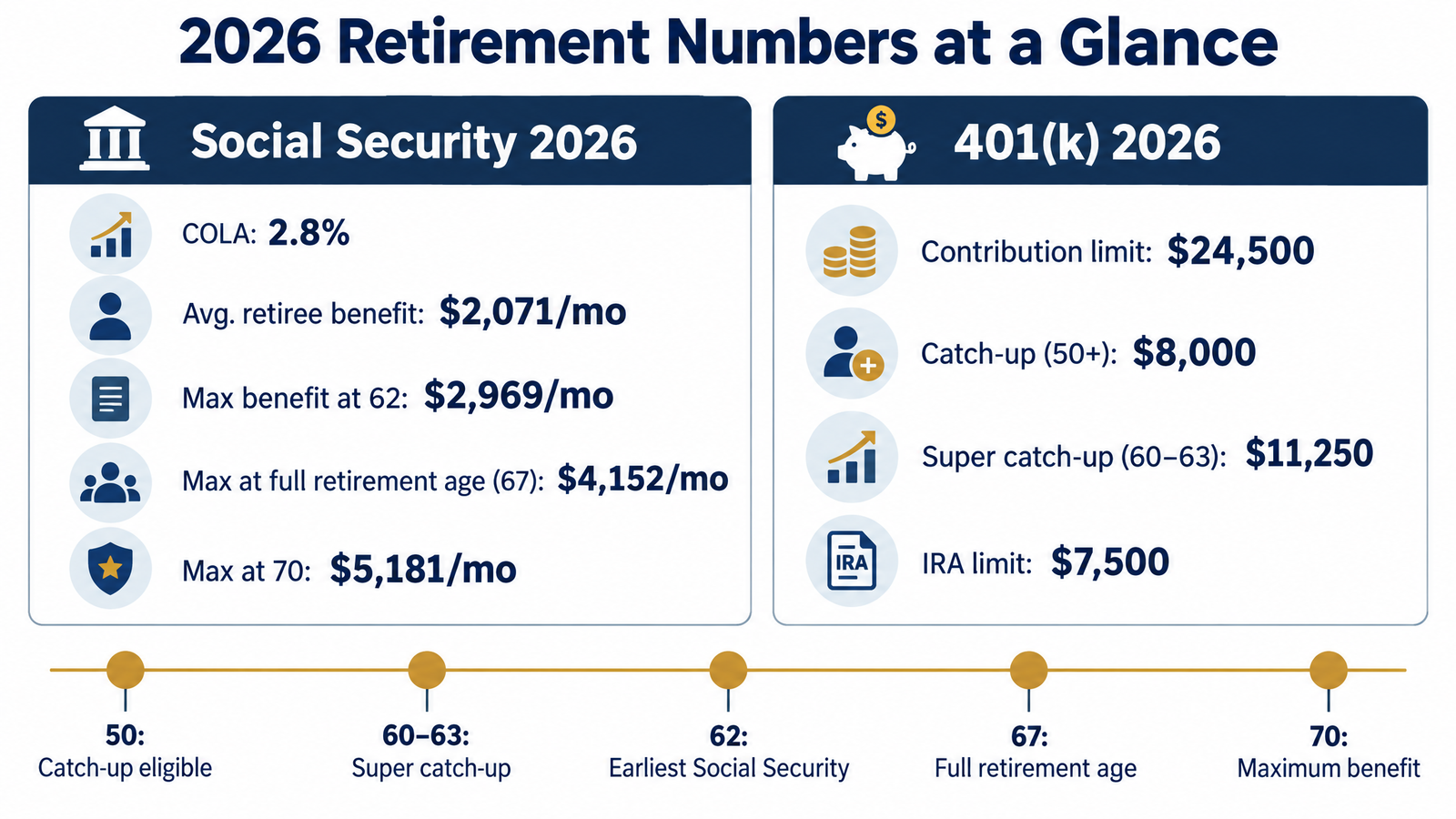
- 2.8% COLA increase — beneficiaries saw their average monthly check rise by about $56.
- Full Retirement Age (FRA) is now 67 for anyone born in 1960 or later — a milestone that officially took effect in November 2026.
- Maximum monthly benefit at FRA: $4,152; if you delay to age 70, that jumps to $5,181.
- Maximum taxable earnings rose to $184,500.
Here’s the catch: 40% of non-retired Americans fear Social Security will be depleted before they can collect, and 76% are worried about potential benefit cuts. With the trust fund projected to face a potential 22% benefit reduction by 2032 if Congress doesn’t act, those fears aren’t unfounded. The lesson? Don’t build your retirement plan around Social Security alone.
New Tax Breaks You Might Be Missing
Here’s some genuinely good news: 2026 brought several new tax opportunities that could meaningfully boost your retirement savings:
- 401(k) contribution limit: $24,500 — with an $8,000 catch-up for those 50 and older, and a new “super catch-up” of $11,250 for workers aged 60–63.
- IRA contribution limit: $7,500 — with a $1,100 catch-up for those 50+.
- New $6,000 senior deduction for Americans 65 and older (non-itemized, through 2028).
- SALT deduction cap quadrupled to $40,000 through 2028 — worth revisiting if you itemize.
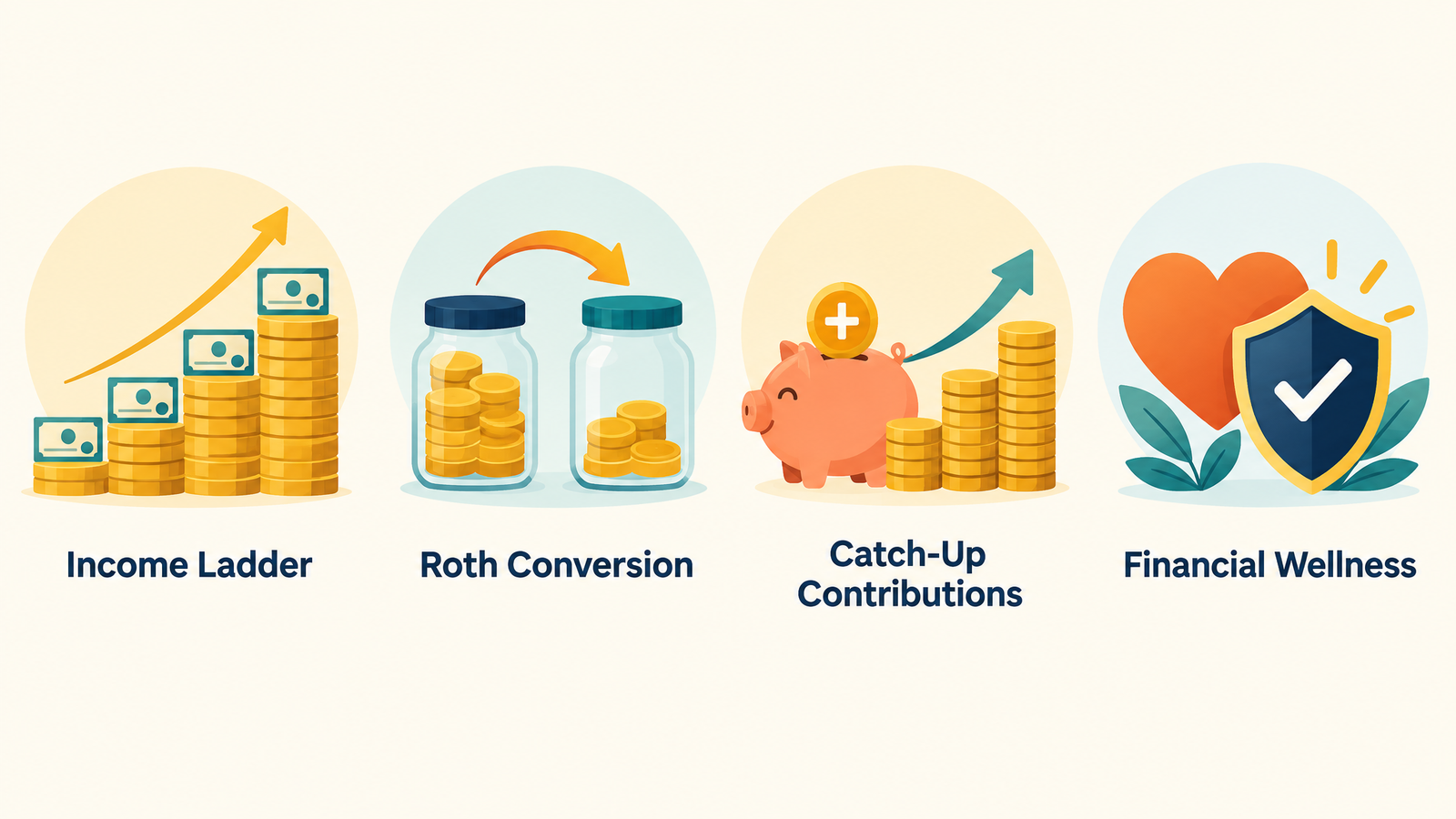
Financial advisors are also highlighting Roth conversions as a smart move right now, especially during market pullbacks. Converting traditional IRA funds to a Roth IRA reduces your current tax bill (if done during a down market) and sets you up for tax-free growth — with no required minimum distributions (RMDs) for the original owner.
The Boomer Perspective: “The System Is Working — If You Work It”
If you’re in the optimist camp — let’s call it the Boomer perspective — there’s actually a lot to feel good about. Record retirement assets. Higher contribution limits. New tax deductions. Auto-enrollment in 401(k) plans is now offered by nearly half of all plans, and 96.8% of plans offer a Roth option. The tools are there.
The Boomer take: the system rewards those who stay consistent. Dollar-cost averaging, employer matches, compound interest — these aren’t just buzzwords. They’re the engine of long-term wealth. If you’ve been contributing steadily for 20 or 30 years, you’re likely sitting on a balance that would have seemed unimaginable when you started. The key is to not panic during market volatility, keep contributing, and take advantage of every tax break available.
Delaying Social Security from age 62 to 70 increases your payout by roughly 8% per year — that’s a guaranteed return you can’t get anywhere else. And with the new super catch-up contributions for ages 60–63, there’s never been a better time to make up for lost ground in the final stretch before retirement.
At Your Career Place, we’ve seen this play out time and again: the people who stay the course, even when it’s hard, tend to come out ahead. Consistency beats timing, every single time.
The Doomer Perspective: “The Math Just Doesn’t Add Up for Most People”
Now for the harder truth. 80% of Americans now view retirement security as a national crisis — up from 67% in 2020. And it’s not hard to see why.
The median retirement savings for prime-age workers is under $37,000. The recommended target is over $1 million. That’s not a gap — that’s a chasm. And it’s getting wider, not narrower. In 2026, the share of workers who increased their retirement savings fell by 16% year-over-year, while the share who reduced their savings rose to 14%. Inflation, housing costs, debt, and healthcare are eating people alive before they can even think about saving for the future.
The Doomer take: the system is built for people who already have money. If you’re living paycheck to paycheck, maxing out a 401(k) isn’t a realistic option. And the “just delay Social Security to 70” advice assumes you can afford to wait — which many people, especially those in physically demanding jobs or with health issues, simply cannot.
Then there’s the AI wildcard: 48% of non-retired workers worry that artificial intelligence could force them into an earlier-than-planned retirement — not by choice, but by job displacement. If your industry is being automated, your retirement timeline might be getting compressed whether you like it or not.
And don’t forget those forgotten 401(k) accounts. If you’ve changed jobs and left a small balance behind, there’s a 68% chance it’s quietly losing value right now. That’s money you worked for — and it’s slipping away.
Key Takeaways: What You Can Do Right Now
Whether you’re feeling optimistic or overwhelmed, here are the most actionable steps you can take today:
- Track down any old 401(k) accounts. If you’ve changed jobs, find those old accounts and roll them into your current plan or an IRA. Don’t let fees drain what you’ve already earned.
- Maximize your employer match — at minimum. If your employer matches contributions, not contributing enough to get the full match is leaving free money on the table.
- Take advantage of catch-up contributions. If you’re 50 or older, you can contribute significantly more to your 401(k) and IRA. If you’re 60–63, the new “super catch-up” is a game-changer.
- Don’t count on Social Security alone. Build your plan assuming you’ll get less than projected. Anything extra is a bonus.
- Consider a Roth conversion. If you’re in a lower tax bracket now than you expect to be later, converting traditional IRA funds to a Roth could save you significantly in the long run.
- Build an income floor. Financial advisors recommend creating “income ladders” using bonds or annuities to cover essential expenses in retirement — so you’re not forced to sell investments during a market downturn.
- Stress-test your plan. What happens if you retire 5 years earlier than planned? What if you need long-term care? Running these scenarios now — not at 70 — gives you time to adjust.
The bottom line: retirement planning in 2026 is harder than it’s ever been for many Americans — but the tools and opportunities available to those who engage with the system are also better than ever. The gap between those who plan and those who don’t is widening every year.
At Your Career Place, we’re here to help you bridge that gap. Whether you’re just starting out, playing catch-up, or fine-tuning a plan that’s already in motion, the most important step is the next one. Don’t wait for the “perfect” time — it doesn’t exist. Start where you are, with what you have, and build from there.
Your future self will thank you.
Disclaimer: This article is for informational and educational purposes only and does not constitute financial, investment, or tax advice. The information presented reflects publicly available data and expert commentary as of November 2026. Individual financial situations vary widely — please consult a qualified financial advisor, tax professional, or retirement planning specialist before making any decisions about your retirement savings, investments, or tax strategy. Your Career Place does not provide personalized financial advice.