
Made in America Again? The Manufacturing Reshoring Boom — Real Jobs or Empty Promises?
Made in America Again? The Manufacturing Reshoring Boom — Real Jobs or Empty Promises?

You’ve seen the headlines. New factories breaking ground across the Midwest. Semiconductor plants rising in Arizona. EV battery gigafactories transforming the Southeast. Politicians on both sides of the aisle are celebrating a manufacturing renaissance — a triumphant “Made in America” comeback story decades in the making. But here’s the question nobody’s asking loudly enough: are those factories actually creating the jobs people think they are?
The answer, like most things in today’s economy, is complicated. At Your Career Place, we dig into the real numbers so you can make smart decisions about your career — not just react to the hype. This week, we’re unpacking the manufacturing and reshoring job trend that’s reshaping entire regions of the country, and what it actually means for workers in 2026.
What’s Actually Happening on the Factory Floor
Let’s start with the facts, because they tell a fascinating — and somewhat contradictory — story.
As of May 2026, the U.S. manufacturing sector employs approximately 12.595 million workers, according to the Bureau of Labor Statistics. That sounds like a lot — and it is — but here’s the twist: factory payrolls have actually contracted for 32 consecutive months as of June 2026, with a net decline of roughly 47,000 jobs from the prior year. Meanwhile, the S&P Global Flash Manufacturing PMI hit a 49-month high of 55.7 in June 2026, signaling that manufacturing output is booming.
Output up. Payrolls down. How is that possible?
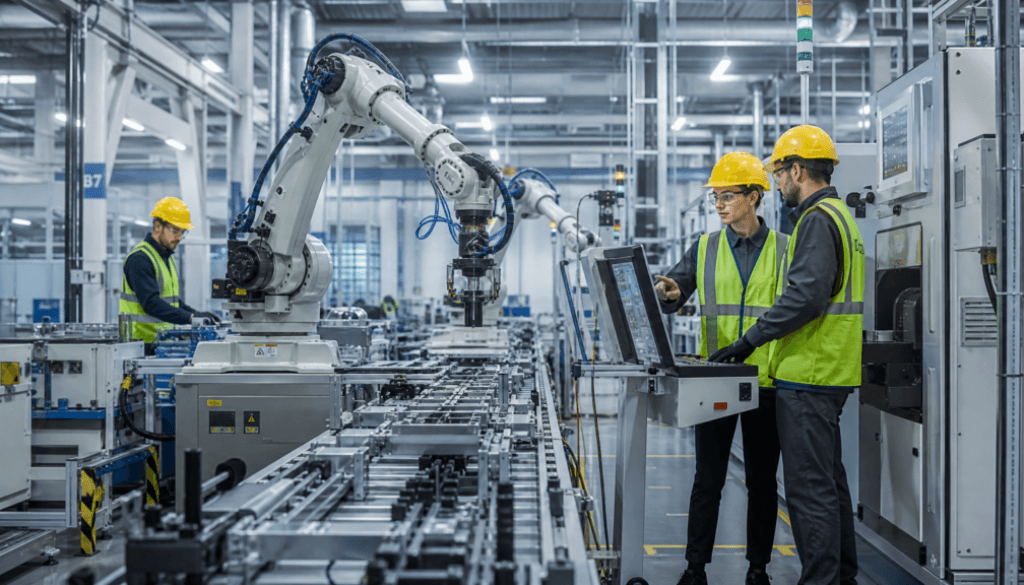
Two words: automation and timing. Modern factories are increasingly run by robotics, AI-driven systems, and advanced machinery that can produce more with fewer hands. And the massive megaprojects — semiconductor fabs, EV battery plants — operate on 7-to-9-year timelines from announcement to full employment. The ribbon-cutting ceremony happens years before the hiring surge.
On the reshoring front, the numbers are genuinely impressive. The Reshoring Initiative reports that 244,000 manufacturing jobs were announced in 2024, with cumulative announcements since 2010 surpassing 2 million jobs. Tariff uncertainty, supply chain resilience priorities, and federal incentives like the CHIPS Act and the Inflation Reduction Act are all pulling production back to American soil. In fact, tariff citations as a driver for reshoring jumped a staggering 454% in Q1 2025 compared to the same period in 2024.
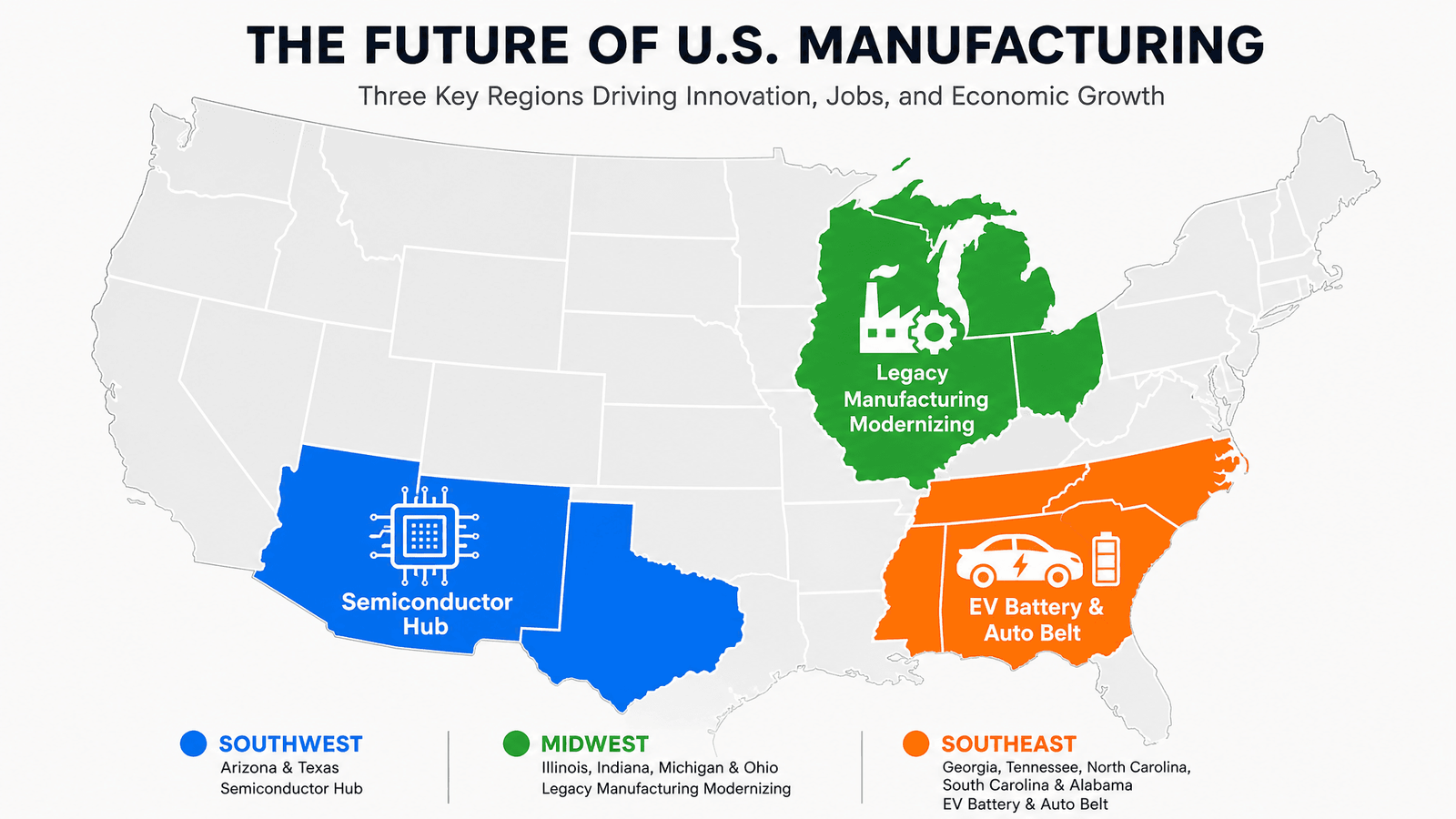
The geographic picture is equally striking. The Southwest — particularly Arizona and Texas — has become a semiconductor manufacturing hub. The Southeast (Georgia, Tennessee, North Carolina, South Carolina, Alabama) is attracting massive automotive and EV battery investment. And the Midwest (Ohio, Indiana, Michigan, Illinois) is leveraging its legacy manufacturing base to modernize with automation. These aren’t just economic statistics — they’re real communities being transformed.
But there’s a catch that’s keeping workforce experts up at night: the skills gap. There are currently 477,000 manufacturing job openings sitting unfilled. Deloitte and the Manufacturing Institute project the industry will need 3.8 million new workers by 2033 — and up to 1.9 million of those roles could remain vacant if the talent pipeline doesn’t catch up. The hardest roles to fill? Controls engineers, automation specialists, and PLC/SCADA programmers — the people who actually run the high-tech equipment in these new facilities.
The Boomer’s Perspective: America’s Industrial Comeback Is the Real Deal
If you’re optimistic about manufacturing’s future — and there are very good reasons to be — here’s the case for why this reshoring wave is genuinely transformative for American workers.
First, the wages. Manufacturing compensation has reached historic highs. Average hourly earnings for production workers crossed $30 per hour for the first time in April 2026. Total average compensation for all manufacturing employees hit $36.68–$36.71 per hour. For workers with specialized skills — controls engineers, automation technicians, manufacturing engineers — salaries at advanced facilities frequently range from $90,000 to $120,000 annually. These are not minimum-wage assembly line jobs. These are middle-class, career-building positions with real earning power.
Second, the momentum is real and broad-based. A remarkable 75.3% of manufacturers surveyed by the National Association of Manufacturers in Q1 2026 reported a positive business outlook. That’s not spin — that’s the people actually running factories expressing genuine confidence. And with 29% of manufacturers having already completed reshoring operations and another 45% actively pursuing plans, this isn’t a trend that’s about to reverse.
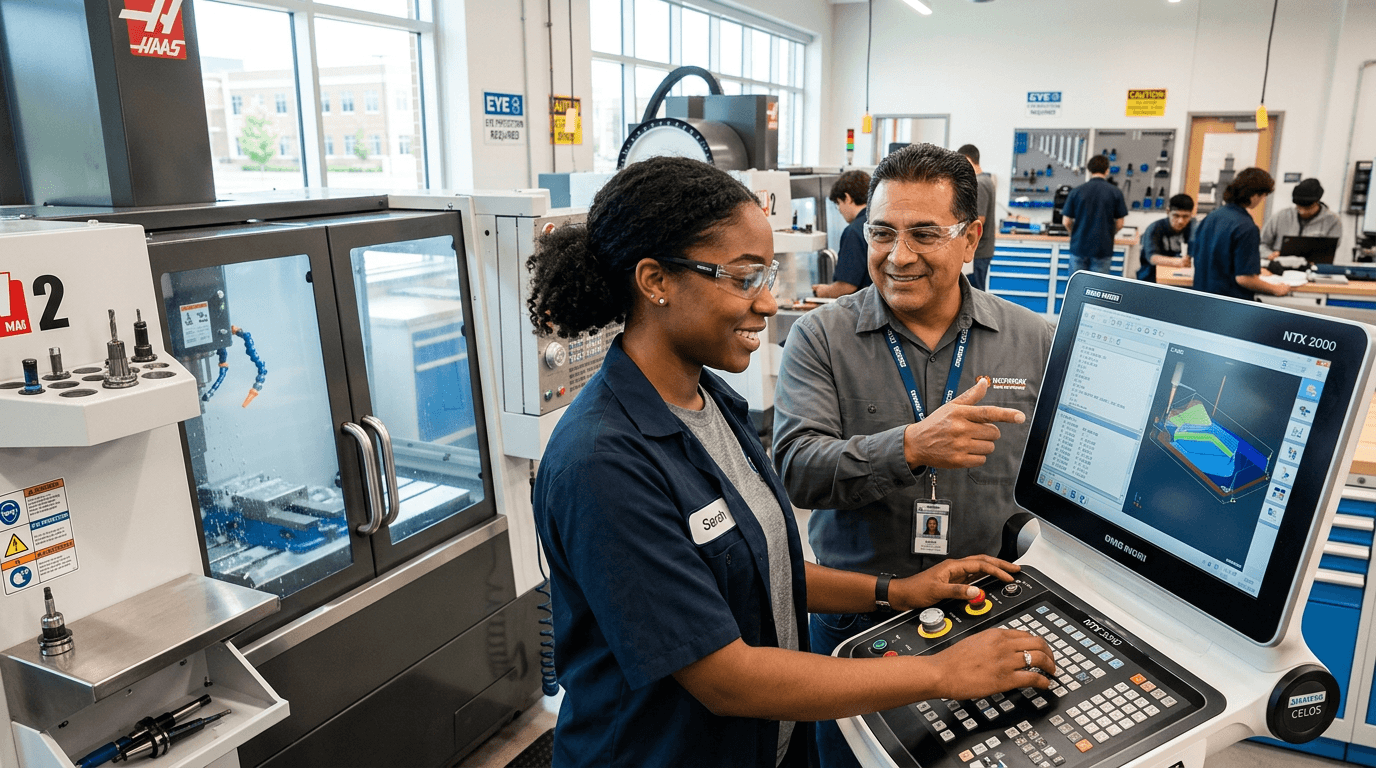
Third, consider the opportunity for career reinvention. The skills gap that everyone worries about is, from another angle, a massive opportunity. Companies are so desperate for qualified workers that they’re partnering with community colleges and technical training providers, building talent pipelines 12 to 18 months before facilities even open. That means if you’re willing to invest in the right technical skills — even through a two-year associate’s degree or a focused certification program — you can walk into a high-paying job in a sector that’s actively recruiting.
At Your Career Place, we’ve seen this play out firsthand: workers who upskill into automation, robotics maintenance, or CNC programming are finding themselves in the driver’s seat of their careers, with multiple competing job offers and salaries that would have seemed impossible a decade ago. The manufacturing renaissance isn’t just about factories — it’s about rebuilding the American middle class, one skilled worker at a time.
And let’s not forget the geopolitical dimension. After the supply chain chaos of the pandemic years, companies and governments alike have realized the danger of over-relying on distant foreign suppliers. Reshoring isn’t just an economic trend — it’s a national security imperative. That means this wave of investment has political support across party lines, making it more durable than typical economic cycles.
The Doomer’s Perspective: The Factories Are Coming Back, But the Jobs Aren’t
Now for the harder truth — the one that the ribbon-cutting ceremonies don’t advertise.
The headline number is damning: of the 2 million manufacturing jobs announced since 2010 through reshoring and foreign direct investment, only about 1.7 million have actually been filled. That’s a 15% gap between promise and reality — and it’s growing. The “announcement-to-payroll” gap is a structural feature of modern manufacturing, not a bug. When a semiconductor fab announces 3,000 jobs, it means 3,000 jobs eventually, over a decade, many of which require highly specialized skills that most displaced workers simply don’t have.
The automation reality is even more sobering. Modern factories are deliberately designed to maximize output per worker. The same technological forces that make reshoring economically viable — robotics, AI, advanced machinery — are the forces that ensure those factories won’t employ anywhere near the number of people that a comparable facility would have in 1985. We’re building 21st-century factories and expecting them to solve 20th-century employment problems. They can’t.
The skills mismatch is brutal for workers who don’t have the right background. If you’re a 50-year-old former assembly line worker whose plant closed a decade ago, the new semiconductor fab in your county isn’t hiring you — it’s hiring controls engineers with four-year degrees and specialized certifications. The communities that lost manufacturing jobs to offshoring are often not the same communities that will benefit from reshoring, because the new jobs require fundamentally different skills.
And the wage picture, while improved, has a dark side. Yes, average manufacturing wages have risen — but they’ve risen because the low-skill jobs have been automated away, leaving only the high-skill, high-wage positions in the data. The workers who most need good manufacturing jobs — those without advanced technical training — are increasingly priced out of the sector by their own skill gaps.
There’s also the policy risk. Much of the reshoring boom is driven by federal incentives (CHIPS Act, IRA) and tariff policy. Both are subject to political change. If the incentive landscape shifts, some of the investment pipeline could slow or redirect. Companies that reshored primarily to capture subsidies may reconsider if those subsidies change.
The bottom line from the pessimist’s corner: America is building impressive factories. But “Made in America” increasingly means “Made by Robots in America, Maintained by a Small Team of Highly Paid Engineers.” That’s great for some workers — and a dead end for many others.
Key Takeaways: What This Means for Your Career
Whether you’re optimistic or pessimistic about the manufacturing reshoring wave, the career implications are clear. Here’s what the team at Your Career Place recommends you take away from this week’s deep dive:
- The skills gap is your opportunity. With 477,000 open manufacturing jobs and 1.9 million projected vacancies by 2033, the demand for skilled workers is real and urgent. If you’re willing to invest in technical training — automation, robotics, CNC programming, PLC/SCADA systems — you’re entering one of the most in-demand career paths in the country.
- Geography matters more than ever. The manufacturing boom is concentrated in specific regions: the semiconductor corridor in Arizona and Texas, the EV battery belt in the Southeast, and the modernizing Midwest. If you’re serious about a manufacturing career, consider whether relocation to one of these hotspots makes sense for your situation.
- Community college is your fast track. Companies are actively partnering with community colleges and technical schools to build talent pipelines. A two-year associate’s degree or focused technical certification in the right field can open doors to $70,000–$100,000+ salaries faster than a four-year degree in many other fields.
- Don’t wait for the factory to open. Companies are hiring 12–18 months before facilities go online. If you’re in a region where a major manufacturing facility is being built, start your job search and skills development now — not when the plant opens.
- Watch the announcement-to-payroll gap. Not every announced job becomes a real job on the timeline promised. Do your research on specific companies and facilities before making major career or relocation decisions based on job announcements.
- Automation is a career, not just a threat. The robots aren’t just taking jobs — they’re creating new ones for the people who build, program, and maintain them. Positioning yourself as someone who works with automation technology, rather than competing against it, is the smartest long-term career move in manufacturing.
The manufacturing reshoring story is real, complex, and full of genuine opportunity — if you know where to look and what skills to bring. At Your Career Place, we’re here to help you navigate exactly that. Whether you’re a recent graduate considering a technical career, a mid-career professional thinking about a pivot, or a seasoned manufacturing veteran looking to upskill, the resources and guidance you need are right here.
The factories are coming back. The question is: will you be ready when they do?
Stay connected with Your Career Place for weekly insights on the job market trends shaping your career. Subscribe to our newsletter and follow us on social media for the latest career advice, job market data, and opportunities in your field.