
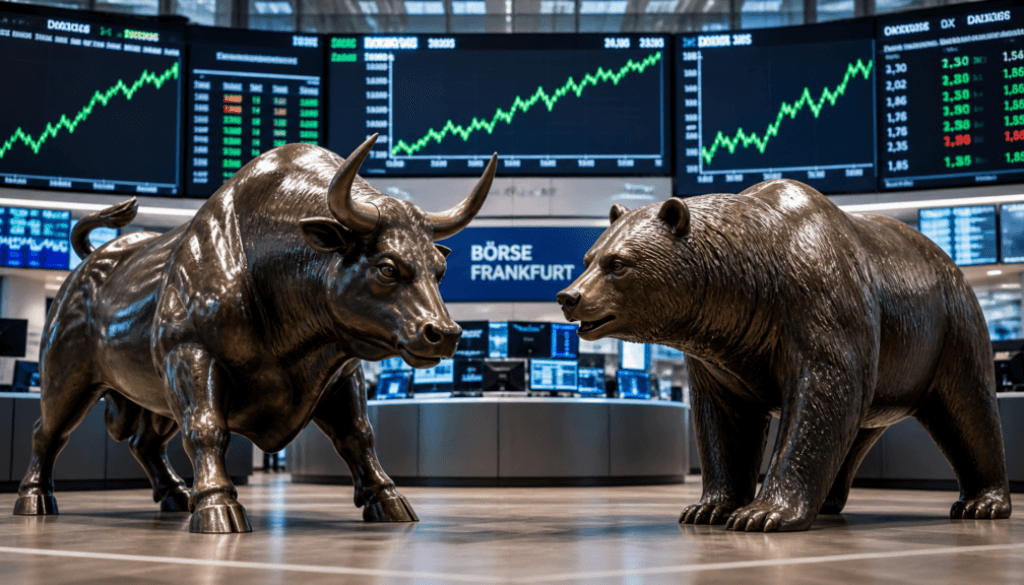
Investing: Bull Market Brilliance or Bubble Trouble?
Investing in 2026
By Your Career Place | July 29, 2026
If you’ve been watching your investment portfolio lately, you’ve probably felt that familiar mix of excitement and anxiety. The S&P 500 is up roughly 9–10% year-to-date, AI stocks are still the talk of every financial news channel, and yet the Federal Reserve is holding interest rates steady at 3.50%–3.75% with no clear cuts on the horizon. So what’s a working professional supposed to do with their hard-earned money in the second half of 2026?
At Your Career Place, we believe that understanding both the optimistic and pessimistic sides of any financial story helps you make smarter, more confident decisions. That’s why we’re breaking down the investing landscape right now — the good, the not-so-good, and the “it depends on your situation.”
Whether you’re a seasoned investor who’s been riding market waves for decades or someone just starting to think seriously about building wealth, this post is for you. Let’s dig in.
What’s Actually Happening in the Markets Right Now
Before we get into the Boomer vs. Doomer debate, let’s ground ourselves in the facts. Here’s a quick snapshot of where things stand as of late July 2026:
- S&P 500 performance: Up approximately 9–10% year-to-date, with Wall Street’s median year-end target sitting at 7,850. Goldman Sachs has raised its forecast to 8,000, citing strong earnings growth.
- Corporate earnings: Full-year 2026 S&P 500 earnings growth is estimated at 24–25%. Importantly, this isn’t just the “Magnificent Seven” tech giants — non-Magnificent Seven stocks are projected to grow earnings by 20% as well.
- AI investment boom: Artificial intelligence capital expenditure continues to be the primary engine driving business investment and corporate profits. But scrutiny is growing over whether the returns on all that AI spending will actually materialize.
- Interest rates: The Fed, now under new Chair Kevin Warsh, is holding steady at 3.50%–3.75%. Markets have actually shifted from expecting rate cuts to pricing in potential rate hikes by year-end.
- ETF trends: Active ETFs are capturing nearly 90% of monthly inflows, challenging the long dominance of passive index funds. Short-term Treasury ETFs are also seeing strong demand as investors seek safety.
- Valuations: The S&P 500’s cyclically adjusted price-to-earnings (CAPE) ratio has reached levels not seen since the dot-com bubble — a fact that has both bulls and bears paying close attention.
Now, with that context in mind, let’s look at how two very different types of investors are interpreting this same set of facts.
The Boomer Perspective: “Stay the Course — The Fundamentals Are Strong”

If you’re in the optimistic camp — let’s call it the Boomer perspective — you’re looking at 2026 and seeing a market that has proven its resilience time and time again. Here’s the case for staying invested and even leaning in:
Earnings Are the Real Story
The bull market isn’t running on hype alone. Corporate earnings are genuinely strong, with 24–25% projected growth for the full year. When profits are growing at that pace, higher stock prices aren’t necessarily a bubble — they can be a rational reflection of improved business performance. Goldman Sachs raised its S&P 500 year-end target to 8,000 specifically because earnings expectations were upgraded, not just because of market sentiment.
Broad Market Participation Is Expanding
One of the most encouraging signs for long-term investors is that market gains are broadening beyond the handful of mega-cap tech stocks that dominated 2024 and 2025. Non-Magnificent Seven companies are expected to grow earnings by 20% this year. Small-cap and international stocks have also shown strength. This kind of broad participation is typically a healthier sign for a bull market than one driven by just a few names.
Index Funds and ETFs Still Work
For the everyday investor at Your Career Place, the core strategy of consistent contributions to diversified index funds remains as sound as ever. Dollar-cost averaging — putting in a fixed amount every month regardless of market conditions — has historically been one of the most effective ways to build wealth over time. You don’t need to time the market perfectly; you just need to stay in it.
AI Is a Genuine Productivity Revolution
The optimist sees AI not as a speculative bubble but as a genuine transformation of the economy. Companies that successfully integrate AI are seeing real productivity gains, and those gains are showing up in earnings. The AI capital expenditure cycle is expected to continue driving business investment through the rest of 2026 and beyond.
Higher Rates Mean Better Bond Yields
Here’s a silver lining that often gets overlooked: with the Fed holding rates at 3.50%–3.75%, short-term Treasury bonds and money market funds are actually paying meaningful yields for the first time in years. For investors who want to balance their portfolios with fixed income, this is genuinely good news. You can earn real returns on the “safe” portion of your portfolio.
The Boomer bottom line: Stay diversified, keep contributing, don’t panic over headlines, and trust that the long-term trajectory of the market rewards patient investors. History is on your side.
The Doomer Perspective: “Proceed With Caution — The Risks Are Real”

Now let’s flip the coin. The pessimistic — or Doomer — perspective isn’t about panic. It’s about recognizing that the current market environment has some genuine warning signs that deserve serious attention.
Valuations Are at Historically Dangerous Levels
The CAPE ratio — a measure of stock valuations that smooths out short-term earnings fluctuations — has reached levels not seen since the dot-com bubble of the late 1990s. That doesn’t mean a crash is imminent, but it does mean that stocks are priced for near-perfection. Any disappointment in earnings, any geopolitical shock, or any unexpected Fed move could trigger a significant correction. When you’re buying at these valuations, your margin of safety is thin.
The AI Story Could Disappoint
The market has priced in enormous returns from AI investment. But what if those returns take longer to materialize than expected? Analysts are already warning about potential commoditization of AI technology and overcapacity in AI infrastructure. If the hyperscalers — the Amazons, Microsofts, and Googles of the world — start reporting that their AI investments aren’t generating the expected returns, the market could reprice quickly and painfully.
Interest Rates Aren’t Coming Down Anytime Soon
Earlier in 2026, many investors were counting on Federal Reserve rate cuts to provide a tailwind for stocks. That tailwind has evaporated. Not only is the Fed holding steady, but markets are now pricing in the possibility of rate hikes. New Fed Chair Kevin Warsh has moved away from traditional forward guidance, making it harder to predict what comes next. Higher-for-longer rates put pressure on companies with significant debt, squeeze consumer spending, and make bonds more competitive with stocks.
Geopolitical Risks Are Elevated
Tensions in the Middle East — particularly involving the U.S. and Iran — have already impacted energy markets and contributed to “sticky” inflation. Geopolitical events are by definition unpredictable, but the current environment has more potential flashpoints than we’ve seen in years. A significant escalation could send energy prices surging, reignite inflation, and force the Fed’s hand in ways that would be bad for both stocks and bonds.
Market Breadth Is Still Narrow at the Top
While earnings are broadening, the index itself is still heavily weighted toward a small number of mega-cap stocks. If those stocks stumble — and at current valuations, they don’t have much room for error — the index could fall significantly even if the broader economy is doing fine. This is the classic “narrow market” risk that has preceded several historical corrections.
Midterm Election Year Volatility
Historically, midterm election years bring increased market volatility. With 2026 being a midterm year, investors should expect more turbulence than usual, regardless of which party benefits from the results. Political uncertainty tends to make institutional investors cautious, which can amplify market swings.
The Doomer bottom line: This isn’t the time to be cavalier. Stretched valuations, geopolitical risks, and a Fed that could move in either direction create a genuinely uncertain environment. Maintaining adequate cash reserves, reducing exposure to the most speculative positions, and stress-testing your portfolio against a 20–30% correction are all prudent steps.
Key Takeaways: What Should You Actually Do?
At Your Career Place, we’re not in the business of telling you whether to be a Boomer or a Doomer. Both perspectives contain real truths. What we can do is give you a practical framework for navigating this environment, whatever your risk tolerance and time horizon.
1. Know Your Time Horizon
If you’re 30 years from retirement, short-term market volatility is largely irrelevant to your long-term outcome. If you’re 5 years out, the calculus is very different. Your investment strategy should be calibrated to your actual timeline, not to whatever the market is doing this week.
2. Don’t Abandon Index Funds — But Consider Diversifying Within Them
The core case for low-cost index funds remains strong. But given the concentration risk in the S&P 500, consider whether your portfolio has adequate exposure to small-cap stocks, international markets, and value-oriented investments. The Schwab U.S. Dividend Equity ETF (SCHD) and similar quality-focused funds have gained traction for good reason.
3. Take Advantage of Higher Bond Yields
With short-term Treasuries yielding meaningful returns, this is a good time to ensure your emergency fund and short-term savings are working harder. Short-term Treasury ETFs like SGOV or VGSH offer safety and liquidity with yields that actually beat inflation on a short-term basis.
4. Don’t Try to Time the Market
Whether you’re bullish or bearish, the evidence consistently shows that trying to time the market — getting out before a crash, getting back in at the bottom — is extraordinarily difficult even for professionals. Dollar-cost averaging into a diversified portfolio remains the most reliable strategy for most working professionals.
5. Review Your Risk Tolerance Honestly
If the thought of a 25% portfolio decline keeps you up at night, you may be taking more risk than is appropriate for your situation. This is a good time to have an honest conversation with yourself — or a financial advisor — about whether your current allocation matches your actual risk tolerance, not just your theoretical one.
6. Keep an Eye on the Fed
With new Fed Chair Kevin Warsh moving away from traditional forward guidance, the next few months could bring surprises. The July 30 PCE inflation report and upcoming Fed meetings will be critical data points. Stay informed, but don’t make reactive decisions based on single data releases.
The Bottom Line
Investing in 2026 is neither as simple as “the market always goes up” nor as dire as “a crash is inevitable.” The reality, as always, is more nuanced. Strong corporate earnings and broadening market participation give genuine reasons for optimism. Stretched valuations, geopolitical risks, and an unpredictable Fed give genuine reasons for caution.
The investors who will come out ahead aren’t necessarily the ones who called the market correctly — they’re the ones who built diversified, disciplined portfolios aligned with their goals and stuck to their plan when things got bumpy.
At Your Career Place, we’re here to help you think through these decisions with clarity and confidence. Whether you’re just starting your investment journey or fine-tuning a portfolio you’ve been building for years, the principles of diversification, consistency, and long-term thinking remain your most powerful tools.
What’s your investing strategy for the second half of 2026? Are you leaning Boomer or Doomer? Drop your thoughts in the comments — we’d love to hear from the Your Career Place community.
Disclaimer: This article is for educational and informational purposes only and does not constitute individualized financial, investment, or tax advice. Please consult a qualified financial professional before making investment decisions.