

Culture Fit Interviews in 2026: The Bias Battle, the Culture Add Revolution, and What Job Seekers Need to Know
Culture Fit Interviews in 2026: The Bias Battle, the Culture Add Revolution, and What Job Seekers Need to Know
If you have walked into a job interview in 2026 and been asked something like “So, do you think you’d enjoy grabbing a beer with the team after work?”—congratulations, you just experienced what is now widely known as the “beer test.” It sounds friendly. It sounds casual. But behind that innocent question is a hiring practice that has cost countless qualified candidates jobs they were perfectly capable of doing. Welcome to the culture fit interview, one of the most controversial and misunderstood techniques in modern hiring.
At Your Career Place, we have watched this interview format evolve from a feel-good team-building exercise into a battleground over bias, diversity, and what it actually means to belong at a company. In 2026, the old rules are being rewritten—fast. Some employers are dumping the phrase “culture fit” entirely. Others are rebranding it as “culture add” and building entire interview frameworks around it. Job seekers, meanwhile, are stuck in the middle trying to figure out what interviewers actually want to hear.
What Just Happened? A Quick Recap of the 2026 Culture Interview Landscape
Over the past year, the hiring world has been rocked by a growing realization: traditional culture fit interviews were acting as a “bias machine.” Research from Northwestern University’s Kellogg School of Management and multiple HR organizations has confirmed what many candidates already suspected—when interviewers ask vague questions about “fit,” they are usually measuring whether someone reminds them of themselves. Shared hobbies, similar educational backgrounds, matching communication styles, and even how someone dresses have all been used as proxies for “culture fit.” The result? Homogeneous teams, missed talent, and in some cases, legal liability.
That is why 2026 has become the year of the culture add revolution. Major employers, from tech giants to government agencies, are shifting away from hiring people who “blend in” and instead seeking candidates who will expand what the team can do. The question is no longer “Do we like this person?” It is becoming “What does this person bring that we currently lack?”
Meanwhile, the explosion of AI-generated resumes has made technical qualifications look increasingly uniform. If every candidate has a polished resume and a perfect LinkedIn profile, how do you differentiate? Employers are increasingly turning to culture interviews—structured, behavioral, and values-based—to assess the human qualities AI cannot fake: judgment, empathy, communication style, and the ability to navigate disagreement.
Recent News and Data You Should Know
Here is what has been happening in the real world:
- Forbes HR Council published a blistering critique in 2025, calling culture fit a “hiring cop-out” and urging companies to replace gut feelings with documented, behaviorally anchored criteria.
- USA Today ran a widely shared feature explaining how culture interviews have become the “deciding factor” in AI-saturated hiring pipelines, where technical skills alone can no longer separate candidates.
- SocialTalent and AIHR both published updated frameworks in 2026 showing that companies using structured rubrics for culture interviews reduce turnover by as much as 68% compared to those relying on unstructured conversations.
- LinkedIn and Twitter discussions are filled with candidates sharing their frustration after being rejected for “not being a fit”—a phrase that increasingly feels like coded language for “not like us.”
- Bloomberg reported on how companies like Anthropic are designing culture fit interviews that are effective when done right—using specific behavioral questions, not vague vibes.
The data is clear: unstructured culture interviews have a predictive validity near zero to .20 for actual job performance. That is worse than a coin flip. Structured interviews, by contrast, combined with work samples and cognitive ability assessments, are among the most accurate predictors of success.
Your Career Place has been tracking this shift closely, and the message for job seekers is unambiguous: culture fit is not going away. It is getting smarter, harder, and more structured. You need to be prepared for a completely different kind of conversation than the casual chat many candidates expect.
Boomer’s Perspective: “This Is the Best Thing to Happen to Hiring in Decades”
Not everyone is mourning the death of the old culture fit interview. In fact, many hiring managers and business leaders are celebrating the 2026 overhaul as a long-overdue correction.
From the boomer’s perspective, the shift from vague “fit” to structured “culture add” is a massive win. For the first time, culture interviews are being treated with the same rigor as technical assessments. Companies are defining their values in specific, behaviorally anchored terms. Instead of saying “we value transparency,” they are saying “transparency means sharing bad news early, directly, and with proposed solutions.” Interviewers are trained on unconscious bias. Scoring rubrics are documented. Diverse panels are required. Independent scoring prevents any single interviewer from vetoing a candidate based on personal preference.
Best of all, candidates finally know what they are being evaluated on. The old system was a black box. A candidate could crush a technical interview, ace a case study, and still get rejected because the hiring manager “did not feel a connection.” That is not hiring. That is making friends. The 2026 approach gives candidates a clear playbook: research the company’s documented values, prepare concrete examples using the STAR method (Situation, Task, Action, Result), and show how you have demonstrated those values in real situations. No more guessing. No more code words.
From a business standpoint, the boomer view is that companies using structured culture interviews are seeing better retention, more innovation, and stronger team performance. When you hire for what someone adds to the culture—not just what they match—you get cognitive diversity, which is directly linked to higher profitability and better problem-solving. This is not theory. It is backed by decades of organizational research.
At Your Career Place, we see this perspective reflected in the most successful candidates we coach. The ones who adapt to the new structure—who treat culture interviews as serious, preparation-heavy conversations rather than casual hangouts—are landing offers at companies that genuinely value them. The system is not perfect, but it is getting dramatically better. That is worth celebrating.
Doomer’s Perspective: “It Is Still Just Bias in a Nicer Suit”
Of course, not everyone is convinced. The doomer perspective sees the 2026 “culture add” rebranding as exactly that—a rebranding. The underlying problem, critics argue, has not been solved. It has just been given new vocabulary and a fresh coat of paint.
Here is the core concern: even if companies swap “fit” for “add,” the people conducting the interviews are still human. They still have unconscious biases. They still gravitate toward candidates who look, talk, and think like them. Changing the name of the interview does not change the psychology of the interviewer. If a hiring manager interprets “culture add” as “someone who challenges our thinking—but in a way that feels comfortable and familiar to me”—the bias is still operating in full force. It is just harder to detect and call out.
And then there is the legal risk. Despite all the new frameworks, many companies are still rejecting candidates with vague explanations like “not aligned with our culture” or “lacked the right team dynamic.” These phrases are essentially the same as the old “not a fit” language, and they carry the same disparate-impact liability. Under Title VII in the U.S. and equivalent laws in the EU and UK, employers can face serious consequences for hiring practices that disproportionately exclude protected groups—even if there was no explicit intent to discriminate. The doomer view is that most companies are not prepared for the legal scrutiny that will inevitably come.
There is also the candidate burden. The 2026 culture interview is now a lot of work. Candidates are expected to research 3 to 5 core values, prepare 15 or more behavioral stories, and rehearse delivering them in a structured format. For candidates with limited time, limited English fluency, or limited access to coaching resources, this raises the barrier to entry. It is not just about being qualified anymore. It is about being a skilled interview performer. The doomer asks: is this really hiring the best person for the job, or just the best-prepared interviewee?
And let us not forget the irony: as AI-generated resumes make everyone look identical, companies are leaning harder than ever into subjective, human judgment to differentiate candidates. That judgment is supposed to be structured now, but in practice, many interviewers are still winging it. The doomer’s warning is that we have not fixed the problem. We have just moved the goalposts and made the game harder to play.
At Your Career Place, we hear from frustrated candidates every week who have been rejected by companies claiming to value “culture add”—only to discover the team they would have joined is made up of people with the exact same alma mater, same major, and same hobbies as the hiring manager. The rebranding is real. The execution? That is still a work in progress.

Key Takeaways for Job Seekers in 2026
Whether you are a boomer or a doomer on this topic, here is what you need to know to survive—and thrive—in the 2026 culture interview landscape:
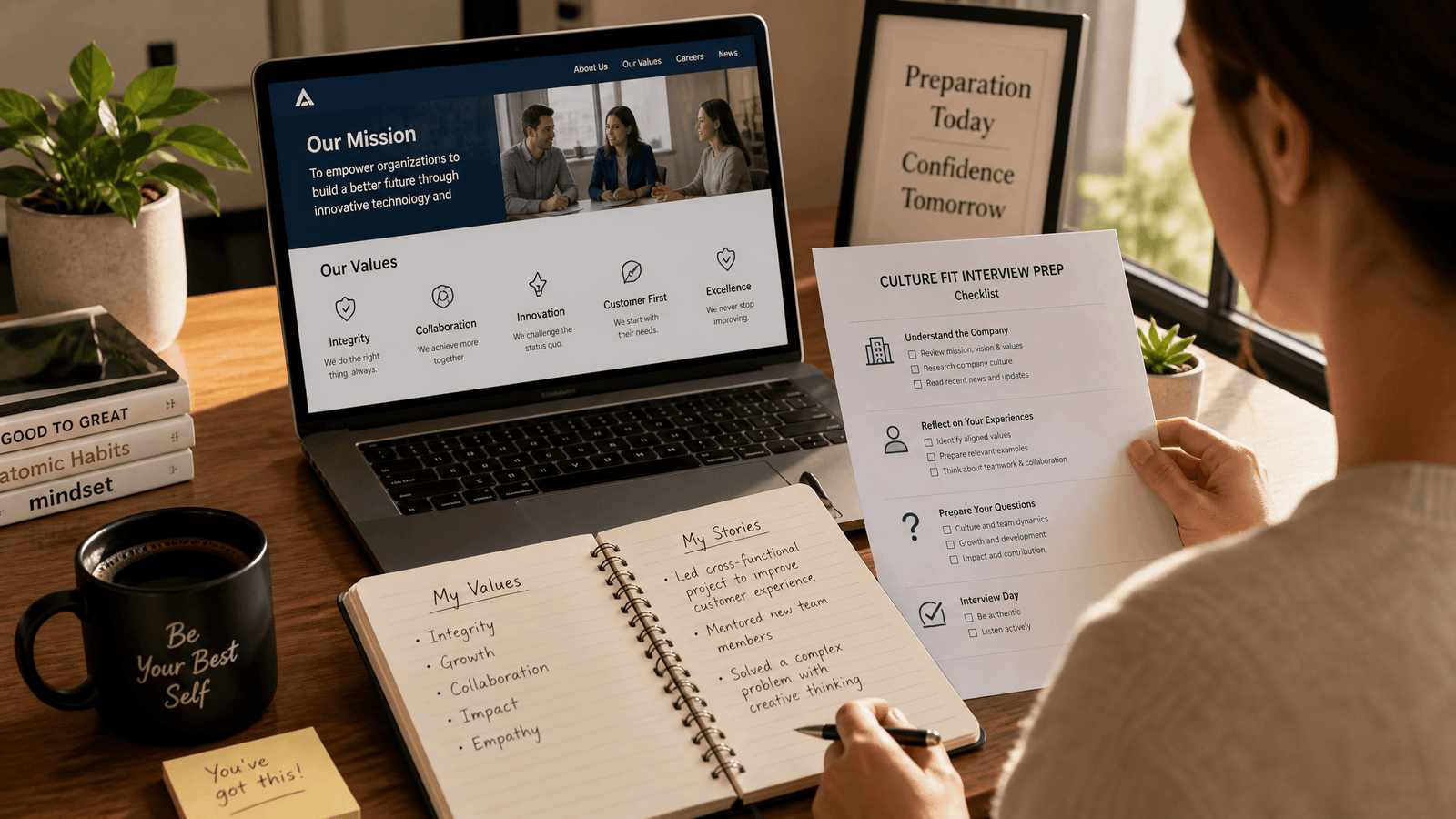
- Research the company’s documented values before you walk in. Do not just read the careers page. Look for specific language, recent blog posts, employee testimonials, and even Glassdoor reviews. If a company claims to value “transparency,” find examples of what transparency looks like in action at that company.
- Prepare 15+ behavioral stories using the STAR method. Each story should map to a specific value or competency. Practice saying them out loud. Do not memorize a script—memorize the structure so you can adapt in real time.
- Ask your own culture questions. The best way to show you understand culture is to interrogate it. Ask: “How does this team handle conflict?” “What does a successful first 90 days look like here?” “Can you tell me about a time someone challenged a decision and what happened?” This turns the interview into a genuine two-way conversation.
- Be authentic, not performative. In 2026, AI-generated answers are everywhere. Recruiters are increasingly trained to spot rehearsed, generic responses. Ground your answers in real, specific experiences. A story about a real failure you learned from is more powerful than a polished answer about teamwork.
- Know your rights. If you are rejected with vague language about “fit” or “culture,” and you suspect bias may have played a role, document everything. You have legal protections under employment discrimination law, and companies are increasingly being held accountable for subjective rejection criteria.
- Apply to companies that walk the talk. Not every company has moved to structured, values-based interviews. If your interview feels like a casual hangout with no clear criteria, that is a red flag. The best employers in 2026 are transparent about what they evaluate and how they score it.
The culture interview is not dead. It is evolving. And at Your Career Place, we are here to help you navigate every twist and turn of this new landscape. Whether you are preparing for your first culture interview or your fiftieth, the key is to approach it with preparation, authenticity, and a healthy dose of skepticism about companies that still think “fit” means “someone I would want to have a beer with.”
The future of hiring is not about finding clones. It is about building teams that are stronger because of their differences. The question is whether the companies interviewing you are ready for that future—or just pretending to be.