
The AI Arms Race in Job Interviews
How Candidates and Employers Are Locked in an AI-Powered Battle in 2026
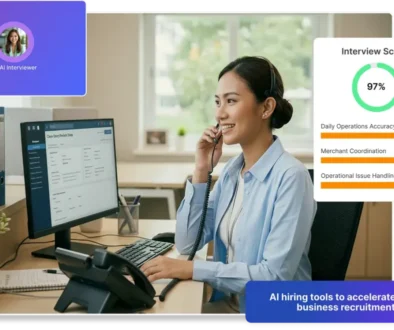
Let me paint you a picture. You are sitting in your home office, camera on, heart pounding, ready for what could be the most important job interview of your career. What you do not know is that the recruiter on the other end is not just reading your resume. They are running your responses through an AI sentiment analyzer, checking your eye contact patterns, and cross-referencing your every word against a database of ten thousand past candidates. Meanwhile, you are quietly glancing at a second screen where your own AI assistant is whispering real-time talking points into your ear. Welcome to the 2026 job interview. It is not just a conversation anymore. It is an arms race.
Here at Your Career Place, we have been tracking the hiring landscape for years, and 2026 has brought something we have never seen before. Both sides of the interview table are now armed with artificial intelligence. Candidates are using AI to polish resumes, generate STAR-format responses, and even transcribe questions in real time. Employers are firing back with AI proctoring, advanced sentiment analysis, and structured rubrics designed to strip away the polish and find the real person underneath. The question is not whether you should use AI in your next interview. The question is whether you can afford not to, and whether it will even help you win.
What Is Actually Happening Right Now
The numbers do not lie, and they are staggering. According to industry reports from mid-2026, over 75 percent of large employers now use AI-powered Applicant Tracking Systems for initial resume screening. That means before a human even lays eyes on your application, a machine has already decided if you are worth the time. But that is just the beginning. Nearly 70 percent of hiring teams now use structured interviews with predefined scoring rubrics, and AI is increasingly involved in evaluating those scores. Virtual and immersive technology is projected to be used in approximately 50 percent of interviews by the end of this year, allowing companies to simulate real-world job scenarios in controlled environments.
On the other side of the table, candidates are not sitting idle. Approximately 22 percent of job seekers now use AI-powered interview assistants during live interviews. These tools generate real-time talking points, transcribe questions, suggest polished responses, and even help candidates maintain the right tone and pacing. It is the digital equivalent of having a coach whispering in your ear during a boxing match. The problem? The other boxer has a coach too, and the referee is increasingly suspicious.
The market context makes this arms race even more intense. July 2026 is what economists are calling a “frozen” hiring market. Only 57,000 nonfarm payroll jobs were added in June, and 720,000 people dropped out of the labor force entirely. Employers are hoarding headcount rather than expanding, and employees are staying put because the grass does not look greener anywhere else. In this environment, every open position is a precious commodity, and every interview is a high-stakes battle where both sides are bringing every weapon they have.
Your Career Place has been advising job seekers through turbulent markets before, but this is different. The tools have changed, the rules have changed, and the very definition of what it means to be “prepared” for an interview has been rewritten. Let us break down the two perspectives on this transformation.
The Boomer’s Perspective: “This Is the Best Thing to Ever Happen to Prepared Candidates”
If you ask the optimist, the AI arms race is actually a massive leveling of the playing field. For decades, the job interview was a game of charisma, networking, and who could tell the most compelling story. Introverts got steamrolled. Candidates without polished communication skills were dismissed. People who simply did not know the unwritten rules of corporate interviewing were filtered out before they ever got a fair shot. AI is changing that, and the Boomer perspective says that is a good thing.
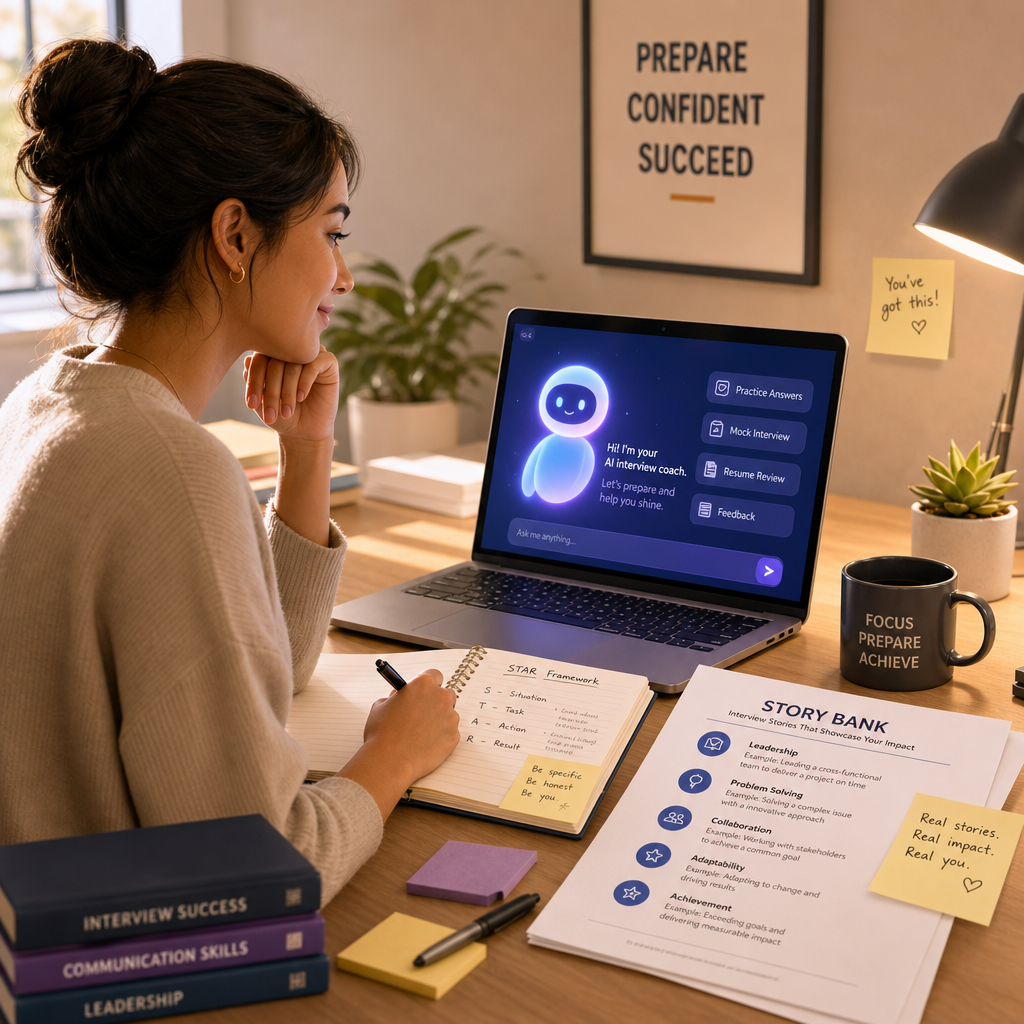
First, AI tools democratize interview preparation. A candidate in a small town with no access to expensive career coaching can now use AI to generate a story bank of five to eight polished anecdotes, practice structured responses using the STAR or SOAR frameworks, and get real-time feedback on their pacing, tone, and word choice. The playing field is leveling. Your background, your zip code, and whether you can afford a $500 interview coach matter less when you have an AI assistant in your pocket.
Second, employer-side AI is actually making hiring fairer. Structured interviews with predefined rubrics mean every candidate is asked the same questions in the same order and scored against the same criteria. The era of the “gut-feel” hire, where an interviewer decides they like you because you went to the same college or root for the same sports team, is fading. AI-driven scoring reduces unconscious bias. It forces hiring decisions to be evidence-based rather than personality-based. For candidates who have the skills but not the polish, this is a dream come true.
Third, the shift toward skills-based hiring, powered by AI assessment, is opening doors for non-traditional candidates. Seventy-three percent of employers have now adopted skills-based hiring, prioritizing cognitive ability and job-relevant competencies over degrees. AI can evaluate a candidate’s actual problem-solving ability, coding skills, or project management capabilities in ways that a resume never could. If you are a self-taught developer, a career changer, or someone who learned their craft on the job rather than in a classroom, the AI revolution is your moment to shine.
Finally, Boomers see compressed interview timelines as a win for candidates. The traditional five-round, multi-week interview process is being replaced by streamlined 7-to-10-day cycles. That means less time sweating, less time waiting, and less chance that a competing offer will slip through your fingers while you are still in round three. In a market where top talent is scarce, speed is a candidate’s friend. The AI-powered efficiency on both sides is making the entire process faster, fairer, and more focused on what actually matters: can you do the job?
Your Career Place has always believed that preparation is the great equalizer, and the Boomer perspective says AI is just the most powerful preparation tool ever invented. Use it wisely, and the interview arms race becomes a race you can actually win.

The Doomer’s Perspective: “We Have Turned Human Connection Into an Algorithmic Chess Match”
Now flip the coin. The pessimist looks at the same landscape and sees something deeply troubling. We have turned the most human moment in the hiring process, the conversation between two people trying to figure out if they can work together, into an algorithmic chess match where both sides are bluffing with machines.
Let us start with the candidate side. Twenty-two percent of candidates are using AI assistants during live interviews. That means nearly one in four people you are interviewing is not entirely themselves. They are a hybrid, a human-AI collaboration, where the real person may be barely articulate, anxious, or unprepared, but the AI is doing the heavy lifting. The ethical gray area here is enormous. Are you hiring the candidate, or are you hiring the AI that coached them? When a candidate nails every behavioral question with a perfectly structured STAR response, is that because they are a great communicator, or because their AI assistant fed them the exact formula? When you strip away the AI, what is left?
On the employer side, the response has been an escalating surveillance apparatus. Companies are implementing advanced AI proctoring, facial expression analysis, speech pattern recognition, and keyword matching algorithms designed to catch candidates who are being artificially enhanced. The interview is no longer a conversation. It is an interrogation in which the candidate is monitored, analyzed, and scored by machines that may not even understand context, nuance, or cultural differences. A candidate who pauses to think might be flagged as “hesitant.” A candidate who speaks with an accent might be scored lower on “clarity.” A candidate who is neurodivergent and does not make typical eye contact might be penalized by a system that was trained on neurotypical behavior patterns.
The arms race also creates a vicious cycle. Candidates use AI to game the system. Employers build better AI to catch the gaming. Candidates upgrade their AI tools. Employers upgrade their detection. Nobody is actually getting better at hiring or interviewing. We are just spending more money on software and creating more distance between the human beings who are supposed to be connecting. The 2026 market data makes this even worse. In a frozen hiring market with fewer jobs and more candidates, the pressure to use every possible advantage is overwhelming. The result is a hiring process that feels less like a conversation and more like a cybersecurity battle.
And perhaps the most dystopian element is the rise of the “AI twin” on the recruiter side. Recruiters are now using AI assistants to handle scheduling, CRM updates, and even initial candidate screening. In some cases, the first “person” a candidate interacts with is not a person at all. We are rapidly approaching a world where an AI interviews an AI, with a human somewhere in the loop who may or may not actually understand what either machine decided. Your Career Place has coached thousands of candidates, and the Doomer’s worry is this: when both sides are optimized by algorithms, the entire process becomes a simulation. We are not hiring people anymore. We are optimizing match scores between two sets of prompts.
Key Takeaways: How to Survive the AI Arms Race
Whether you are a Boomer or a Doomer about the direction of hiring in 2026, one thing is undeniable: the arms race is here, and you cannot opt out. Here is how to navigate it.
First, know your tools, but do not let them own you. AI interview assistants can be incredibly helpful for preparation. Use them to build your story bank, practice STAR responses, and research the company deeply. But during the actual interview, be careful. If you are using real-time assistance, understand the risks. Some employers are now explicitly asking candidates to confirm they are not using AI tools during live interviews. The ethical line is blurry, and the consequences of getting caught can be severe. Preparation is fair game. Real-time augmentation is a gray area that is getting darker.
Second, optimize for the human moment. Even in a world of AI screening and structured rubrics, there is still a human making the final decision. Build rapport. Ask thoughtful questions about the team’s challenges and how success is measured. Show curiosity and genuine interest. The data shows that human skills, emotional intelligence, adaptability, and resilience are more valued than ever. Be the candidate who is memorable not because their AI was perfect, but because they were genuinely engaged.
Third, master the fundamentals that AI cannot fake. Live coding sessions, real-time problem-solving demonstrations, and portfolio reviews are replacing take-home assignments because they are harder to game. Be ready to show your work in real time. Practice thinking out loud. The candidate who can explain their reasoning, adapt to unexpected questions, and demonstrate actual competence under pressure will always beat the candidate who is just reading from an AI-generated script.
Fourth, treat the interview as a two-way evaluation. In a frozen market, the power dynamic is not as one-sided as it looks. Top talent is still scarce in hot sectors like healthcare, infrastructure, and skilled trades. Ask about performance metrics, team culture, and what the company is doing to adapt to the same AI revolution that is reshaping your industry. The best candidates are evaluating the employer as much as the employer is evaluating them. Your Career Place always reminds our community: an interview is a conversation, not an audition. Even in 2026, that truth still matters.
Finally, stay adaptable. The tools will change again. The arms race will escalate. What is cutting-edge today will be standard tomorrow and obsolete next year. The candidates who thrive are not the ones who master a single AI tool. They are the ones who build genuine skills, stay curious, and treat every interview as a chance to learn something new about themselves and the market. In a world of algorithms, being authentically human is still your greatest competitive advantage.
The AI arms race in job interviews is not going away. It is only heating up. At Your Career Place, we are here to help you navigate it, prepare for it, and ultimately, win it. Whether you see the glass as half full or half empty, the only thing that matters is that you are ready when the camera turns on.