

The Cybersecurity Job Market Boom
Is This the Most Recession-Proof Career of 2026?
By Your Career Place | July 27, 2026
Introduction: The Digital Battlefield Is Hiring
Imagine a job market where unemployment is essentially zero, salaries routinely top six figures, and employers are so desperate for talent that they’re rewriting the rulebook on who gets hired. That’s not a fantasy — that’s cybersecurity in 2026.
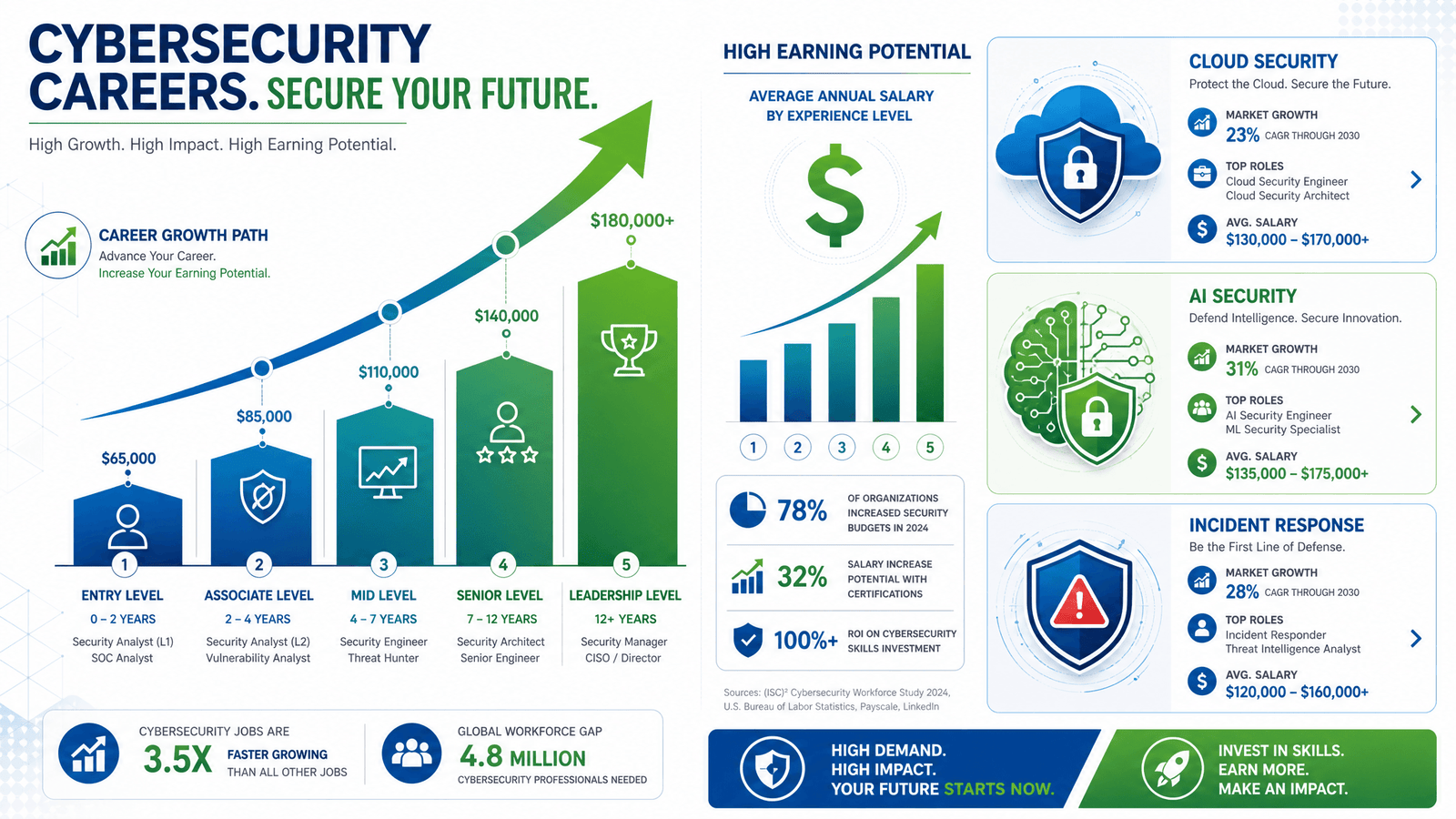
While headlines scream about layoffs in tech, hiring freezes across industries, and AI eating jobs for breakfast, the cybersecurity sector is quietly — and loudly — doing something remarkable: it can’t find enough people to fill its roles. With an estimated 4.8 million unfilled cybersecurity positions globally and over 500,000 open roles in the United States alone, this is one of the most extraordinary talent gaps in modern employment history.
But is the cybersecurity boom everything it’s cracked up to be? Is this the golden ticket for career changers and new graduates, or is the reality more complicated than the headlines suggest? At Your Career Place, we dug into the data, the trends, and the competing perspectives to give you the full picture.
What’s Driving the Cybersecurity Hiring Surge?
The numbers are staggering. The U.S. Bureau of Labor Statistics projects 29–33% employment growth for information security analysts through 2033–2034 — a rate that dwarfs the average for virtually every other profession. The global cybersecurity workforce has grown to approximately 5.5–6.7 million professionals, yet the gap between supply and demand keeps widening, growing 19% year-over-year.
Several forces are converging to create this perfect storm of demand:
1. The AI Threat Multiplier
Artificial intelligence isn’t just changing how we work — it’s supercharging the threats that organizations face. Cybercriminals are using AI to launch more sophisticated phishing attacks, automate ransomware deployment, and probe for vulnerabilities at machine speed. The result? Organizations need more skilled defenders, not fewer. A staggering 86% of organizations reported at least one security breach in the past 12 months, with 29% suffering five or more incidents.
2. Regulatory Pressure Is Mounting
New compliance frameworks — including NIS2, DORA, and emerging AI governance regulations — are forcing companies to hire dedicated Governance, Risk, and Compliance (GRC) specialists. It’s no longer optional to have cybersecurity expertise on staff; it’s a legal and financial necessity. The average cost of a data breach now exceeds $1 million per incident for more than half of affected organizations.
3. Cloud Complexity Is Exploding
As businesses migrate to multi-cloud and edge computing environments, the attack surface grows exponentially. Cloud security engineers and architects are among the hardest roles to fill and command some of the highest salary premiums in the entire tech sector.
4. AI Is Creating New Job Categories
Here’s the twist: while AI is automating some routine security tasks, it’s simultaneously creating entirely new roles. AI Security Engineers, AI Governance Analysts, and Machine Learning Security Specialists are among the fastest-growing job titles in 2026. Over 64% of cybersecurity job listings now explicitly require AI, ML, or automation skills.
The Money Is Real: What Cybersecurity Professionals Earn
Let’s talk compensation, because the salary data in cybersecurity is genuinely eye-opening:
- Entry to mid-level roles: $85,000–$125,000 median
- Cybersecurity Engineers and Network Security Engineers: $105,000–$180,000
- Senior Security Architects and Threat Hunters: $175,000–$300,000+
- Chief Information Security Officers (CISOs): $256,000–$450,000+
- Certification premium: Holding credentials like CISSP, CISM, or CCSP adds a 12–35% salary boost
These aren’t Silicon Valley outliers — these are industry-wide figures reflecting a market where employers are competing fiercely for a limited talent pool. For career changers exploring their options, the team at Your Career Place consistently highlights cybersecurity as one of the highest-ROI fields to transition into, particularly for those with backgrounds in IT, networking, or software development.
The Boomer’s Perspective: This Is a Generational Career Opportunity
“The cybersecurity field is one of the most exciting and stable career paths I’ve seen in 40 years of watching the job market. If you’re willing to put in the work, the rewards are extraordinary.”
The optimistic case for cybersecurity careers in 2026 is compelling, and it’s hard to argue with the fundamentals.
Near-zero unemployment is not a talking point — it’s a reality. In a job market where many sectors are experiencing volatility, cybersecurity professionals enjoy something approaching full employment. The talent shortage is so severe that organizations are actively rethinking their hiring criteria, dropping rigid degree requirements, and embracing skills-based hiring. This is genuinely good news for career changers and self-taught professionals.
The field rewards continuous learning. Unlike industries where skills become obsolete, cybersecurity professionals who stay current are perpetually in demand. The emergence of AI-driven threats isn’t a threat to cybersecurity careers — it’s a career accelerant. Every new technology wave creates new vulnerabilities, and new vulnerabilities create new jobs.
The mission matters. There’s something deeply meaningful about protecting hospitals from ransomware attacks, safeguarding financial systems from fraud, and defending critical infrastructure from nation-state actors. Cybersecurity professionals aren’t just earning good salaries — they’re doing work that genuinely matters to society.
The barriers to entry are falling. The shift toward competency-based hiring means that a motivated individual with the right certifications, hands-on lab experience, and demonstrated skills can break into the field without a four-year computer science degree. Bootcamps, online platforms, and certification programs have democratized access to cybersecurity education in ways that simply didn’t exist a decade ago.
From the Boomer’s perspective, the cybersecurity boom represents exactly the kind of opportunity that previous generations found in fields like accounting, law, or medicine — a profession with genuine scarcity, strong compensation, and long-term stability. The advice from seasoned career coaches at Your Career Place: if you have any aptitude for technology and problem-solving, cybersecurity deserves serious consideration.
The Doomer’s Perspective: The Boom Has a Dark Side
“Everyone talks about the 4.8 million job openings. Nobody talks about why those jobs aren’t getting filled — or what it’s actually like to work in cybersecurity day-to-day.”
The pessimistic case for cybersecurity careers is less frequently discussed, but it’s important to understand before making a major career pivot.
The entry-level pipeline is broken. Despite millions of open positions, many organizations report making zero entry-level hires. The dirty secret of the cybersecurity talent shortage is that employers want experienced professionals — and they’re not willing to invest in developing junior talent. Entry-level roles increasingly require 1–3 years of adjacent experience, creating a classic catch-22 for newcomers. The gap between “there are 4.8 million open jobs” and “I can actually get hired” is wider than the headlines suggest.
Burnout is an epidemic. Only 34% of cybersecurity professionals plan to remain in their current roles. The work is relentless — security operations centers run 24/7, incident response can mean days without sleep, and the psychological weight of being the last line of defense against sophisticated attackers takes a real toll. High salaries don’t fully compensate for the stress of knowing that one missed alert could cost your organization millions.
AI is a double-edged sword. While AI creates new cybersecurity roles, it’s also automating the entry-level tasks that used to serve as the training ground for junior professionals. Alert triage, basic vulnerability scanning, and first-pass threat analysis are increasingly handled by AI systems. This means the “learn on the job” pathway that built previous generations of security professionals is narrowing.
Budget constraints are the real bottleneck. Here’s a counterintuitive finding from 2026 research: budget constraints have now surpassed “lack of qualified talent” as the primary reason cybersecurity roles go unfilled. Organizations know they need more security staff, but they’re not allocating the budget to hire them. This suggests the talent shortage may be partly manufactured — a convenient narrative that keeps salaries from rising even faster.
The skills treadmill never stops. The same continuous learning that makes cybersecurity exciting also makes it exhausting. Professionals must constantly update their skills, pursue new certifications, and adapt to an ever-shifting threat landscape. For some, this is energizing. For others, it’s a recipe for burnout and career fatigue.

Key Takeaways: What This Means for Your Career
Whether you’re a Boomer or a Doomer on the cybersecurity job market, the data points to some clear, actionable conclusions:
- The opportunity is real, but so are the barriers. Cybersecurity offers some of the best compensation and job security of any field in 2026. But breaking in requires genuine skill development, not just enthusiasm. Focus on hands-on experience through labs, capture-the-flag competitions, and practical certifications.
- AI literacy is non-negotiable. With 64% of job listings requiring AI or automation skills, professionals who understand how to work alongside AI-driven security tools will have a significant advantage. This isn’t optional — it’s the new baseline.
- Specialize strategically. The highest-demand and highest-paying roles in 2026 are in cloud security, AI security, incident response, and DevSecOps. Generalist security knowledge is valuable, but specialization is where the real salary premiums live.
- Don’t ignore the human side. Burnout is real in cybersecurity. Before making a career move, research the culture of specific organizations, ask about on-call expectations, and look for employers who invest in mental health and work-life balance.
- The path in may be unconventional. Given the shift to skills-based hiring, career changers from IT, networking, software development, and even non-technical fields like law and compliance have viable pathways into cybersecurity. The key is demonstrating competency, not just credentials.
The cybersecurity job market boom of 2026 is one of the most significant career opportunities of our time — but like all opportunities, it rewards those who approach it with clear eyes, realistic expectations, and a genuine commitment to developing the skills that employers actually need.
At Your Career Place, we’re here to help you navigate these decisions with the information and perspective you need to make the right move for your career. Whether you’re considering a pivot into cybersecurity, looking to level up within the field, or simply trying to understand where the job market is heading, we’ve got you covered.
What’s your take on the cybersecurity job market? Are you considering a career in security, or are you already working in the field? Share your thoughts in the comments below — we’d love to hear from the Your Career Place community.
About Your Career Place: Your Career Place is your go-to resource for job market insights, career advice, and professional development strategies. We cut through the noise to give you the real story on where the job market is heading and how to position yourself for success.