

The Gig Economy in 2026
Freedom, Fortune, or a Freelancer’s Trap?

Picture this: You wake up at 9 AM, brew your coffee, open your laptop, and start your workday — no commute, no dress code, no boss hovering over your shoulder. For millions of Americans, that’s not a fantasy. It’s Tuesday. The gig economy has exploded into one of the most significant labor market shifts of our generation, and in 2026, it’s showing no signs of slowing down.
Over 70 million Americans — roughly 36% of the entire U.S. workforce — now participate in some form of freelance or contract work. Globally, an estimated 1.57 billion people identify as freelancers, representing nearly half the world’s working population. The global gig economy is projected to hit $674 billion in market value in 2026, with long-range forecasts pointing toward $2.1 trillion by 2034.
But here’s the thing: not everyone is celebrating. For every freelancer raking in six figures from their home office, there’s another struggling to cover a $1,000 emergency expense. The gig economy is a story of two very different realities — and at Your Career Place, we think it’s time to look at both sides honestly.
Whether you’re considering making the leap to freelancing, already deep in the gig trenches, or just trying to understand where the job market is headed, this week’s deep dive is for you.
What’s Happening Right Now: The State of the Gig Economy in 2026
The numbers are staggering. U.S. freelancers collectively contributed an estimated $1.5 trillion to the economy in 2024–2025 — a figure comparable to the GDP of entire nations and roughly 5% of total U.S. GDP. That’s not a side hustle. That’s an industry.
The average annual income for a U.S. freelancer has climbed to approximately $108,028, and a record 5.6 million independent workers earned over $100,000 in 2025 alone. High-demand roles in AI prompt engineering, machine learning, and media buying are commanding anywhere from $50 to over $250 per hour.
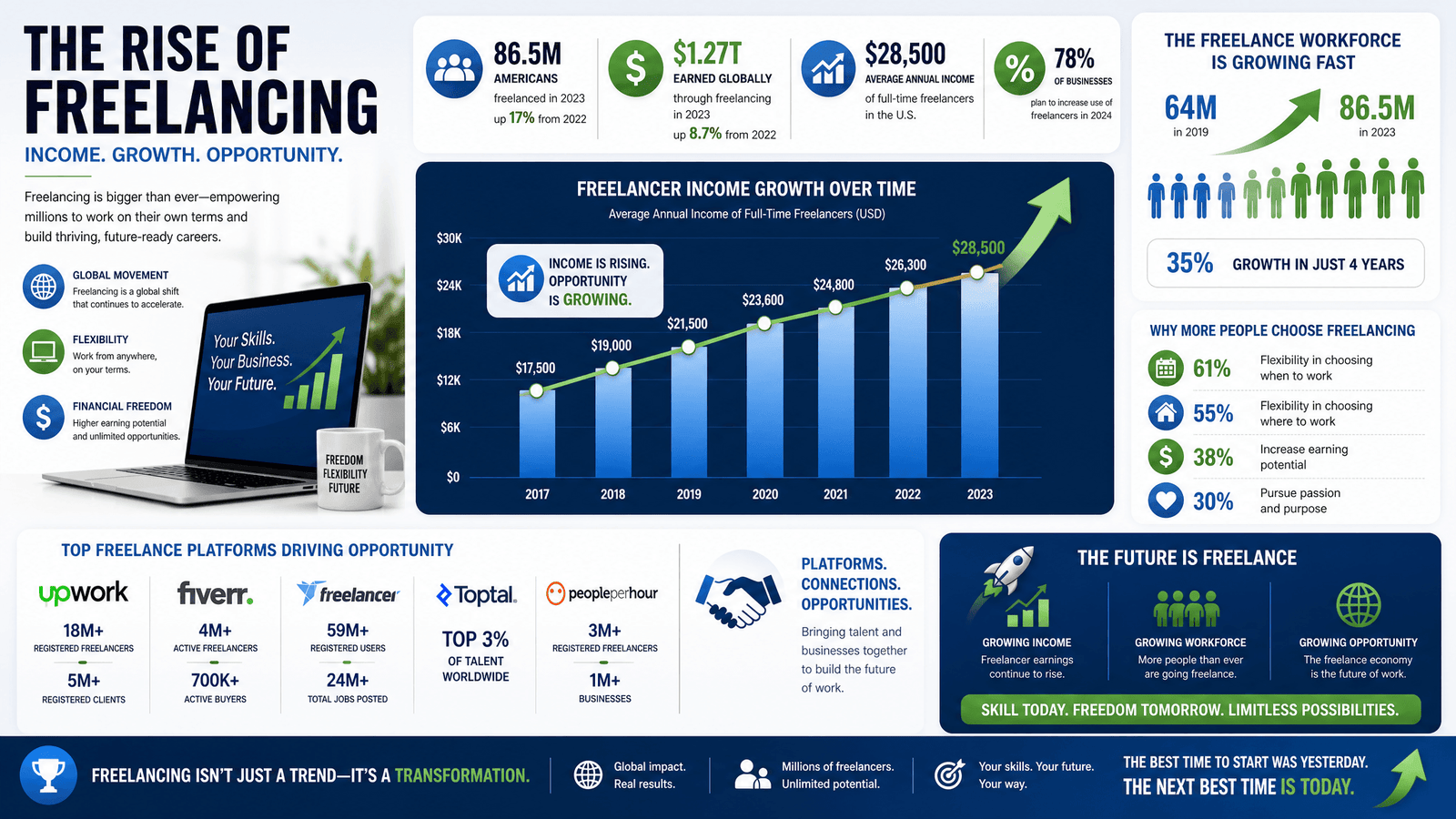
Corporate America is paying attention. As of 2026, 68% of companies globally hire freelancers on a regular basis — up from just 48% in 2020. Following the wave of tech layoffs in 2023–2024, 69% of employers turned to independent contractors to fill staffing gaps. Nearly half of all CEOs say they plan to increase their reliance on freelance talent going forward.
The platforms powering this shift are evolving rapidly. Upwork continues to dominate enterprise-level contracts, now integrating AI tools like “Uma AI” to help freelancers write proposals and gain project insights. Fiverr remains the go-to for packaged digital services. Meanwhile, zero-commission platforms like Jobbers.io, Braintrust, and Contra are gaining serious traction by letting freelancers keep 100% of their earnings — potentially saving $5,000 to $10,000 annually compared to traditional commission-based sites.
AI is reshaping the freelance landscape in real time. Demand for AI-related skills on major platforms surged 109% year-over-year by 2025. Freelancers who use AI tools earn approximately 40% more per hour and save an average of eight hours per week. The message is clear: adapt or get left behind.
Generationally, this is a Millennial and Gen Z phenomenon. Millennials make up 48% of the gig workforce, while Gen Z accounts for 30% — and for Gen Z, freelancing isn’t a fallback. It’s a first choice. A full 53% of Gen Z workers have engaged in freelance work, many treating it as their primary career path rather than a side hustle.
The Boomer’s Perspective: The Gig Economy Is the Greatest Career Opportunity of Our Time
Let’s be real: the traditional 9-to-5 model was never perfect. You traded your time, your autonomy, and often your health for a steady paycheck and the illusion of job security. The gig economy blows that model wide open — and for those willing to embrace it, the rewards are extraordinary.
Think about what’s actually happening here. 5.6 million Americans earned six figures as independent workers in 2025. The average freelancer is pulling in over $108,000 a year. High-skill professionals in AI, software development, and digital marketing are commanding rates that would make many corporate salaries blush. This isn’t the gig economy of Uber drivers and TaskRabbit handymen — this is a sophisticated, high-earning professional class that has chosen freedom over the cubicle.
The flexibility argument alone is compelling. Approximately 63% to 77% of gig workers report high satisfaction with their work arrangements. They cite the ability to choose their projects, set their own hours, and work from anywhere as primary motivators. In a world where burnout is epidemic and work-life balance is increasingly elusive in traditional employment, that’s not nothing. That’s everything.
And the corporate world is validating this shift with its wallet. When 68% of global companies are regularly hiring freelancers and nearly half of all CEOs plan to expand their use of independent talent, that’s not a trend — that’s a structural transformation of how work gets done. The smart career move isn’t to resist this shift. It’s to position yourself to benefit from it.
At Your Career Place, we’ve seen firsthand how professionals who develop in-demand skills — particularly in AI, data analysis, cybersecurity, and digital marketing — are thriving in the freelance marketplace. The tools have never been better. Zero-commission platforms mean you keep more of what you earn. AI tools mean you can do more in less time. The global talent marketplace means your potential client base is literally the entire world.
The regulatory environment is also maturing. The EU’s Platform Work Directive, set for full implementation by December 2026, is establishing clearer rights and protections for gig workers across Europe. Portable benefits advocacy is gaining momentum in the U.S. The infrastructure to support a sustainable freelance career is being built in real time.
Is it easy? No. Does it require discipline, self-marketing, and continuous skill development? Absolutely. But the gig economy rewards those who treat their freelance career like a business — and the upside for those who do is genuinely exciting. The question isn’t whether the gig economy is a good opportunity. The question is whether you’re ready to seize it.
The Doomer’s Perspective: The Gig Economy Is a Gilded Cage for Most Workers
Before you hand in your resignation letter and fire up your Upwork profile, let’s pump the brakes and look at what the glossy statistics are hiding. Because behind the headline numbers of $108,000 average incomes and 5.6 million six-figure earners, there’s a much darker story that affects the majority of gig workers.
Start with this: 80% of full-time gig workers say they would struggle to cover a $1,000 emergency expense. Let that sink in. These are people working full-time — not part-time, not as a side hustle — and four out of five of them are one car repair or medical bill away from financial crisis. The “average income” figures are heavily skewed by a small number of high earners. For most gig workers, the reality is far more precarious.

The benefits gap is staggering. Only 40% of gig workers have access to employer-sponsored health insurance. That means 60% are navigating the individual insurance market — paying premium prices for coverage that’s often inferior to what traditional employees receive. And because gig workers are classified as independent contractors, they bear the full burden of self-employment taxes, covering both the employee and employer portions of Social Security and Medicare. That’s an immediate 15.3% hit to your income before you even start thinking about health insurance, retirement savings, or business expenses.
Then there’s the algorithmic management problem. Many gig workers don’t answer to a human boss — they answer to an algorithm. Opaque systems dictate job assignments, ratings, and pay with little transparency and even less recourse. A single bad review, a platform policy change, or an algorithm update can devastate your income overnight. Platform dependency is a real and serious risk: when your livelihood is controlled by a corporation’s terms of service, you’re not as free as you think.
AI is also a double-edged sword. Yes, AI-skilled freelancers are earning premiums. But AI is simultaneously destroying demand for the entry-level gig work that many people rely on. Basic writing, translation, data entry, simple graphic design — these are the accessible on-ramps to the freelance economy, and they’re being automated away. The gig economy is bifurcating into a small class of high-earning specialists and a large pool of workers competing for scraps in a race to the bottom.
The mental health toll is real and underreported. Without the structure of a traditional workplace, many freelancers experience isolation, chronic stress, and burnout from the constant pressure to hustle for the next client. The “feast or famine” cycle — periods of overwhelming work followed by income droughts — creates a kind of financial anxiety that never fully goes away.
And let’s be honest about who the gig economy really serves. When 69% of employers turned to contractors after tech layoffs, they weren’t doing workers a favor — they were finding a way to get the same work done without paying benefits, providing job security, or taking on legal obligations. The gig economy, at its core, is a mechanism for corporations to externalize risk onto individual workers. The flexibility you gain comes at the cost of the protections that generations of workers fought to establish.
At Your Career Place, we believe in giving you the full picture. The gig economy can be a powerful tool — but for many workers, it’s a trap dressed up as freedom.
Key Takeaways: What This Means for Your Career
- The gig economy is massive and growing. With 70+ million Americans freelancing and the global market approaching $674 billion, this is not a fringe phenomenon. Understanding it is essential for every career professional.
- AI skills are the great differentiator. Freelancers with AI proficiency earn 40% more per hour and are far more competitive. If you’re considering freelancing — or want to stay relevant in any job market — investing in AI skills is non-negotiable.
- The financial risks are real and often underestimated. Before going full-time freelance, build an emergency fund (aim for 6 months of expenses), research health insurance options, and understand your self-employment tax obligations. Go in with eyes open.
- Platform choice matters. Zero-commission platforms like Contra and Braintrust can significantly increase your take-home pay. Don’t default to the biggest names without comparing your options.
- Treat freelancing like a business, not a job. The most successful freelancers build personal brands, diversify their client base, continuously upskill, and manage their finances with the discipline of a small business owner.
- Hybrid careers may be the future. Industry experts increasingly predict that the norm by 2030 will be “hybrid careers” — combining traditional employment with freelance income streams. You don’t have to choose one or the other.
- Advocacy matters. Support for portable benefits, fair worker classification, and gig worker protections isn’t just a political issue — it’s a career issue. The regulatory environment is evolving, and staying informed helps you navigate it.
The gig economy is neither the utopia its boosters promise nor the dystopia its critics fear. It’s a complex, rapidly evolving labor market that offers genuine opportunity alongside genuine risk. The workers who thrive in it are those who go in informed, prepared, and strategic.
At Your Career Place, our mission is to give you exactly that — the honest, practical career guidance you need to make smart decisions in a changing world. Whether you’re a seasoned freelancer, a curious employee, or somewhere in between, we’re here to help you navigate what comes next.
What’s your experience with the gig economy? Are you thriving, surviving, or somewhere in between? Drop your thoughts in the comments — we read every one.