

Diversity and Inclusion in Hiring
Is Corporate America Moving Forward or Falling Back?
Published by Your Career Place | June 29, 2026
Introduction: The DEI Crossroads
If you’ve been following the news lately, you’ve probably noticed that diversity, equity, and inclusion — better known as DEI — is everywhere. It’s in boardroom debates, political speeches, Supreme Court rulings, and your LinkedIn feed. And if you’re a job seeker, a hiring manager, or simply someone trying to navigate today’s workplace, you’re probably wondering: what does all of this actually mean for you?
The truth is, the landscape of diversity and inclusion in hiring has never been more complicated — or more consequential. On one hand, the data is crystal clear: diverse teams outperform, out-innovate, and out-earn their less diverse counterparts. On the other hand, a wave of legal challenges, executive orders, and political pressure is forcing companies to rethink how they pursue those goals.
At Your Career Place, we believe that understanding the full picture — the optimistic and the pessimistic — is the only way to make smart career decisions. So let’s dig in.
What’s Happening Right Now: The State of DEI in 2026
The year 2026 has been a turning point for diversity and inclusion in the American workplace. Here’s a snapshot of where things stand:
The Legal Earthquake
In 2025, the U.S. Supreme Court issued two landmark rulings that sent shockwaves through corporate HR departments. First, in Ames v. Ohio Department of Youth Services, the Court unanimously eliminated the “background circumstances” requirement for so-called “reverse discrimination” claims — making it significantly easier for majority-group employees to sue under Title VII of the Civil Rights Act. In a separate 6-3 ruling, the Court drew a sharp line: DEI policies that use quotas or explicit identity-based hiring targets are unconstitutional. Broad inclusion initiatives — mentorship programs, outreach, training — remain legal, as long as they’re accessible to everyone.
Then, in March 2026, President Trump signed Executive Order 14398, which prohibits federal contractors from engaging in what it calls “racially discriminatory DEI activities.” The order requires contractors to certify compliance, ties violations to the False Claims Act (meaning serious financial penalties), and directs the Department of Justice to prioritize DEI-related investigations. By July 2026, agencies are expected to have modified existing contracts to include these requirements.
The Corporate Response
So how are companies responding? Perhaps surprisingly, the answer for most is: quietly, but not by retreating. According to recent data, only 5% of companies with DEI programs have eliminated them entirely. Meanwhile, 65% report their DEI budgets will remain unchanged, and 22% plan to increase funding. What has changed is the approach — companies are moving away from splashy public commitments and toward internal governance, data-driven accountability, and what some are calling “quiet commitment.”
The shift makes sense when you consider the legal calculus. Remarkably, 68% of C-suite leaders believe that moving away from DEI would actually increase their organization’s legal risk — not decrease it. Discrimination lawsuits don’t disappear just because DEI programs do.
The Numbers That Matter
The business case for diversity remains as strong as ever. Companies in the top quartile for ethnic diversity are 36–39% more likely to outperform their peers in profitability. Gender-diverse executive teams are 25% more likely to achieve above-average profitability. Diverse leadership teams generate 45% of their revenue from innovation, compared to just 26% for less diverse organizations. And cognitively diverse teams solve problems 87% faster than homogeneous groups.
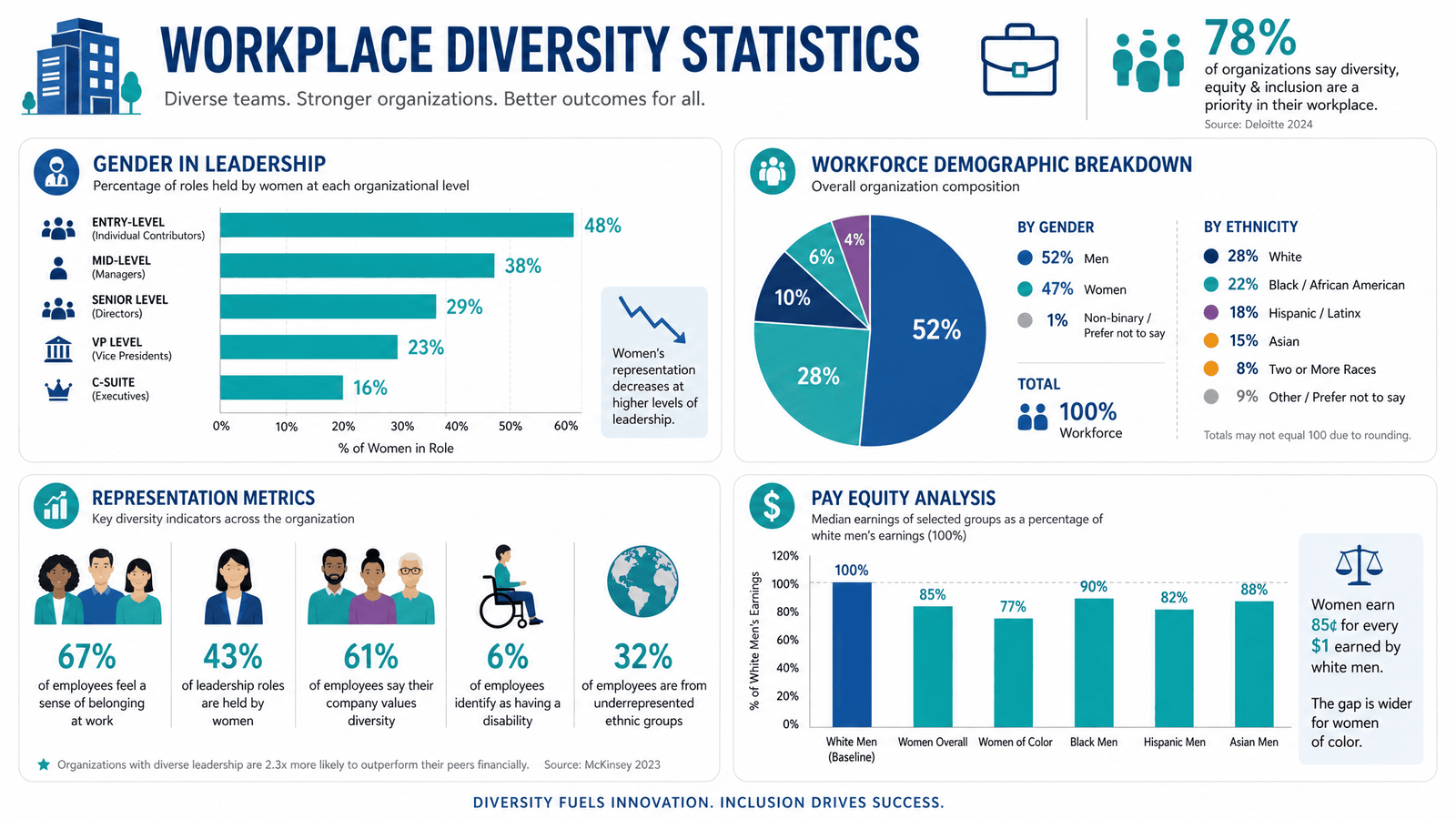
Yet representation gaps persist. Women hold 63% of entry-level roles but only 29% of C-suite positions. For every 100 men promoted to manager, only 87 women and 73 women of color receive the same promotion. Black and Hispanic workers each hold less than 10% of total tech roles. The gender pay gap means women earn approximately 83.6 cents for every dollar men earn — and for Hispanic and Black women, that figure drops to 65 and 69 cents respectively.
The Boomer’s Perspective: Reasons for Optimism
Not everyone who sees the glass as half-full is naive — sometimes they’re just reading the data more carefully.
If you’re inclined toward optimism on this issue, there’s actually a lot to work with. Here’s the case that diversity and inclusion in hiring is, despite the noise, moving in the right direction.
The Business Case Has Never Been Stronger
For decades, DEI advocates argued that diversity was the right thing to do. Now, the data has caught up to the argument. When diverse teams solve problems 87% faster, generate more innovation, and drive higher profitability, diversity isn’t just a moral imperative — it’s a competitive advantage. Smart companies know this, and they’re not going to walk away from a proven performance driver just because the political winds have shifted.
At Your Career Place, we’ve seen this play out in real time: the employers who are most aggressively recruiting diverse talent are often the same ones posting the strongest growth numbers. That’s not a coincidence.
Skills-Based Hiring Is a Win for Everyone
One of the most promising trends emerging from the current legal environment is the accelerated shift toward skills-based hiring. Rather than relying on traditional credentials — college degrees from prestigious schools, specific job titles, or network connections — more companies are evaluating candidates on demonstrated competencies. This approach is both legally safer in the current environment and genuinely more inclusive, because it opens doors for talented people who may have been overlooked by credential-focused systems.
If you’re a job seeker who has built real skills through non-traditional paths — bootcamps, community college, self-teaching, or hands-on experience — this trend is genuinely good news for you. The playing field is getting more level, not less.
Pay Transparency Is Becoming the Norm
Another bright spot: pay transparency is rapidly becoming standard practice. More companies are posting salary ranges upfront, conducting regular pay audits, and taking pay equity seriously — not just because it’s the right thing to do, but because candidates increasingly demand it. When 76% of job seekers say a company’s commitment to diversity is important when evaluating job offers, employers who ignore that signal do so at their own peril.
The “Quiet Commitment” Is Still a Commitment
Yes, some companies have dialed back their public DEI messaging. But the data suggests that most are continuing the work internally. The shift from performative public statements to genuine internal accountability might actually be a sign of maturity — less virtue signaling, more actual change. Companies are now tracking workforce diversity metrics (87% of them, in fact), conducting bias audits of their AI hiring tools, and building more structured, standardized interview processes that reduce the role of unconscious bias.
The optimist’s take: the DEI movement is growing up. It’s moving from slogans to systems, from announcements to accountability. That’s progress.
The Doomer’s Perspective: Reasons for Concern
Pessimism isn’t always wrong — sometimes it’s just paying attention.
Now let’s be honest about the headwinds. Because there are real reasons to worry about where diversity and inclusion in hiring is headed.
The Legal Landscape Is Genuinely Hostile
Let’s not sugarcoat it: the combination of the Supreme Court’s 2025 rulings and Executive Order 14398 has created a genuinely chilling effect on DEI programs. When companies face potential False Claims Act liability for their diversity initiatives — with penalties that could include contract termination and debarment from federal work — many will choose the path of least resistance. And the path of least resistance is often to do less, not more.
The Supreme Court’s ruling in Ames is particularly concerning. By making it easier for majority-group employees to bring discrimination claims, the Court has created a legal environment where companies may be more afraid of doing too much for underrepresented groups than of doing too little. That’s a significant shift, and its full impact on hiring practices is still playing out.
The Representation Gaps Are Stubborn
Despite decades of DEI initiatives, the numbers at the top haven’t moved nearly enough. Women represent only 11% of Fortune 500 CEOs. Women of color account for just 1 in 16 C-suite leaders. The “broken rung” — the gap in promotions from individual contributor to first-level manager — continues to compound over careers, meaning that even when companies hire diversely at entry level, the pipeline to leadership remains leaky.
And the pay gaps are real and persistent. When Hispanic and Black women earn 65 and 69 cents respectively for every dollar earned by white men, that’s not a rounding error — it’s a structural problem that DEI programs alone haven’t been able to fix. Approximately 40% of Black workers report experiencing discrimination in hiring, pay, or promotions. Candidates with “distinctively Black names” remain statistically less likely to receive interview callbacks. These aren’t historical artifacts — they’re current realities.
AI Could Make Things Worse Before It Makes Them Better
Here’s a troubling irony: the same AI tools that companies are deploying to make hiring more efficient may be baking in historical biases at scale. When 88% of companies use AI for initial applicant screening, and those algorithms are trained on historical hiring data that reflects past discrimination, the potential for automated bias is enormous. Yes, companies are increasingly aware of this risk and working to audit their algorithms — but awareness and action are two different things, and the technology is moving faster than the governance.
At Your Career Place, we’ve heard from job seekers who feel like they’re being screened out before a human ever sees their resume. If AI hiring tools are systematically disadvantaging certain groups, the scale of that harm could dwarf anything that happened in the pre-AI era.
Political Polarization Is Paralyzing Progress
Perhaps the most frustrating aspect of the current moment is that DEI has become so politically charged that honest conversations about it are nearly impossible. Companies are afraid to talk about their diversity efforts for fear of political backlash from one direction; they’re afraid to abandon those efforts for fear of backlash from the other. The result is a kind of paralysis — lots of internal activity, very little public accountability, and no shared framework for measuring progress.
When a topic becomes a culture war flashpoint, the people who suffer most are often those the policies were designed to help. Job seekers from underrepresented groups are left wondering whether the company they’re interviewing with is genuinely committed to inclusion or just going through the motions.

Key Takeaways: What This Means for Your Career
Whether you’re a job seeker, a hiring manager, or a business leader, the current DEI landscape has real implications for how you navigate the job market. Here’s what Your Career Place recommends keeping in mind:
- Skills are your best asset right now. The shift toward skills-based hiring is real and accelerating. If you can demonstrate what you can do — through portfolios, certifications, project work, or measurable results — you’ll be better positioned than candidates who rely solely on credentials or connections.
- Ask about pay transparency before you accept an offer. With pay equity gaps still significant, don’t leave money on the table. Research salary ranges, ask for them upfront, and don’t be afraid to negotiate. Companies that are serious about equity will welcome the conversation.
- Look beyond the press release. A company’s public DEI statements tell you less than their actual data. Ask about representation at leadership levels, promotion rates, and pay equity audits. Companies doing the real work will have real answers.
- Understand the legal landscape if you’re in HR. The combination of the Supreme Court’s rulings and Executive Order 14398 means that DEI programs need to be carefully designed to avoid legal risk. Skills-based, process-driven approaches that are accessible to all candidates are both legally safer and genuinely more inclusive.
- Don’t let the noise distract you from the signal. The political debate around DEI is loud, but the underlying business case for diversity is solid. Companies that figure out how to build genuinely inclusive cultures — not just check boxes — will have a real competitive advantage in attracting and retaining talent.
- Belonging matters more than ever. In a hybrid and remote work world, the companies that win the talent war will be the ones that make every employee feel genuinely valued and included. If your current workplace doesn’t do that, it might be time to look elsewhere — and Your Career Place can help you find somewhere that does.
The Bottom Line
Diversity and inclusion in hiring is at a genuine inflection point in 2026. The legal environment has shifted, the political debate has intensified, and companies are navigating a more complex landscape than ever before. But the fundamental truth hasn’t changed: diverse teams perform better, and inclusive workplaces attract and retain better talent.
The question isn’t whether diversity matters — the data on that is clear. The question is whether companies will find ways to pursue it effectively in a more constrained legal and political environment. Some will. Some won’t. And the difference will show up in their performance, their culture, and their ability to compete for the best people.
At Your Career Place, we’ll keep watching these trends and bringing you the analysis you need to make smart career decisions — no matter which way the political winds are blowing. Because your career is too important to leave to chance.
Stay informed. Stay strategic. And remember: the best career move you can make is understanding the landscape you’re navigating.
About Your Career Place: Your Career Place is your go-to resource for job market insights, career advice, and workplace trends. Whether you’re job hunting, negotiating a raise, or planning your next career move, we’ve got the research and perspective to help you succeed.