

Cryptocurrency in October 2026: Is Bitcoin’s Next Big Move Up — or Down?
Cryptocurrency in October 2026: Is Bitcoin’s Next Big Move Up — or Down?
If you’ve been watching the crypto markets lately, you know one thing for certain: nothing stays quiet for long. Bitcoin is hovering around $83,000 — a far cry from its all-time high of $126,080 set just a year ago in October 2025, but still a remarkable recovery from the lows of mid-summer. Meanwhile, regulators are finally getting serious, institutional money keeps flowing in, and new technologies are reshaping what’s possible on the blockchain.
So where does that leave everyday investors? Should you be loading up on crypto, steering clear, or somewhere in between? At Your Career Place, we believe in giving you the full picture — the optimistic case and the cautionary tale — so you can make decisions that actually fit your financial life. Let’s dig in.

What’s Happening in Crypto Right Now
The cryptocurrency market in October 2026 is in a fascinating — and somewhat tense — moment of recalibration. Here’s a snapshot of the key developments shaping the landscape:
Bitcoin Stuck at a Crossroads
Bitcoin is trading in the $83,000–$84,000 range as of mid-October, having staged an impressive 43.8% rally from its July lows near $57,800. But the asset is struggling to break through the critical $87,397 resistance level. Why? A stronger U.S. dollar, rising Treasury yields (the 10-year is sitting at 5.17%), and the looming Federal Reserve meeting on October 27–28 — where there’s a 64% probability of another quarter-point rate hike — are all creating headwinds. Standard Chartered analysts still maintain a year-end target of $100,000, but getting there won’t be a straight line.
Regulation Is Finally Getting Real
After years of regulatory ambiguity, 2026 has been a landmark year for crypto oversight. In March, the SEC and CFTC issued a joint interpretive release establishing a formal taxonomy for crypto assets — classifying them as digital commodities, digital collectibles, digital tools, stablecoins, or digital securities. In August, the SEC proposed “Regulation Crypto Assets,” a new framework that includes startup exemptions for raises up to $5 million and tiered fundraising exemptions up to $75 million annually. The UK’s Financial Conduct Authority opened its crypto authorization gateway on September 30, and France is advancing tax amendments targeting crypto-to-stablecoin swaps. The regulatory era has arrived.
Institutional Adoption Keeps Growing
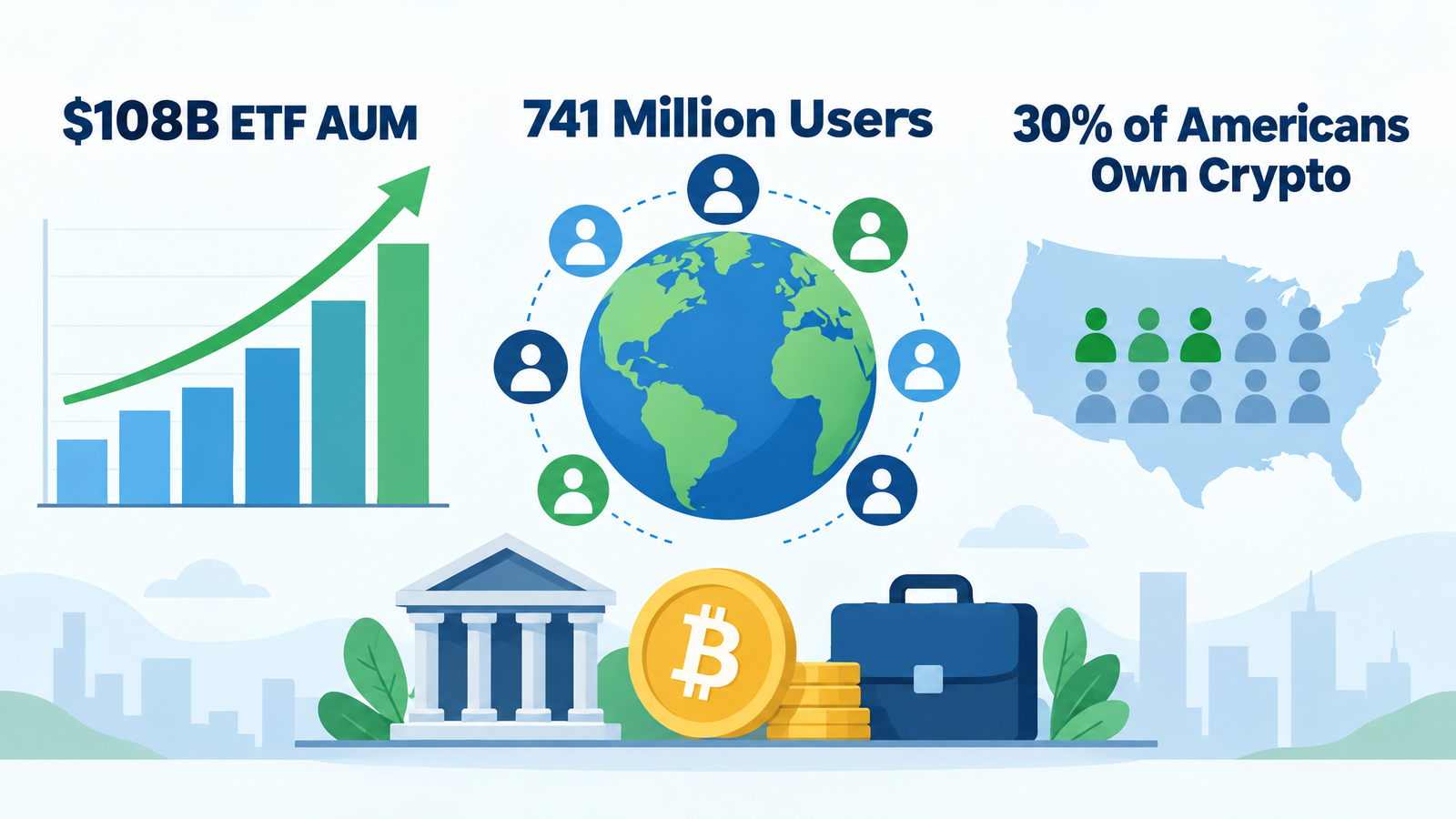
U.S. spot Bitcoin ETFs now hold approximately $108.4 billion in assets under management — a staggering figure that would have seemed impossible just a few years ago. Standard Chartered has enabled direct Bitcoin and Ether trading for affluent clients in the UAE. Corporate treasuries continue to hold massive positions, with entities like Strategy holding over 843,000 BTC. And real-world asset (RWA) tokenization — where traditional assets like U.S. Treasuries are represented on blockchain — has surpassed $26.71 billion in on-chain value.
Technology Is Advancing Fast
On the tech side, Ethereum is progressing through its “Glamsterdam” testing phase, targeting 200 million gas block capacity for improved scalability. Solana’s major “Alpenglow” consensus upgrade, scheduled for October 21, aims for 150-millisecond transaction finality. And developers on the XRP Ledger just neutralized a critical decade-old bug that could have allowed fraudulent minting of trillions of XRP — a reminder that security remains an ongoing challenge.
Adoption Is Broadening
About 30% of American adults now own some form of cryptocurrency, up from 27% in 2024. Globally, an estimated 741 million people held crypto in 2025, growing at 12.4% annually. Prediction markets — platforms like Kalshi and Polymarket — have exploded, with combined monthly volume hitting $24 billion by April 2026. The crypto ecosystem is maturing, even if it remains volatile.
The Boomer Perspective: “This Is the Maturation We’ve Been Waiting For”
If you’re an optimist about crypto — or what we might call a “Boomer” in the sense of someone who sees the boom ahead — the current environment looks genuinely exciting. Here’s why the bulls are feeling good:
Regulatory clarity is a feature, not a bug. For years, the biggest knock on crypto was that it existed in a legal gray zone. Now, with the SEC and CFTC establishing clear taxonomies, proposing structured frameworks, and working together rather than fighting over jurisdiction, the path is clearer for legitimate businesses to build and for institutional investors to participate. This is exactly what the market needed to grow up.
The ETF era has changed everything. When spot Bitcoin ETFs launched in the U.S., it opened the floodgates for retirement accounts, pension funds, and wealth managers to gain exposure to crypto without the complexity of self-custody. With $108 billion in ETF assets, this isn’t a fringe investment anymore — it’s becoming part of mainstream portfolio construction. At Your Career Place, we’ve seen growing interest from professionals in their 40s and 50s who want a small crypto allocation through their brokerage accounts, and ETFs make that accessible.
The technology is genuinely improving. Ethereum’s scalability upgrades, Solana’s speed improvements, and the growth of real-world asset tokenization aren’t just hype — they represent real infrastructure being built. When BNY and Citadel Securities are experimenting with tokenized U.S. Treasuries to speed up financing, that’s a signal that blockchain technology is finding legitimate use cases in traditional finance.
The long-term trajectory is still up. Yes, Bitcoin is 34% below its all-time high. But it’s also up roughly 43.8% from its summer lows. Standard Chartered’s $100,000 year-end target isn’t crazy — it would represent a recovery to levels seen just months ago. For investors with a multi-year horizon who can stomach volatility, the case for a small crypto allocation remains intact.
Global adoption is accelerating. With 741 million global crypto users and growing, and countries from South Korea to Brazil to India showing massive retail volume, this is a global phenomenon that isn’t going away. The U.S. even established a Strategic Bitcoin Reserve — a signal that governments are taking digital assets seriously as a store of value.
The Doomer Perspective: “The Risks Are Real and Underappreciated”
Of course, the crypto world has never been short on cautionary tales, and the “Doomer” case — the view that the risks outweigh the rewards — deserves serious attention. Here’s what the skeptics are watching:
The macro environment is genuinely hostile. Rising interest rates are crypto’s kryptonite. When the 10-year Treasury yields 5.17% and the Fed is likely to hike again, why take on the volatility of Bitcoin when you can earn guaranteed returns in bonds? The slowdown in ETF inflows — from nearly $1 billion per day in late September to just $134 million by September 25 — suggests institutional buyers are getting cautious. If the Fed keeps tightening, crypto could face sustained pressure.
Security threats haven’t gone away. In 2025 alone, over $3.4 billion was stolen through crypto exploits, and scams resulted in an estimated $17 billion in losses. Just this month, Ledger confirmed that unauthorized hardware implants were found in devices sold by a Southeast Asian reseller — capable of transmitting wallet keys over mobile networks. The XRP Ledger bug that was just patched could have allowed fraudulent minting of 18.45 trillion XRP. These aren’t edge cases; they’re ongoing systemic risks.
The “four-year cycle” may be broken. Many crypto investors have relied on the halving cycle — the idea that Bitcoin’s price follows a predictable four-year pattern tied to its supply reduction events. But analysts at CoinDesk and elsewhere are now questioning whether this framework still holds, given the increasing influence of macroeconomic factors, institutional leverage, and political dynamics. If the cycle is broken, the playbook many investors have relied on may no longer apply.
Leverage and derivatives remain dangerous. Despite improved transparency tools, derivatives-driven leverage continues to dominate short-term price action. The October 2025 flash crash — which wiped out $19 billion in a single event — was a stark reminder of how quickly leveraged positions can unwind. “Paper bitcoin” in the form of perpetual futures can amplify both gains and losses in ways that catch retail investors off guard.
Regulatory risk cuts both ways. While clearer regulation is generally positive, it also means more compliance costs, potential restrictions, and tax implications. France’s proposed 31.4% flat tax on crypto-to-stablecoin swaps is a preview of what governments might do when they decide crypto profits should be taxed more aggressively. The Genius Act’s AML provisions and the California Digital Financial Assets Law add compliance burdens that could squeeze smaller players.
At Your Career Place, we always emphasize that understanding the downside is just as important as chasing the upside. Crypto can go to zero — and some assets in the space have done exactly that.
Key Takeaways: What Should You Actually Do?
Whether you’re a crypto enthusiast or a skeptic, here are the practical takeaways that Your Career Place recommends for navigating the current environment:
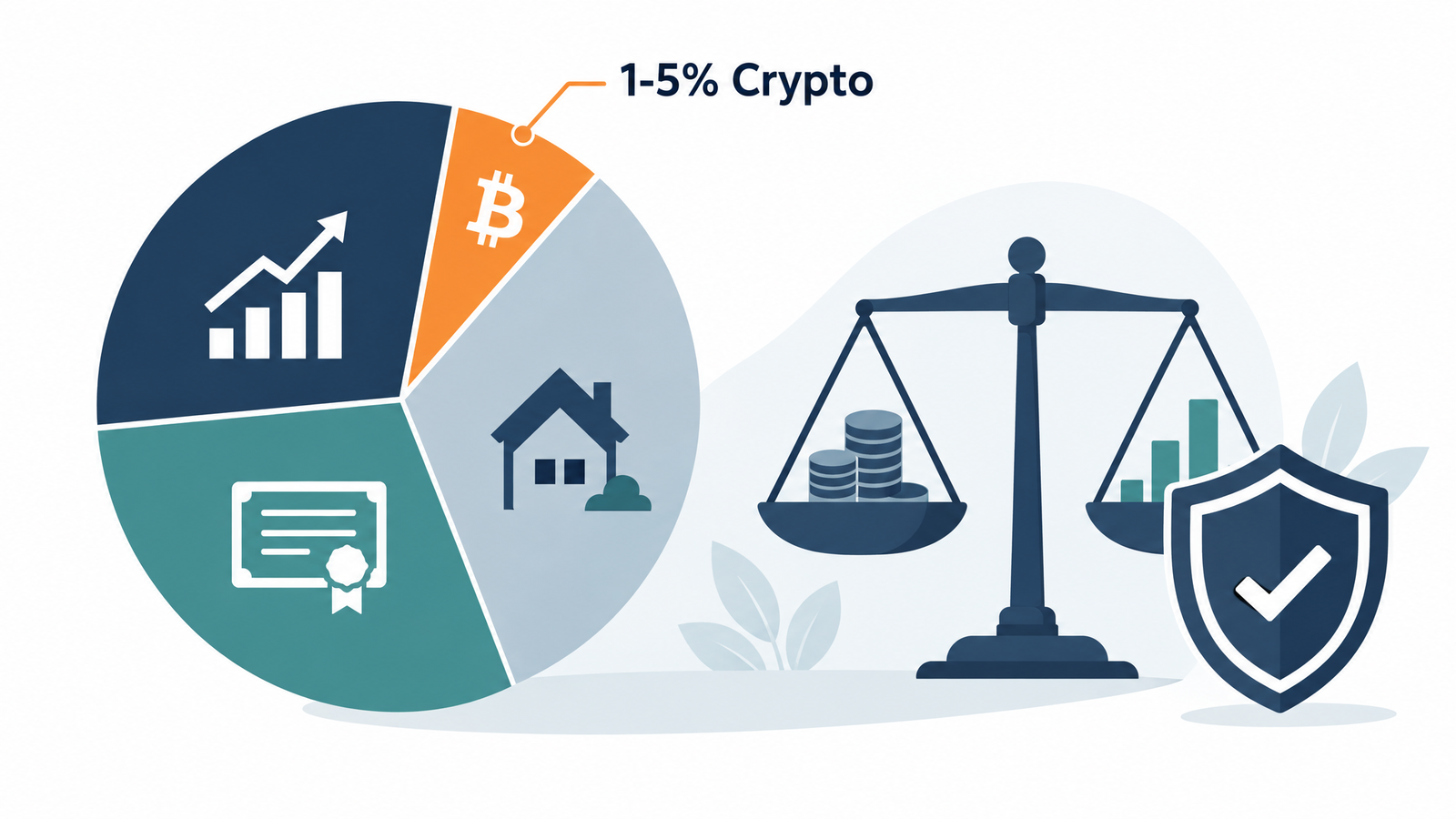
- Treat crypto as a satellite, not a core holding. Financial experts consistently recommend limiting crypto to 1%–5% of your total portfolio. It should complement your stocks, bonds, and real estate — not replace them. If a 50% drawdown in your crypto allocation would derail your retirement plans, you have too much.
- Get your financial house in order first. Before putting a dollar into crypto, make sure you have an emergency fund (3–6 months of expenses), manageable debt levels, and a solid foundation in traditional investments. Crypto is a high-risk, high-reward satellite — not a financial foundation.
- Use regulated products when possible. If you want crypto exposure without the complexity of managing wallets and private keys, spot Bitcoin ETFs available through your brokerage account are a legitimate option. They provide exposure with the regulatory protections of traditional financial products.
- Don’t try to time the market. Nobody knows if Bitcoin will hit $100,000 by year-end or drop back to $70,000. Dollar-cost averaging — investing a fixed amount at regular intervals — removes the pressure of trying to pick the perfect entry point and smooths out volatility over time.
- Stay informed on regulation. The regulatory landscape is changing fast. The SEC’s proposed “Regulation Crypto Assets,” the Genius Act’s stablecoin provisions, and state-level laws like California’s Digital Financial Assets Law could all affect the value and accessibility of your holdings. Stay current.
- Prioritize security. If you hold crypto directly, use hardware wallets from reputable sources, enable two-factor authentication, and never share your seed phrase. The $17 billion lost to scams in 2025 is a reminder that security isn’t optional.
- Know your risk tolerance. Crypto is not for everyone. If market volatility keeps you up at night, or if you’re within 5–10 years of retirement and can’t afford significant losses, it may simply not be appropriate for your situation — and that’s perfectly fine.
The Bottom Line
Cryptocurrency in October 2026 is at an inflection point. The regulatory framework is finally taking shape, institutional adoption is real and growing, and the technology continues to advance. But the macro headwinds are significant, security risks persist, and the market remains highly volatile and speculative.
The honest answer is that crypto can be a legitimate part of a diversified financial strategy — but only if you approach it with clear eyes, appropriate position sizing, and a long-term perspective. It’s not a get-rich-quick scheme, and it’s not a guaranteed path to financial freedom. It’s a high-risk asset class that rewards patience, discipline, and careful risk management.
At Your Career Place, our goal is always to help you make financial decisions that align with your real life — your income, your goals, your timeline, and your risk tolerance. Whether crypto belongs in your portfolio is a personal decision, but it should be an informed one.
What’s your take on crypto right now? Are you holding, buying, or staying on the sidelines? We’d love to hear from you in the comments below.
Disclaimer: This article is for informational and educational purposes only and does not constitute financial, investment, or legal advice. Cryptocurrency investments are highly speculative and involve significant risk of loss. Past performance is not indicative of future results. Always consult with a qualified financial advisor before making investment decisions. Your Career Place does not endorse any specific cryptocurrency, exchange, or investment product.