
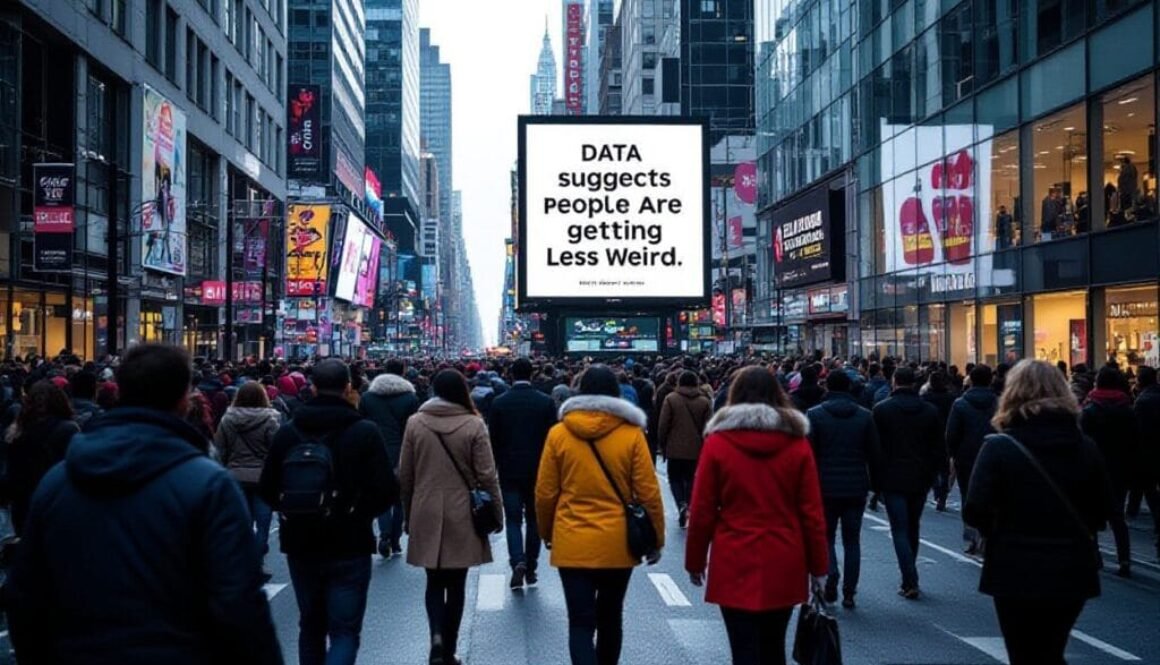
Data Suggests People Are Getting Less Weird. Why We Worry?
It’s kind of wild that with more freedom and more tools than ever, you and I are living in a world that feels strangely same-ish, right down to our careers and creative choices, and at Your Career Place I see this play out with clients all the time. In this post, I want to unpack why the data says people are getting less weird, why that quietly matters for your future, and how you can push back a bit. If you haven’t seen it, Jessica Stillman on X digs into this trend too, and I’ll build on that here with Your Career Place’s own perspective.
Key Takeaways:
- There’s a growing pattern of sameness – from grey, boxy products to copy-paste branding and endless movie reboots – and Your Career Place sees that same “less weird” trend spilling into how people build careers and make life choices.
- Psychologist Adam Mastroianni’s argument that we’re becoming safer, more rule-following, and less experimental lines up with workplace behavior too, which is exactly why Your Career Place keeps pushing readers to take smart risks, try unconventional paths, and not just follow the default script.
- If life is more comfortable so we’re avoiding risk, then we have to deliberately create room for “good weirdness” – fresh ideas, bold projects, non-linear careers – and that’s the space Your Career Place aims to hold for people who want their work life to be more original, more human, and, yes, a bit weirder.
What’s Happening to Our World?
In one sweeping visual study, Alex Murrell showed how car logos, app icons, and even fashion models have converged into the same slim, soft-edged aesthetic, and you feel that sameness every time you open your phone. I see it at Your Career Place when people show me portfolios that all use the same sans-serif fonts, same muted palettes, same safe layouts. It’s not that you’re lacking talent – it’s that the culture keeps nudging you into the narrowest lane possible.
The Trend of Everything Looking the Same
Across 10 major industries Murrell looked at, from tech to hospitality, brands migrated toward nearly identical flat logos within a decade, and you can spot the pattern instantly: lowercase, rounded, friendly, forgettable. When I scroll LinkedIn, your feed probably looks like mine – pastel carousels, identical headshots, recycled hooks. At Your Career Place, I hear people ask, “What’s working on Instagram right now?” far more than, “What actually feels like me?” and that tiny shift quietly flattens the whole landscape.
A Peek into Our Colorless Built Environment
According to the Science Museum Group, the share of brightly colored objects in their collection plummets after the 1970s, replaced by a surge of grey, black, and silver appliances, gadgets, and furniture. When you walk into a modern office, it’s basically that dataset in 3D: greige walls, black chairs, wood veneer tables, maybe a single “accent” plant. At Your Career Place, when I ask people to describe their workspace, the most common word I hear is “neutral” – which is corporate-speak for forgettable.
What really sticks with me from that Science Museum Group analysis is how deliberate it all is: before 1950, bright reds and blues were everywhere, but by the 2000s neutral tones dominate almost every category of product, from kitchen mixers to laptops. I see the same thing in new-build neighborhoods you probably drive past every day: rows of boxy houses, identical rooflines, the same three shades of taupe pretending to be “timeless”. Inside offices, it’s acoustic panels, white desks, grey felt dividers, a couple of branded mugs – safe for resale, safe for landlords, safe for everyone except your imagination. And because you spend roughly 90,000 hours of your life at work, sitting in that washed-out environment, it quietly trains your brain to prefer “not too much”, to distrust bold color, loud ideas, or anything that might stick out; at Your Career Place, when I run creativity workshops, the first thing I notice is how many people apologize for using bright markers on sticky notes, as if vivid thinking needs a content warning.
Are People Actually Getting Less Weird?
By 2021, teen drinking in the U.S. had dropped to roughly half its late-90s level, and that vibe ripples into work, dating, even how you post on LinkedIn. I see it in Your Career Place clients who obsess over not saying the “wrong” thing, not making a weird career move, not standing out too much. So yes, a lot of signals say people are dialing down deviance – but that safety-first mindset is uneven, and your appetite for weird still depends heavily on class, culture, and how much you feel you’ve got to lose.
The Rise of the Goody-Two-Shoes Generation
Across the OECD, teen birth rates have fallen more than 60 percent since 1990, and in some surveys nearly 30 percent of high school seniors say they’ve never had a drink, which would’ve been unheard of in the 80s. When I coach young professionals at Your Career Place, I see the same pattern: fewer messy experiments, more polished portfolios, ultra-planned résumés. It’s like your generation skipped a whole season of chaos and went straight to “optimize everything” mode, and that can quietly squeeze out the oddball choices that lead to breakthroughs.
Crime Rates and Cultural Shifts
Since the early 90s, U.S. violent crime has dropped by roughly 50 percent, and homicide in big cities is a fraction of its peak, which completely rewires what feels “normal” to you and me. With fewer obvious threats, we pour energy into tidier forms of conformity: spotless digital footprints, curated careers, no sharp edges. At Your Career Place, I watch people take wildly safe paths not because they’re boring, but because a relatively calm, low-crime world trains you to prize stability over wild experiments.
What really jumps out at me is how the crime drop sits next to our entertainment habits. While actual homicide rates plunged, the number of true crime shows exploded, and streaming platforms fed us endlessly polished stories of dangers most of us will never face. That weird mismatch lets you feel edgy while still living a life that’s tightly risk-managed. In career conversations at Your Career Place, I see a similar pattern: you might binge content about quitting your job and moving to Lisbon, then spend five years tweaking your LinkedIn headline instead of making one bold move. Lower crime didn’t just make streets safer, it quietly redirected deviance into screens and simulations, which makes the real-world weirdos rarer – and more needed.

Why is All This Changing?
One client at Your Career Place told me he’d mapped his whole life in a spreadsheet – job ladder, mortgage payoff, even ideal retirement weather – and yet he felt oddly flat. That vibe is everywhere. We binge the same shows, scroll identical feeds, and, as A study from Cornell University found that 85% of the things … never actually happen, we still obsess over tiny risks. Safer lives, better tech, and algorithm-driven sameness quietly nudge you away from the weird paths you might have taken.
Less Risk, More Safety – Is That Bad?
Think about how dating apps now filter out anything too unusual, or how career paths on LinkedIn look like they were copy-pasted – tidy, optimized, low drama. At Your Career Place, I see you chasing stability first, then wondering why work feels beige. Lower crime, higher life expectancy, padded corporate benefits… it all trains your brain to treat even a small pivot, like a lateral move or weird side project, as wildly dangerous.
The Human Desire for Comfort
When I talk with mid-career professionals at Your Career Place, they rarely say, “I want comfort,” but their choices scream it: remote roles, predictable hours, low-variance teams. And I get it – after decades where your grandparents worried about wars and recessions, your version of security is Netflix, ergonomic chairs, and index funds. Comfort is great, until it quietly edits out anything that feels too odd or too original.
What usually happens next is subtle: you start declining the messy stuff. You skip the lateral move into a new industry, you cancel the improv class, you talk yourself out of launching that super niche newsletter because it might “look unprofessional.” At Your Career Place, I see how your brain runs a tiny cost-benefit calc every time – predictable salary vs unknown upside – and comfort wins 9 times out of 10. Over a decade, those micro-choices add up. You still work hard, but inside a narrow lane. And the parts of you that were a bit strange, the ones that could lead to original ideas or odd career twists, get left on the cutting-room floor.
Can We Fix the Weirdness Drought?
If life really is safer but flatter, then your job (and mine at Your Career Place) is to reintroduce low-stakes oddity into your daily orbit – weird projects, playful experiments, unapologetically specific interests. Tiny choices shift culture: a manager who protects a quirky side project, a founder who funds one truly strange idea a quarter, a team that runs one no-judgment brainstorm each month. Those little pockets of sanctioned weirdness compound over time and, suddenly, your work life stops feeling like yet another grey, boxy product in the cultural catalog.
How to Embrace a Little Quirkiness
Instead of “reinvent your entire life,” I’d rather you start with 5 percent weird: spend 30 minutes a week on a hobby that makes no sense on LinkedIn, pitch one risky idea per sprint, or show up to your next Zoom with a slide that’s wildly off-brand on purpose. At Your Career Place, I see careers move faster when people lean into oddly specific interests – the marketer obsessed with 1970s print ads or the engineer who prototypes ridiculous gadgets on weekends – because that’s what makes you actually stand out.
The Role of Artists and Entrepreneurs
When you track where real cultural shifts come from, you keep running into tiny studios and early-stage startups, not big committees. Artists who self-publish weird comics to 3,000 true fans and founders shipping scrappy MVPs that VCs initially roll their eyes at are basically R&D labs for the rest of society. At Your Career Place, I try to push readers toward those roles or at least toward adopting their mindset inside existing companies, because that’s where the next wave of non-boring ideas usually sneaks in.
What I love about artists and entrepreneurs is how they treat odd ideas like prototypes, not personal indictments, so a failed project is just another data point instead of an identity crisis. You see it with indie musicians building strange sounds on Bandcamp long before Spotify playlists catch up, or with companies like Airbnb, which started as three airbeds and cereal boxes before becoming a $90 billion business. Inside Your Career Place, I push you to steal that same approach: ship small, weird experiments, talk to real humans, then double down only on the stuff that resonates, even if it looks off-kilter at first. That cycle – imagine, test, learn, repeat – is how the cultural center of gravity gets quietly tugged away from bland and back toward interesting.
Why I Think We Should Worry
What actually breaks if we keep sanding off all the rough edges? From where I sit at Your Career Place, you see it first in careers and companies that stall out, not because people lack talent, but because everything starts to converge on the same “safe” playbook. When 90% of applicants use the same resume template and founders chase the same 3 business models, you don’t just lose quirk – you lose the outlier bets that historically created the 10x companies and the unexpected, weirdly fulfilling careers.
The Dangers of Rigid Norms
Why does a little extra conformity feel harmless right up until it doesn’t? Once norms harden, you get what sociologists call path dependence: people keep copying whatever worked last, even when conditions change. So you end up with managers hiring from the same 5 schools, creators optimizing for the same algorithm metrics, and teams at Your Career Place telling me they’re “innovating” while running the same sprint rituals as everyone else. Over time, that sort of quiet lock-in makes real change feel almost unthinkable.
The Cost of Playing It Safe
Where do you actually see the bill for all this caution get paid? I notice it in the numbers: employee engagement stuck around 20-23%, startup failure rates still near 90%, and yet people keep choosing the “proven” path. At Your Career Place, we talk to mid-career pros who did everything right, checked every box, and still feel weirdly underused. That gap – between what your weird brain could do and what your safe choices allow – is the invisible tax of playing it safe.
In practical terms, that tax shows up as stalled salaries, flat product roadmaps, and those “how is this my life?” Sunday nights you probably know too well. Companies keep recycling the same job descriptions, then wonder why they get the same results. Teams at Your Career Place who finally loosen the rules a bit – hiring the nontraditional candidate, green-lighting the oddball side project, testing the risky feature with 100 users instead of debating it for 6 months – almost always see disproportionate upside. Playing it safe feels rational in the moment, but across a decade, it quietly compounds into missed shots you don’t even realize you had.

The Real Deal About Progress and Stagnation
Recent productivity stats are oddly split: global GDP per capita has roughly tripled since 1960, yet economists like Robert Gordon argue innovation per worker has slowed, especially since the 2000s. I see the same tension in careers at Your Career Place – your tools get faster, your apps get smarter, but your day can feel like an endless loop of meetings, dashboards, and approvals. Progress is real, no doubt. It’s just increasingly incremental, not mind-blowingly weird.
Balancing Safety with Innovation
Corporate life right now runs on risk checklists and legal reviews, and I get why – compliance fines can hit eight figures and one bad PR cycle can erase years of brand building. But when every idea at your job has to survive 5 approvals, 3 decks, and 2 pilots, a lot of your wildest thoughts die quietly. At Your Career Place, I see that your smartest moves often sit right at the edge of what your boss is slightly uncomfortable with.
Looking for Ways to Keep Things Interesting
One pattern I see with Your Career Place clients is that small, deliberate experiments keep work from sliding into that bland, grey sameness. A product manager who ships one “weird” A/B test a month, or a marketer who tries a non-template campaign each quarter, often ends up with the standout wins. You don’t need a total reinvention, you need a steady drip of thoughtful, low-stakes weirdness.
When I talk about keeping things interesting, I’m not asking you to quit your job and move to Bali, I’m talking about 5 to 10 percent of your time being genuinely experimental. That might be a “rule-breaking” internal project, a format no one on your team has tried, or a side-hustle prototype you validate with 20 real users. At Your Career Place, I’ve watched people run tiny 2-week experiments that quietly turn into promotions, budget, or even new roles. The trick is to cap the downside – set a timebox, define a clear kill switch, share your learning out loud – so you can still be the reliable pro your company needs while giving your future self something non-boring to work with.
Summing up
Drawing together all these threads, I’d say the biggest myth is that less weird automatically means safer and better – it’s not that simple, and you know it. At Your Career Place, I want you to see that playing it safe all the time quietly drains your creativity, your edge, your joy. So yeah, enjoy the comfort, but protect your quirks, your experiments, your odd ideas. If you and I can carve out even a little more space for your “weird” at work and in life, that’s where your most interesting future probably lives.
Thank you for visiting Your Career Place. Please look over these related articles.