AI Productivity Tools in 2026
The Small Business Revolution You Can’t Afford to Miss
If you’re a small business owner and you haven’t yet explored what AI productivity tools can do for your day-to-day operations, you’re not alone — but you might be falling behind. At Your Career Place, we keep a close eye on the technologies reshaping the world of work, and right now, the story is all about AI tools that are making small businesses faster, smarter, and more competitive than ever before.
AI is no longer just for big corporations — it’s becoming the backbone of small business productivity in 2026.
What’s Happening Right Now in AI Productivity
The year 2026 is shaping up to be a turning point. Major technology companies — Microsoft, Google, and OpenAI — have all made significant moves to bring powerful AI tools within reach of small businesses, not just Fortune 500 companies. And the numbers back it up: surveys show that 62% of small businesses are already using AI for data analysis, and that figure is climbing fast.
Here’s a quick rundown of the biggest developments:
Microsoft 365 Copilot Business
Microsoft launched a new version of its Copilot AI assistant specifically designed for businesses with up to 300 users. With promotional pricing starting around $18 per user per month and no minimum seat requirements, it’s now genuinely affordable for a small team. Copilot is deeply embedded in Word, Excel, Outlook, and PowerPoint — meaning it can draft emails, summarize documents, build spreadsheets from plain-English instructions, and even create full presentations with your company’s branding. Early studies suggest ROI for small businesses using Copilot can range from 132% to 353%. That’s not a typo.
Google Workspace with Gemini AI
Google has folded its powerful Gemini AI models directly into Google Workspace Business plans — no expensive add-ons required. For around $14 per user per month, small businesses now get AI that can build entire spreadsheets from a prompt, generate professional videos with AI avatars in 24 languages, and automatically summarize meetings with action items. Google’s new “Workspace Intelligence” system is rolling out in 2026, enabling agentic automation — like automatically reviewing invoices for discrepancies — without any manual setup.
Notion AI Agents
Notion has transformed from a note-taking app into an AI-native workspace. Its new “Notion Agents” can autonomously perform multi-step tasks — compiling customer feedback, converting meeting notes into proposals, or managing a content calendar — all without you lifting a finger. For small businesses drowning in administrative work, this is a genuine game-changer.
ChatGPT for Business
ChatGPT remains the Swiss Army knife of AI tools. One digital media company reported saving 5.5 hours per employee per week using ChatGPT Business. A translation firm saved over $100,000 per month by automating its workflow. The upcoming GPT-5.5 is designed to act more like an autonomous “coworker companion,” capable of handling complex research, coding, and analysis tasks end-to-end.

The future of small business productivity is a partnership between human creativity and AI efficiency.
Why This Matters for Small Businesses
For years, enterprise-grade AI was out of reach for small businesses — too expensive, too complex, and too dependent on large IT teams. That era is over. The tools available today are designed for people who run a bakery, a law firm, a marketing agency, or a landscaping company — not just tech giants.
At Your Career Place, we talk to small business owners every week, and the most common pain points we hear are: not enough hours in the day, too much administrative work, and struggling to compete with larger competitors on marketing and customer service. AI productivity tools directly address all three of these challenges.
Here’s where small businesses are seeing the biggest impact:
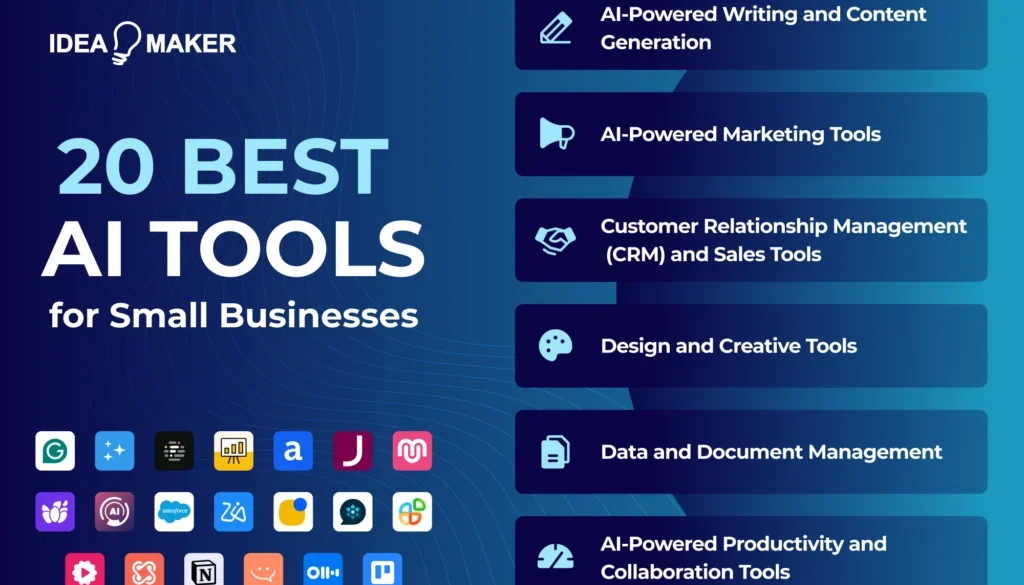
- Marketing & Content: Tools like Jasper, Copy.ai, and ChatGPT generate blog posts, social media captions, and ad copy in minutes — content that used to take hours or require hiring a freelancer.
- Customer Support: AI chatbots from Tidio and ManyChat provide 24/7 support, answering common questions and capturing leads even when you’re asleep.
- Meeting Management: Tools like Otter.ai and Fireflies.ai automatically transcribe and summarize meetings, so you never lose track of action items again.
- CRM & Sales: HubSpot, Salesforce, and Zoho CRM now use AI to draft follow-up emails, summarize customer records, and predict which leads are most likely to convert.
- Operations: AI features in Asana, ClickUp, and Notion help manage projects, flag blockers, and automate routine task assignments.
🌟 Boomer’s Perspective: “This Is the Great Equalizer”
Let’s be honest — for decades, small businesses have been fighting with one hand tied behind their backs. Big corporations had entire departments dedicated to marketing, data analysis, customer service, and operations. You had yourself, maybe a few employees, and a lot of hustle.
AI productivity tools are changing that equation in a profound way. For the first time in history, a solo entrepreneur or a five-person team can access the same caliber of tools that Fortune 500 companies use — and at a price point that won’t break the bank.
Think about what it means to have an AI assistant that can draft your weekly newsletter, summarize your customer feedback, prepare your meeting notes, and build a financial projection spreadsheet — all before lunch. That’s not science fiction. That’s Microsoft Copilot or Google Gemini, available today for less than the cost of a daily coffee per employee.
The ROI numbers are staggering. Businesses using these tools are reporting time savings of 5+ hours per employee per week. That’s over 250 hours per year, per person — time that can be redirected toward growing the business, serving customers better, or simply reclaiming work-life balance.
At Your Career Place, we believe this is the most exciting moment in small business history. The playing field is leveling. The tools are here. The question is simply: are you going to use them?
The businesses that embrace AI productivity tools now will build a compounding advantage. Every hour saved is an hour reinvested. Every process automated is a process that scales without adding headcount. This isn’t just about efficiency — it’s about building a more resilient, more competitive, and ultimately more profitable business.
The bottom line from Boomer’s corner: AI productivity tools are the best thing to happen to small businesses since the internet. Get in now, experiment boldly, and watch your business transform.

Small business owners who embrace AI tools are finding more time for what matters most — growing their business and serving their customers.
⚠️ Doomer’s Perspective: “Slow Down — There Are Real Risks Here”
Before you rush out and subscribe to every AI tool on the market, let’s pump the brakes for a moment. The hype around AI productivity tools is real, but so are the risks — and small businesses, with fewer resources and less IT support, may be more vulnerable than they realize.
The cost trap is real. Yes, $18 per user per month sounds affordable. But add up Microsoft Copilot, Google Gemini, a chatbot subscription, a meeting transcription tool, and an AI content platform, and you’re suddenly spending hundreds of dollars a month on software. Gartner predicts that 40% of “agentic AI” projects will be canceled by the end of 2025 due to unclear strategies and disappointing ROI. Not every AI investment pays off, and small businesses can’t afford to throw money at tools that don’t deliver.
Your data is at risk. When you feed customer information, financial records, and proprietary business data into third-party AI tools, you’re trusting those companies with your most sensitive assets. Data breaches, unclear privacy policies, and the risk of your data being used to train future AI models are all legitimate concerns. GDPR and CCPA compliance adds another layer of complexity that many small business owners aren’t equipped to navigate alone.
AI makes mistakes — sometimes costly ones. AI-generated content can be factually wrong, legally problematic, or simply off-brand. An AI that drafts a customer email with incorrect information, or generates marketing copy that inadvertently makes a false claim, can damage your reputation or even expose you to legal liability. Human oversight isn’t optional — it’s essential.
Dependency is a vulnerability. What happens when your AI provider changes its pricing, discontinues a feature, or suffers an outage? If your entire operation is built around a single AI platform, you’re one policy change away from a crisis. The businesses that are most at risk are those that automate everything without maintaining the human skills and processes to fall back on.
The skills gap is widening. AI tools are only as good as the people using them. If your team doesn’t understand how to prompt AI effectively, interpret its outputs critically, or identify when it’s wrong, you’re not gaining an advantage — you’re just adding a new source of errors. Investing in AI literacy and training isn’t optional; it’s the price of admission.
At Your Career Place, we don’t say this to scare you away from AI. We say it because we want you to succeed. The businesses that will thrive are those that adopt AI thoughtfully — with clear goals, proper security practices, human oversight, and a plan for when things go wrong.
The bottom line from Doomer’s corner: AI productivity tools are powerful, but they’re not magic. Approach them with clear eyes, a solid strategy, and a healthy dose of skepticism — and you’ll be far better positioned than those who dive in blindly.
🎯 Key Takeaways for Small Business Owners
- Start small and specific. Don’t try to automate everything at once. Pick one pain point — like meeting summaries or social media content — and find an AI tool that solves it well. Prove the ROI before expanding.
- The big platforms are your best starting point. If you’re already using Microsoft 365 or Google Workspace, you likely already have access to powerful AI features. Explore what’s included in your current subscription before paying for additional tools.
- Never skip human review. AI is a powerful assistant, not an infallible decision-maker. Always have a human review AI-generated content, especially anything customer-facing or legally sensitive.
- Protect your data. Before connecting any AI tool to your business data, read the privacy policy. Understand what data is stored, how it’s used, and whether it complies with relevant regulations.
- Invest in training. The ROI on AI tools is directly proportional to how well your team uses them. Dedicate time to learning best practices for prompting and interpreting AI outputs.
- Track your ROI. Measure the time and money saved by each AI tool. If a tool isn’t delivering measurable value within 90 days, cut it and try something else.
The AI productivity revolution is here, and it’s moving fast. At Your Career Place, we’ll keep bringing you the latest insights, honest assessments, and practical guidance to help you navigate this new landscape with confidence. Whether you’re a Boomer or a Doomer at heart, the most important thing is to stay informed, stay curious, and keep moving forward.
Have questions about which AI tools are right for your business? Drop a comment below or reach out to the Your Career Place team — we’re here to help you find your path in the age of AI.