
Gamified Interviews in 2026
Are Hiring Games Changing the Rules for Job Seekers?
Published by Your Career Place | May 15, 2026
Introduction: The Job Hunt Just Got a New Rulebook
Picture this: you apply for your dream job, and instead of being handed a stack of behavioral questions or a whiteboard coding challenge, you’re invited to play a game. Not a trick — an actual, interactive game designed to measure how you think, how you make decisions under pressure, and how you collaborate. Welcome to the world of gamified interviews, one of the fastest-growing hiring trends of 2026.
At Your Career Place, we keep a close eye on the shifts reshaping the job market so you don’t have to. And right now, gamification in hiring is impossible to ignore. Companies like Unilever, HSBC, Deloitte, Shell, and Boeing are already using game-based assessments to screen candidates at scale — and the trend is accelerating. This week, we’re diving deep into what gamified interviews actually are, why employers are embracing them, and what they mean for you as a job seeker.
So, What Exactly Is a Gamified Interview?
Let’s clear up the confusion right away. A gamified interview doesn’t mean you’re playing Candy Crush to land a job. There are two main flavors:
- Gamified Assessments: Traditional tests — like personality or situational judgment tests — dressed up with game-like elements such as point systems, progress bars, badges, or interactive drag-and-drop tasks. The underlying test is familiar; the delivery is more engaging.
- Game-Based Assessments: These are fully structured as games. You might solve puzzles, navigate strategy challenges, or complete memory tasks — all while the platform quietly measures your cognitive abilities, emotional intelligence, and behavioral tendencies.
Both types are designed to observe how you actually perform, not just how you describe yourself. That’s a fundamental shift from the classic “Tell me about a time when…” format. Instead of asking you to recall a past situation, these tools put you in a simulated one and watch what you do.
Common formats include job simulation games (where you respond to realistic work scenarios), cognitive ability challenges (testing memory, logic, and numerical reasoning), behavioral assessments (measuring risk tolerance and decision-making style), and emotional intelligence games (tracking how you read and respond to social cues).
Why Is This Trending Right Now?
The rise of gamified interviews in 2026 isn’t a coincidence — it’s a direct response to some very real pressures in the hiring world.
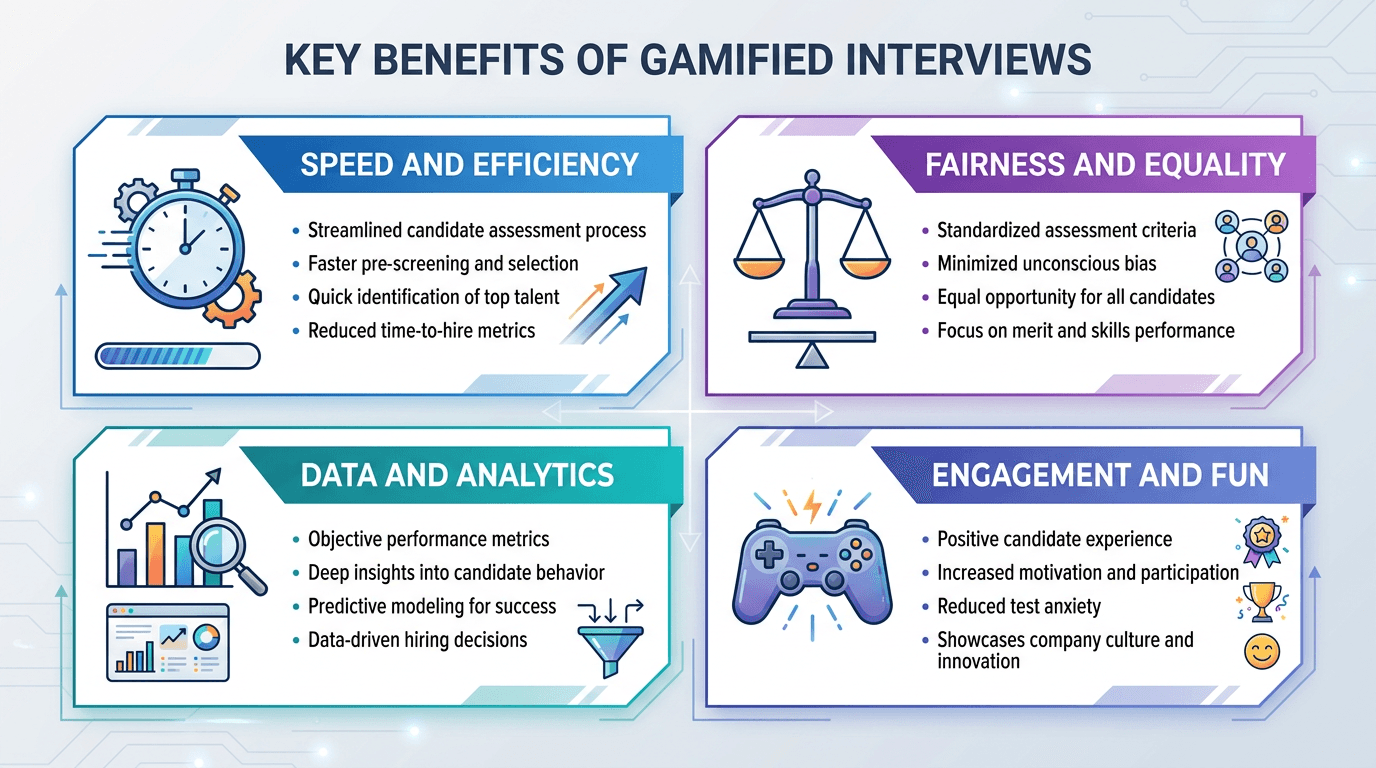
First, application volumes are through the roof. Some organizations are reporting a 40% year-on-year increase in the number of candidates applying for each role. Traditional screening methods simply can’t keep up. Gamified assessments automate and scale the early stages of evaluation, helping recruiters efficiently identify the most promising candidates without burning out their teams.
Second, there’s a growing crisis of confidence in traditional interviews. Research consistently shows that unstructured interviews — the kind where a hiring manager asks whatever comes to mind — can only explain between 14% and 18% of the variance in actual job performance. That’s a pretty weak predictor for such a high-stakes decision. Game-based assessments, by contrast, demonstrate a predictive validity between 0.40 and 0.60, making them significantly more accurate at forecasting how someone will actually perform on the job.
Third, companies are under pressure to build more diverse and equitable workforces. Traditional interviews are riddled with unconscious bias — toward certain schools, certain communication styles, certain backgrounds. Gamified assessments, when designed well, focus purely on behavior and performance, stripping away the pedigree signals that can unfairly advantage some candidates over others.
The results speak for themselves: organizations using gamified hiring tools report up to a 40% shorter interview cycle and a 62% higher offer ratio. That’s not a marginal improvement — that’s a transformation.
The Science Behind the Fun
Here’s something that might surprise you: gamified assessments aren’t just more engaging — they’re scientifically more rigorous. There are four key reasons why.
Implicit measurement over self-report. When you fill out a personality questionnaire, you’re consciously describing yourself — and you can easily game it by picking the “right” answers. In a game-based assessment, you’re making real decisions in real time. The platform captures your natural behavioral signals, which are far harder to fake and far more predictive of how you’ll actually behave at work.
High-resolution behavioral data. A human interviewer can only process so much information in a 45-minute conversation. A gamified platform captures thousands of data points per candidate — including how long you deliberate before making a choice, how you respond when your first strategy fails, and how you manage competing priorities. That’s a level of insight no traditional interview can match.
Ecological validity. The best game-based assessments mirror the actual complexity of the job. You’re not answering abstract questions — you’re navigating scenarios that reflect real work challenges. This means the behaviors observed are genuinely representative of how you’d perform in the role.
Structural resistance to faking. Because it’s not obvious which micro-decisions are being measured or how they map to competency scores, candidates can’t easily reverse-engineer the “right” answers. You have to focus on solving the problem, which lets your natural tendencies emerge.
At Your Career Place, we think this is one of the most important developments in hiring in years — not because it’s flashy, but because it’s genuinely more fair and more accurate than what came before.
The Boomer’s Perspective: Finally, a Hiring Tool That Actually Works
Let’s be honest: the traditional job interview has been broken for a long time. We’ve all sat through interviews where the hiring manager asked questions that had nothing to do with the actual job, or where the candidate who “interviewed well” turned out to be a disaster on the team. The system has been crying out for something better.
From an optimistic standpoint, gamified interviews are exactly the kind of innovation the hiring world needs. They bring objectivity and rigor to a process that has historically been far too subjective. When a company uses a validated game-based assessment, they’re not relying on gut feelings or first impressions — they’re relying on data. And data, when collected and analyzed properly, doesn’t play favorites.
For experienced professionals, this is actually good news. If you’ve spent years building genuine skills and expertise, a well-designed gamified assessment should surface those capabilities clearly. You’re not competing on who can deliver the most polished elevator pitch — you’re competing on actual performance. That’s a more level playing field, not a less level one.
There’s also something to be said for the efficiency gains. Shorter interview cycles mean less time in limbo for candidates. A 40% reduction in time-to-hire isn’t just good for companies — it’s good for job seekers who are tired of waiting weeks or months to hear back. The faster the process moves, the sooner you can get on with your career.
And from an employer branding perspective, companies that use gamified assessments are signaling something important: they take hiring seriously, they invest in fair processes, and they respect candidates’ time. Research shows that 78% of applicants view employers with gamified hiring processes more favorably. That’s a meaningful competitive advantage in a tight talent market.
The bottom line from the optimist’s corner: gamified interviews are a genuine step forward. They’re more accurate, more efficient, more equitable, and more engaging than the status quo. If you’re a job seeker who’s frustrated with the traditional process, this trend is working in your favor.
The Doomer’s Perspective: When Hiring Becomes a Black Box
Not everyone is celebrating, and the concerns are worth taking seriously.
The most fundamental worry is transparency. When a human interviewer rejects you, you can at least try to understand why — maybe you stumbled on a question, maybe there was a mismatch in expectations. But when an algorithm scores your game performance and decides you’re not a fit, what recourse do you have? What exactly was measured? Which decisions counted against you? For many candidates, gamified assessments feel like a black box — opaque, impersonal, and impossible to appeal.
There’s also the question of what these games are actually measuring. The science is promising, but it’s not infallible. A candidate who happens to be a skilled gamer might outperform a more qualified candidate who simply isn’t comfortable with game interfaces. Someone dealing with anxiety, a disability, or an unfamiliar technology setup might perform poorly on a game-based assessment in ways that have nothing to do with their actual job capabilities. The risk of systematic exclusion of certain groups — particularly older workers, people with disabilities, or those from lower-income backgrounds with less access to technology — is real and documented.
Then there’s the bias question. Proponents argue that gamified assessments reduce bias, and there’s truth to that. But algorithms trained on historical data can encode and amplify existing biases in subtle ways. If the training data reflects a workforce that has historically skewed toward certain demographics, the model may inadvertently penalize candidates who don’t fit that mold — even if the game itself appears neutral on the surface.
Finally, there’s the dehumanization concern. Hiring is ultimately about human relationships — about finding people who will work well together, contribute to a culture, and grow within an organization. Reducing that process to a series of game scores risks stripping out the very human judgment that makes great hiring possible. A candidate’s resilience, their passion for the work, their ability to connect with a team — these things are hard to capture in a puzzle game.
At Your Career Place, we believe these concerns deserve to be heard. The technology is promising, but it needs robust governance, transparency, and ongoing validation to live up to its potential without creating new forms of unfairness.
Key Takeaways: What You Need to Know Right Now
Whether you’re excited or skeptical about gamified interviews, they’re here and they’re growing. Here’s what Your Career Place recommends you keep in mind:
- Expect to encounter them. If you’re applying to large companies — especially in finance, consulting, tech, or consumer goods — there’s a good chance you’ll face a gamified assessment in 2026. Don’t be caught off guard.
- You can prepare. While you can’t “study” for a game-based assessment the way you’d memorize interview answers, you can familiarize yourself with the format. Platforms like HireVue and Pymetrics offer practice assessments. Getting comfortable with the interface and the types of tasks involved can reduce anxiety and improve your performance.
- Focus on authentic performance. The structural design of these assessments makes them hard to game. Your best strategy is to engage genuinely, manage your time well, and approach each task as you would a real work challenge.
- Know your rights. If you’re concerned about how your data is being used or how the assessment was validated, you have the right to ask. Reputable employers should be able to explain what the assessment measures and how it was tested for fairness.
- Don’t neglect the human stages. Gamified assessments are typically used for initial screening, not final decisions. The later stages of the process — panel interviews, case discussions, reference checks — still rely heavily on human judgment. Keep sharpening those skills too.
- Stay adaptable. The hiring landscape is changing fast. The candidates who thrive are those who can adapt to new formats, embrace new technologies, and keep learning. That’s always been true — and it’s more true than ever in 2026.
Final Thoughts
Gamified interviews represent one of the most significant shifts in hiring methodology in a generation. They offer real promise — more objective data, faster processes, and a more engaging candidate experience. But they also carry real risks — opacity, potential bias, and the danger of reducing complex human potential to a game score.
The truth, as always, is somewhere in the middle. The best employers will use these tools thoughtfully, transparently, and in combination with human judgment. The best candidates will approach them with curiosity, preparation, and authenticity.
At Your Career Place, our job is to make sure you’re ready for whatever the hiring world throws at you — including a puzzle game that might just determine your next career move. Stay informed, stay adaptable, and keep playing to win.
Want more insights like this? Visit Your Career Place every week for the latest on interview trends, career strategies, and job market news.