
AI Tools for Small Business in 2026
What’s New, What Works, and What to Watch Out For
The AI landscape has shifted dramatically — and if you haven’t updated your toolkit lately, you might be falling behind without even knowing it.
Introduction: AI Has Officially Gone Mainstream for Small Business
Remember when “AI for small business” sounded like something out of a sci-fi movie — or at least something only big corporations with massive IT budgets could afford? Those days are over. As of mid-2026, artificial intelligence has become as standard a part of running a small business as having a website or a social media account.
Here at Your Career Place, we keep a close eye on the tools and trends that actually matter to small business owners — not the flashy tech headlines, but the practical stuff that affects your bottom line. And right now, the AI story for small businesses is moving fast. Faster than most people realize.
Between 58% and 68% of U.S. small businesses now use AI tools regularly, according to recent industry surveys. But here’s the more telling number: businesses that have fully integrated AI into their core operations report that 91% have seen a boost in revenue, and 90% say their operational efficiency has improved. That’s not a small edge — that’s a competitive moat.
So what’s actually new in 2026? What tools should you be paying attention to? And what are the real risks you need to manage? Let’s break it all down.
What’s Changed in 2026: The Big Shifts You Need to Know
The single biggest development of 2026 is this: AI is no longer an add-on. It’s bundled in.
Both Microsoft and Google — the two platforms that power the daily operations of millions of small businesses — have made AI a default part of their core productivity suites. This is a game-changer, because it means you may already be paying for powerful AI tools and not even using them.
Microsoft 365 Copilot: AI Built Into Your Office Apps
As of July 1, 2026, Microsoft replaced its standalone Copilot add-on with new bundled plans that include AI as a standard feature. If your business uses Microsoft 365, here’s what that means for you:
- Microsoft 365 Business Standard with Copilot — approximately $23.50 per user/month
- Microsoft 365 Business Premium with Copilot — approximately $32.00 per user/month
Copilot is embedded directly into Word, Excel, PowerPoint, Outlook, and Teams. It can summarize long email threads in seconds, draft documents from a few bullet points, analyze your spreadsheet data and explain what it means in plain English, and recap meetings so you don’t have to take notes. For a small additional monthly fee over the base plan, you get an always-on AI assistant built into the tools you use every day.
Google Workspace with Gemini: AI for the Google Crowd
Google has taken a similar approach, embedding its Gemini AI model across all paid Google Workspace plans. If you use Gmail, Google Docs, Sheets, or Meet, Gemini is now part of your subscription. The Business Standard plan (around $14/user/month) is the recommended entry point for full access.
What can Gemini do? It can draft emails, summarize long documents, generate images for your presentations, and — this is the exciting new part — help you build your own AI-powered workflows without any coding. Google’s new Workspace Studio, launched in 2026, lets non-technical users create custom AI agents that can handle multi-step tasks automatically, like sorting customer inquiries or reviewing invoices.
OpenAI and ChatGPT: Still the Swiss Army Knife
ChatGPT remains one of the most versatile tools available to small business owners. OpenAI has been aggressively positioning it as a “Main Street growth engine,” and for good reason — the free version is genuinely useful, and the paid Plus plan ($20/month) gives you access to more powerful models capable of handling complex, multi-step tasks. OpenAI’s newest models are being engineered for what they call “long-horizon agentic work,” meaning they can handle entire workflows autonomously, not just answer one-off questions.

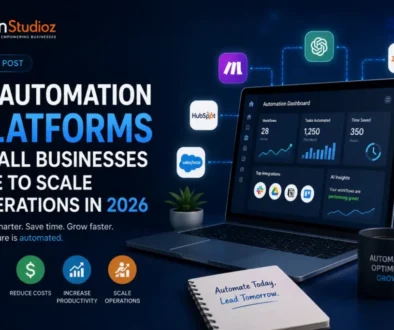
Modern AI dashboards give small business owners real-time insights that were once only available to large enterprises.
Where Small Businesses Are Actually Using AI (And Seeing Results)
At Your Career Place, we always want to cut through the hype and focus on what’s actually working. Here’s where small businesses are putting AI to work right now — and the results they’re seeing:
| Use Case | Common Tools | Reported Benefit |
|---|---|---|
| Marketing & Content Creation (the #1 use case) | ChatGPT, Jasper, Google Gemini | Saves 5–20 hours/month; lowers customer acquisition costs; some businesses double content output with the same team |
| Customer Service Automation | AI chatbots, Intercom, Tidio | Improves customer retention ~20%; reduces response times by up to 72% |
| Administrative Efficiency | Microsoft Copilot, Fireflies.ai, Otter.ai | Workers save an average of 5.6 hours/week; businesses save $500–$2,000/month |
| Dynamic Pricing & Revenue Optimization | AI pricing tools | 94% of users say it’s made their business more competitive |
The most successful small businesses aren’t using one AI tool — they’re using a stack of them. The median number of AI tools used daily by highly integrated small businesses is five. That might sound like a lot, but think of it this way: you probably already use five different apps to run your business. AI is just making each of those apps smarter.
🌟 Boomer’s Perspective: This Is the Great Equalizer
Let’s be honest: for most of the past decade, small businesses have been fighting with one hand tied behind their back. Big corporations had the budget for sophisticated marketing teams, data analysts, 24/7 customer service departments, and custom software. You had… yourself, maybe a few employees, and a lot of hustle.
That’s changing. And the optimistic view — the one that gets us genuinely excited here at Your Career Place — is that AI is the great equalizer small businesses have been waiting for.
Think about what’s now available to a solo entrepreneur or a five-person shop for less than $30 a month: an AI that can draft professional marketing copy, summarize your emails, analyze your sales data, answer customer questions at 2 AM, and help you build presentations that look like they came from a Fortune 500 design team. That’s not a small thing. That’s transformative.
The numbers back this up. Businesses that have embraced AI tools are reporting real, measurable gains — more revenue, lower costs, and more time to focus on the work that actually requires a human touch. The AI adoption curve for new businesses is moving six times faster than it did just seven years ago. That means the tools are getting easier to use, more affordable, and more effective at a remarkable pace.
And here’s the really exciting part: we’re still in the early innings. Google’s Workspace Studio now lets a non-technical business owner build their own custom AI workflows without writing a single line of code. Microsoft Copilot is turning Excel into a tool that can explain your own data back to you in plain English. OpenAI is building AI agents that can handle entire multi-step business processes autonomously.
For small business owners who are willing to learn and adapt, this is one of the most exciting moments in the history of entrepreneurship. The tools that once required a team of specialists are now available to anyone with a laptop and a subscription. The playing field isn’t just leveling — it’s tilting in your favor, if you’re willing to step up and use what’s available.
At Your Career Place, we believe the small business owners who lean into this moment — who take the time to learn even one or two AI tools well — are going to look back in five years and realize this was the turning point.

Entrepreneurs who embrace new tools together tend to adapt faster and build more resilient businesses.
⚠️ Doomer’s Perspective: Slow Down — There Are Real Risks Here
Before you rush out and sign up for every AI tool that promises to transform your business, let’s pump the brakes for a moment. Because while the optimistic case for AI is real, so are the risks — and some of them are serious enough that ignoring them could cost you more than the tools save you.
Here at Your Career Place, we think it’s just as important to talk about what can go wrong as what can go right. So here’s the honest, less comfortable side of the AI story.
Your data might not be as safe as you think. One of the biggest risks facing small businesses right now is what security experts call “shadow AI” — employees using unapproved, public AI tools and inadvertently feeding sensitive company information into them. Client lists, financial data, proprietary processes, confidential communications — all of it can end up being used to train public AI models if you’re not careful about which tools you use and how you use them. The Federal Trade Commission has made it clear: there is no “AI exemption” from consumer protection and privacy laws. If your business handles customer data and you’re not managing your AI tools carefully, you could be exposed to serious legal and reputational risk.
AI makes things up — and it sounds very confident when it does. This is called “hallucination,” and it’s a real problem. AI tools can generate plausible-sounding but completely incorrect information. If you’re using AI to draft customer communications, create marketing materials, or make business decisions, and you’re not carefully reviewing the output, you could be putting misinformation in front of your customers or making decisions based on bad data. The “human in the loop” isn’t optional — it’s essential.
The compliance landscape is getting complicated. New regulations like the EU AI Act and a growing patchwork of U.S. state laws are creating compliance requirements that many small business owners don’t even know exist. Using AI in hiring decisions, for example, can create risks of algorithmic bias and discrimination — and regulators are paying attention. The legal framework around AI is evolving rapidly, and small businesses that aren’t keeping up could find themselves on the wrong side of it.
Tool overload is a real trap. The AI tool market is exploding, and it’s easy to get caught up in signing up for multiple subscriptions without a clear strategy. “Tool overload” — paying for tools you don’t fully use — is a growing problem. And there’s a subtler risk too: overreliance on AI can atrophy the core skills and judgment that make your business distinctive. If your team stops thinking critically because they’re outsourcing everything to an AI, you may find that the quality and authenticity that set you apart starts to erode.
The bottom line from the cautious corner: AI is powerful, but it’s not magic, and it’s not risk-free. Approach it with the same due diligence you’d apply to any significant business investment. Know what you’re signing up for, protect your data, review AI output carefully, and don’t let the excitement of new tools outpace your ability to manage them responsibly.
🔑 Key Takeaways for Small Business Owners
- Check what you’re already paying for. If you use Microsoft 365 or Google Workspace, you likely already have access to powerful AI features. Log in and explore Copilot or Gemini before buying anything new.
- Start with one high-impact use case. Don’t try to overhaul everything at once. Pick your biggest time drain and find one AI tool that addresses it. Master it before expanding.
- Protect your data. Establish a clear company policy on AI tool usage. Never input sensitive client data, financial information, or proprietary business details into public AI tools. Use enterprise-grade tools that keep your data private.
- Always review AI output. Treat everything an AI produces as a first draft. A human being — you or a trusted team member — should always review, fact-check, and edit before anything goes to a customer or is used to make a business decision.
- Stay informed on compliance. The regulatory landscape around AI is evolving. Check in with resources like the SBA’s AI guidance and the NIST AI Risk Management Framework to understand your obligations.
- Think strategically, not reactively. The businesses winning with AI aren’t chasing every new tool — they’re integrating a few tools deeply and using them consistently. Quality of adoption beats quantity of subscriptions every time.
The Bottom Line
The AI revolution for small businesses isn’t coming — it’s already here. The question is no longer whether AI will affect your business, but whether you’ll be the one using it to your advantage or watching your competitors do so.
At Your Career Place, we believe that small business owners who approach AI thoughtfully — embracing the genuine opportunities while managing the real risks — are positioned for some of the most exciting growth in the history of entrepreneurship. The tools have never been more accessible, more affordable, or more powerful.
But “accessible” doesn’t mean “automatic.” You still have to show up, learn, and make smart decisions. That’s always been the small business owner’s edge — and AI doesn’t change that. It just gives you better tools to work with.
Stay curious, stay cautious, and keep building. We’ll be here every week with the latest on what’s working, what’s not, and what’s coming next.