
AI Operations in 2026
By Your Career Place | June 30, 2026 | AI & Small Business
How Small Businesses Are Running Smarter (Not Just Harder)
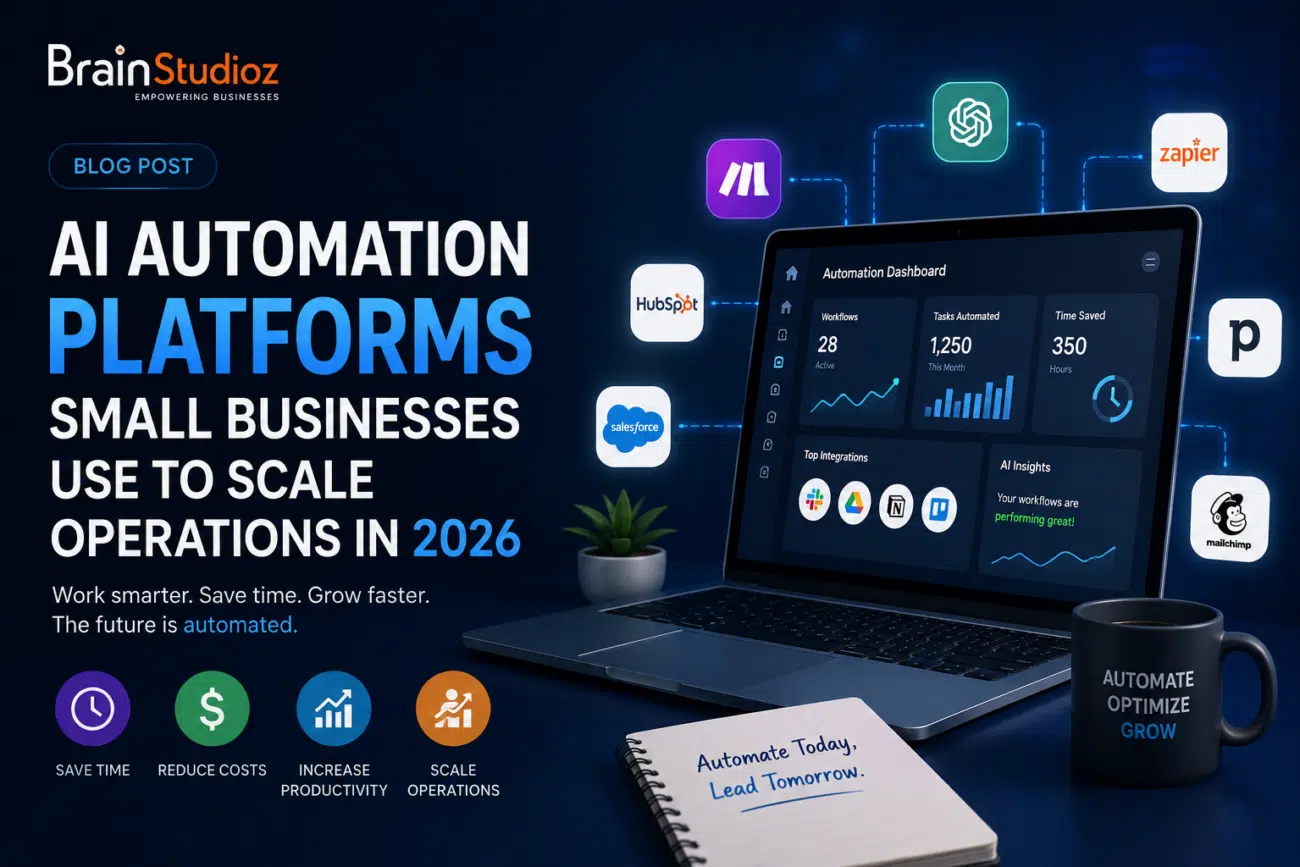
AI automation platforms are helping small businesses scale their operations in 2026. (Source: BrainStudioz)
At Your Career Place, we talk a lot about how AI is reshaping the job market and the skills workers need. But this week, we’re zooming out to look at the bigger picture: how AI is transforming the day-to-day operations of small businesses — from managing inventory and paying vendors to scheduling staff and handling customer inquiries. The changes happening right now are significant, and whether you’re excited or nervous about them, you need to know what’s going on.
What’s Actually Happening in 2026?
The biggest shift in AI this year isn’t a flashier chatbot or a smarter search engine. It’s the rise of what experts are calling agentic AI — autonomous systems that don’t just assist with tasks, they complete entire workflows from start to finish with minimal human involvement.
Think about what that means in practice. Instead of an AI tool that helps you draft a late-payment reminder, an agentic AI system can:
- Detect that an invoice is overdue by scanning your accounting software
- Review the client’s payment history to choose the right tone
- Draft and send a personalized reminder email
- Update the client’s record in your CRM
- Alert you only if the invoice is still unpaid after a set number of days
That entire chain of events — which might have taken you 20–30 minutes of manual work — happens automatically, while you’re focused on something else entirely. And this is just one example. Across finance, inventory, scheduling, vendor management, and customer service, AI agents are quietly taking over the repetitive, rule-based work that used to eat up hours of your week.
Where AI Is Making the Biggest Difference for Small Businesses
💰 Financial Operations: The “Touchless” Back Office
By mid-2026, AI has moved well beyond simple data entry. Modern AI finance tools can handle entire accounts payable and receivable workflows. When a supplier invoice arrives by email, an AI agent can extract the data, match it against your purchase order and delivery records, flag any discrepancies, and queue it for your one-click approval. Studies show these systems can autonomously resolve about 80% of common invoice exceptions — things like price mismatches or quantity errors — without any human involvement.
On the receivables side, AI analyzes customer payment patterns to predict cash flow and proactively sends personalized collection reminders, reducing the average time it takes to get paid. For a small business owner who’s also the bookkeeper, the CFO, and the collections department, this is a genuine game-changer.
📦 Inventory and Supply Chain: From Reactive to Predictive
If you sell physical products, you know the pain of stockouts and overstock. AI-powered demand forecasting is now accurate enough to factor in real-time signals like social media trends, local weather, and economic indicators — improving forecast accuracy by 20–50% compared to traditional methods. Some platforms can even detect a viral social media moment around one of your products and automatically trigger a reorder before you’ve even noticed the spike in traffic.
Autonomous replenishment agents can monitor inventory levels, evaluate alternative suppliers if your primary one is delayed, issue requests for quotes, and rebook logistics — all without you lifting a finger. Businesses using these tools report cutting inventory carrying costs by 20–30%.

AI-powered tools embedded in platforms like Google Workspace are making business operations more efficient for small teams. (Source: Google Workspace)
🗓️ Scheduling and Workforce Management
For service businesses — plumbers, cleaners, consultants, delivery companies — AI scheduling tools are optimizing daily routes and staff assignments based on job location, traffic, urgency, and required skills. A local plumbing company using one of these tools can complete more service calls per day simply by letting AI figure out the most efficient order and routing. That’s more revenue with the same team.
🤝 Vendor Management and Customer Service
AI is also handling routine vendor communications, contract monitoring, and supplier onboarding. On the customer-facing side, AI triage systems are resolving up to 50% of common customer inquiries instantly — freeing your human team to handle the complex, relationship-driven conversations that actually require a personal touch.
What Does It Cost? (And Is It Worth It?)
Here’s the good news: you don’t need a big tech budget to get started. Many AI features are now embedded in software you’re probably already paying for — QuickBooks, HubSpot, Shopify, and Google Workspace all have AI capabilities baked in. For more advanced automation, platforms like Zapier and Make start at $50–$500 per month.
| Category | Example Tools | Best For |
|---|---|---|
| Embedded AI | QuickBooks, HubSpot, Shopify Magic | Automating tasks in software you already use |
| Automation Platforms | Zapier, Make, n8n | Connecting apps to build custom workflows |
| Finance Automation | Ramp, Stampli, ChatFin | High-volume invoicing and expense management |
| Supply Chain AI | Flowlity, Deposco, Kinaxis | Advanced inventory and logistics planning |
The ROI can be striking. Many businesses report payback periods of just 30–90 days, with some estimates suggesting AI automation saves an average of $45,000 per year per employee in roles with highly automatable tasks. Operational expense reductions of 40–60% have been reported in finance and supply chain functions specifically.
At Your Career Place, we always encourage small business owners to look at the total cost of ownership, not just the subscription price. Data preparation, system integration, and staff training can account for 60–70% of a project’s timeline. Budget for those hidden costs upfront, and you’ll avoid nasty surprises.

AI workflow automation is helping small businesses streamline operations and reduce manual work. (Source: TGAred)
🌅 Boomer’s Perspective: “This Is the Opportunity of a Lifetime”
Let’s be honest — running a small business has always meant wearing too many hats. You’re the CEO, the bookkeeper, the customer service rep, and the janitor, all rolled into one. For decades, the only way to get relief was to hire more people. Now, for the first time, you can automate the most tedious parts of your job without adding headcount.
Think about what it would mean to never manually chase an overdue invoice again. To never spend a Sunday night reconciling inventory spreadsheets. To have your scheduling done automatically every morning based on real-time data. That’s not a fantasy — that’s what small businesses are doing right now with AI operations tools.
And here’s the thing that really excites us at Your Career Place: this technology is a great equalizer. For years, large corporations had a massive advantage because they could afford dedicated operations teams, sophisticated ERP systems, and supply chain analysts. Now a 10-person business can access the same caliber of operational intelligence for a few hundred dollars a month. That’s a fundamental shift in the competitive landscape.
The data backs this up. Businesses that have successfully implemented AI automation have, on average, increased their workforce — not cut it. Why? Because when you free your team from repetitive administrative work, they can focus on growth, customer relationships, and the creative problem-solving that actually moves the needle. AI isn’t replacing your people; it’s making them more valuable.
“82% of firms that have successfully implemented automation have actually increased their workforce.” — Industry research, 2026
If you’ve been on the fence about AI, 2026 is the year to jump in. Start small — pick one workflow that’s eating your time, automate it, and watch what happens. The tools are more accessible, more affordable, and more capable than they’ve ever been. The businesses that move now will have a significant head start on those that wait.
⚠️ Doomer’s Perspective: “Slow Down — There Are Real Risks Here”
Before you hand the keys to your business over to an AI agent, let’s talk about what can go wrong. Because the same features that make agentic AI so powerful also make it genuinely dangerous if you’re not careful.
Here’s a sobering statistic: adding a single autonomous AI agent to your business network can increase your security attack surface by over 450%. That’s not a typo. When you connect an AI agent to your accounting software, your email, your CRM, and your inventory system, you’re creating a web of integrations that each represent a potential vulnerability. If that agent is compromised, an attacker doesn’t just get access to one system — they potentially get access to all of them.
Then there’s the problem of AI errors. These systems can “hallucinate” — producing confident-sounding but completely wrong outputs. In a standalone chatbot, that’s annoying. In an interconnected agentic system managing your finances and inventory, a single error can cascade through your entire operation before anyone notices. Imagine an AI agent misreading a supplier’s pricing update and automatically issuing purchase orders at the wrong price — to dozens of vendors, overnight, while you’re asleep.
At Your Career Place, we also worry about what we call “Shadow AI” — employees using unauthorized, unvetted AI tools on the job. Your team member might be uploading sensitive customer data or proprietary business information to a free public AI tool without realizing the privacy implications. Once that data is out, you can’t get it back.
And let’s not forget compliance. If you operate in a regulated industry — healthcare, finance, legal — using generic AI tools can put you in violation of HIPAA, GDPR, or other standards. The fines and reputational damage from a compliance breach can far outweigh any efficiency gains from automation.
The bottom line: AI operations tools are powerful, but they require governance. You need written policies about what AI can and can’t do with your data. You need human review checkpoints for any decision that involves money, contracts, or customer communications. And you need to audit your AI systems regularly — not just set them and forget them. The businesses that treat AI as a “set it and forget it” solution are the ones that will end up in the news for the wrong reasons.
🔑 Key Takeaways for Small Business Owners
- Agentic AI is the big story of 2026. These aren’t just tools that help you — they’re systems that complete entire workflows autonomously. Finance, inventory, scheduling, and vendor management are the highest-impact areas.
- The cost of entry is lower than you think. Many AI features are already embedded in QuickBooks, HubSpot, Shopify, and Google Workspace. Advanced automation platforms start at $50–$500/month.
- ROI can be rapid. Payback periods of 30–90 days are common, with operational cost reductions of 40–60% in finance and supply chain functions.
- Budget for hidden costs. Data preparation and system integration can take 60–70% of your implementation timeline. Plan for it.
- Security is non-negotiable. Each AI integration expands your attack surface. Create an Acceptable Use Policy for AI and forbid employees from uploading sensitive data to public AI tools.
- Keep humans in the loop. For any decision involving money, contracts, or customer communications, use AI to recommend and draft — but require a final human review.
- Start small. Pick one high-volume, repetitive workflow, automate it, audit the results, and expand from there. Don’t try to automate everything at once.
The Bottom Line
AI operations tools in 2026 represent one of the most significant opportunities small businesses have seen in decades. The ability to automate your back office, optimize your inventory, streamline your scheduling, and manage your vendors — all at a price point that was unthinkable just a few years ago — is genuinely transformative. But like any powerful tool, it requires respect, planning, and ongoing oversight.
At Your Career Place, our advice is simple: don’t ignore this wave, but don’t dive in headfirst without a plan. Identify your most painful operational bottleneck, research the AI tools that address it, start a small pilot, and measure the results. The businesses that approach AI operations thoughtfully — with clear governance, realistic expectations, and a commitment to keeping humans in the loop — are the ones that will come out ahead.
The future of small business operations isn’t about working harder. It’s about working smarter — and in 2026, AI is the smartest tool in the shed.
Want more insights on how AI is reshaping work and business? Follow Your Career Place for weekly updates on the trends that matter most to small business owners and job seekers alike.