AI Marketing in 2026
The Small Business Game-Changer You Can’t Ignore

AI marketing tools are transforming how small businesses compete in 2026.
If you’ve been running a small business for any length of time, you know the marketing struggle all too well. You’re competing against companies with entire marketing departments, six-figure ad budgets, and teams of designers and copywriters — and you’re doing it with a fraction of the resources. That gap used to feel insurmountable. In 2026, it’s closing fast, and Your Career Place is here to break down exactly how.
Artificial intelligence has quietly become the great equalizer in small business marketing. We’re not talking about some distant, sci-fi future — we’re talking about tools you can sign up for today, often for free or under $20 a month, that can automate your content creation, personalize your customer outreach, optimize your ad spend, and give you data-driven insights that used to require a full analytics team. The average small business now uses approximately five AI tools, and those that have embraced AI are growing revenue at 2.5 times the rate of their less-automated competitors.
This week, Your Career Place is diving deep into the biggest AI marketing trend of 2026: AI-powered hyper-personalization — and what it means for your business, for better and for worse.
What’s Actually Happening in AI Marketing Right Now?
The buzzword of 2026 in marketing circles is hyper-personalization. But this isn’t just about putting someone’s first name in an email subject line. Today’s AI tools can analyze a customer’s purchase history, browsing behavior, location, and even the time of day they’re most likely to engage — and then automatically generate a uniquely tailored message, offer, or product recommendation for that specific person, in real time.
Think about what that means practically. A local bakery can send a customer who always orders gluten-free items a personalized text on Friday afternoon about a new gluten-free weekend special. A boutique clothing shop can show each website visitor a homepage curated to their style preferences. A B2B consultant can automatically send a prospect a follow-up email that references their specific industry challenges — without lifting a finger.
The tools making this possible are more accessible than ever. Platforms like Mailchimp AI and Klaviyo use predictive segmentation to automatically group your customers and send the right message at the right time. HubSpot AI scores your leads so you know who’s most likely to buy. Jasper AI and Canva Magic Studio let you generate professional ad copy and visuals in minutes. And a new wave of tools like Averi are handling the entire content workflow — from strategy to publishing — in a single platform.
There’s also a seismic shift happening in how people search for information. The rise of AI-powered search engines (think ChatGPT, Gemini, and Perplexity) means that traditional SEO is evolving into Answer Engine Optimization (AEO) — optimizing your content to appear in AI-generated answers, not just Google’s blue links. For small businesses, getting ahead of this curve now could be a major competitive advantage.

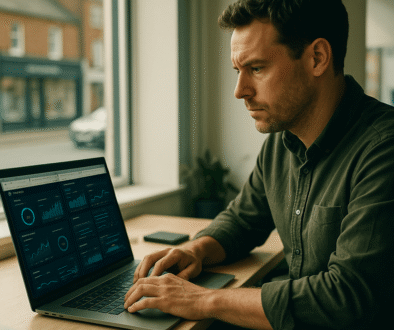
Small business owners are increasingly turning to AI tools to compete with larger brands on marketing.
The Numbers That Should Get Your Attention
Before we get into the perspectives, let’s look at some hard numbers that Your Career Place found in our research:
- AI marketing tools save employees an average of 2.5 hours per day, while improving output quality by 35%.
- AI-driven ad platforms like Google Performance Max can reduce wasted ad spend by 40–60% through predictive bidding.
- AI-powered personalization boosts customer engagement by 30–50%.
- The typical annual cost for AI marketing tools for a small business is $1,500–$2,500, with an average payback period of just 3–4 months.
- One HVAC company that adopted AI marketing tools saw lead volume increase by 42%, reduced marketing time by 70%, and grew annual revenue by $120,000.
- AI-powered chatbots now handle up to 85% of retail customer service interactions.
Those are real numbers from real businesses. But as with any powerful technology, there are two sides to this story. Let’s hear from both.
🌟 Boomer’s Perspective: “This Is the Best Time in History to Run a Small Business”
Look, I’ve been running my hardware store for 28 years. I’ve seen fax machines, the internet, smartphones — every wave of technology that was supposed to either save us or destroy us. And here’s what I’ve learned: the tools that stick around are the ones that actually make your life easier. AI marketing? This one’s a keeper.
For the first time ever, I can compete with the big box stores on marketing. I’m not exaggerating. Last quarter, I set up an AI email campaign through Mailchimp that automatically sends personalized recommendations to customers based on what they’ve bought before. My open rates went up 40%. I didn’t write a single email — the AI did it. I just approved them.
The beauty of these tools is that they give small business owners their time back. I used to spend Sunday evenings writing social media posts for the week. Now, Canva Magic Studio generates a week’s worth of posts in about 15 minutes. That’s time I spend with my family, or thinking about how to grow the business — not grinding away on tasks a computer can do better than me anyway.
And the personalization piece? That’s where it gets really exciting. Customers today expect to feel known. They don’t want generic blasts — they want to feel like you understand them. AI makes that possible for a two-person shop. We can now deliver the kind of customer experience that used to require a team of five. That’s not a threat — that’s an opportunity.
“AI isn’t replacing the small business owner. It’s replacing the parts of the job that were never really ‘you’ in the first place — the repetitive, the administrative, the mechanical. What’s left is the stuff only you can do: relationships, judgment, vision.”
At Your Career Place, we’ve seen this play out with countless small business owners who were skeptical at first and are now true believers. The learning curve is real, but it’s shorter than you think. Start with one tool, solve one problem, and build from there. The ROI will convince you to keep going.
⚠️ Doomer’s Perspective: “We’re Building on a Foundation We Don’t Fully Understand”
I want to be clear: I’m not anti-technology. I use AI tools in my own consulting practice. But I think the breathless enthusiasm around AI marketing is glossing over some serious risks that small business owners need to think carefully about — before they’re in too deep.
First, let’s talk about the data problem. All of this hyper-personalization runs on customer data. To deliver those tailored experiences, you need to collect, store, and process significant amounts of personal information. For a small business, that creates real legal exposure. GDPR, CCPA, and a growing patchwork of state privacy laws mean that mishandling customer data — even accidentally — can result in fines that could cripple a small operation. Most small business owners are not data privacy lawyers, and most AI tool vendors are not going to hold your hand through a compliance audit.
Second, there’s the authenticity trap. Customers are getting smarter. They can increasingly tell when they’re receiving AI-generated content, and the backlash is real. There’s a growing “AI slop” phenomenon — a term for the flood of low-quality, generic AI-generated content that’s starting to pollute the internet. If your brand becomes associated with that, the damage to customer trust can be hard to repair. The same tools that promise to make you sound more personal can, if used carelessly, make you sound like a robot.
Third, consider the dependency risk. When you build your entire marketing operation around a handful of AI platforms, you’re handing significant control to those vendors. What happens when they raise prices? When they change their algorithms? When they get acquired or shut down? Small businesses that have outsourced their marketing brain to an AI platform may find themselves scrambling when the platform changes the rules.
Finally, and perhaps most importantly: AI is accelerating the pace of competition. Yes, it levels the playing field — but it levels it for everyone, including your competitors. If every small business in your market is using the same AI tools to generate the same personalized emails and the same optimized ad campaigns, the differentiation disappears. You’re back to competing on price and relationships — which is where you started, just with a bigger monthly software bill.
At Your Career Place, we believe in honest conversations about technology. The risks here are manageable — but only if you go in with your eyes open.

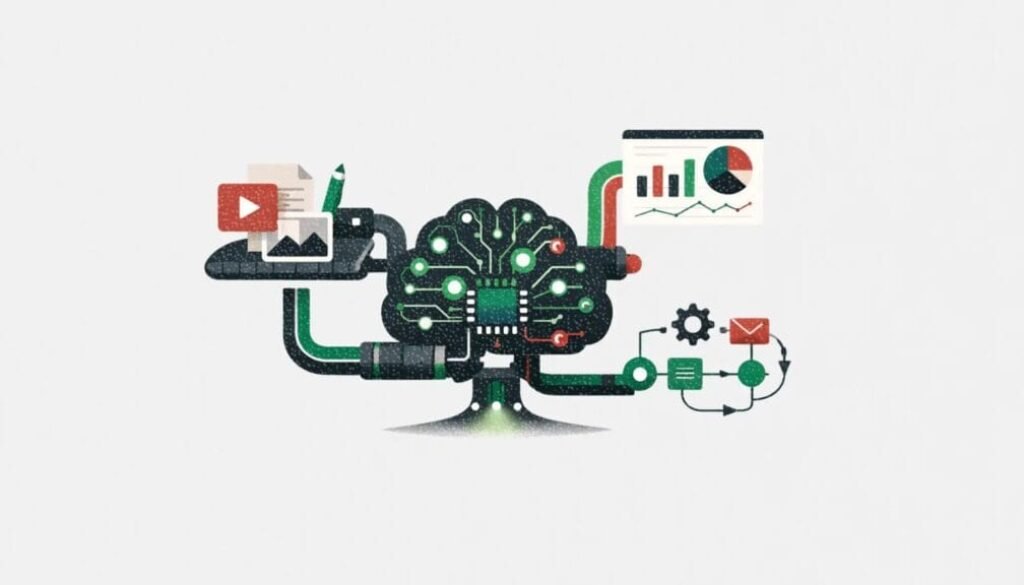
AI-powered automation is transforming marketing workflows — but requires careful human oversight.
The Practical Middle Ground: How to Use AI Marketing Wisely
So where does that leave you, the small business owner trying to make smart decisions? Here’s the balanced roadmap that Your Career Place recommends:
- Start with one pain point. Don’t try to overhaul your entire marketing operation at once. Pick the single most time-consuming task — whether that’s writing social media posts, sending follow-up emails, or designing graphics — and find one AI tool that solves it. Most have free trials.
- Audit your data first. Before you invest in personalization tools, make sure your customer data is clean, organized, and properly consented. Garbage in, garbage out — and legal liability in.
- Keep a human in the loop. Always review AI-generated content before it goes out. AI is a powerful first draft, not a final product. Your brand voice, your values, and your judgment are irreplaceable.
- Prioritize integration. As you add tools, choose ones that connect to each other. The trend toward all-in-one platforms is real — 71% of SMBs are consolidating their tech stacks. Fewer, better-integrated tools beat a sprawling collection of disconnected apps.
- Measure everything. Track your open rates, conversion rates, and customer lifetime value before and after implementing AI tools. If you can’t show the ROI, you can’t justify the investment — or know when to change course.
- Stay curious about AEO. Answer Engine Optimization is the next frontier. Start thinking about how your content answers specific questions, not just how it ranks for keywords. This is where the next wave of organic traffic will come from.
🔑 Key Takeaways
- AI-powered hyper-personalization is the defining marketing trend of 2026 — and it’s now accessible to small businesses at a fraction of the cost it would have taken just two years ago.
- The ROI is real: businesses using AI marketing tools are saving hours daily, cutting ad waste by up to 60%, and boosting engagement by 30–50%.
- The risks are real too: data privacy compliance, authenticity concerns, vendor dependency, and the commoditization of AI-generated content all deserve serious attention.
- Answer Engine Optimization (AEO) is emerging as the next evolution of SEO — small businesses that adapt now will have a head start.
- The smartest approach is strategic and incremental: start small, keep humans in the loop, prioritize data quality, and measure your results.
- AI is a tool, not a strategy. The businesses that will win are those that use AI to amplify their unique human strengths — not replace them.
The AI marketing revolution is not coming — it’s already here. The question isn’t whether to engage with it, but how to do so thoughtfully. At Your Career Place, we’ll keep bringing you the honest, balanced perspective you need to make smart decisions for your business. Because the goal isn’t just to keep up with the technology — it’s to use it to build something that lasts.
Have questions about AI marketing tools for your small business? Drop a comment below or reach out to the team at Your Career Place — we’d love to hear what’s working (and what isn’t) for you.
© 2026 Your Career Place. All rights reserved. | This article is part of our weekly AI for Small Business series, published every Tuesday.