

Cities Where Paydays Favor Skipping College
Just because everyone tells you college is the only way to a high-paying career, it doesn’t always line up with what’s actually happening in some of America’s fastest-growing cities. In this post, I’m digging into where your hustle, skills and smart choices can beat a diploma, using research we pulled together at Your Career Place. I’ll walk you through the cities where you can realistically chase upper-class income without a degree, so you can map out your own path instead of just following someone else’s playbook.
Key Takeaways:
- In cities like Austin, Oklahoma City, Miami, Salt Lake City and Phoenix, a driven person without a college degree can realistically build upper-class wealth through small business, tech-adjacent roles, real estate and other non-degree-heavy paths – exactly the kind of playbook we talk about all the time at Your Career Place.
- What really sets these cities apart is the combo of fast-growing economies, strong startup scenes and relatively manageable costs of living, which makes it way easier to start something, scale it and keep more of what you earn, according to the analysis that inspired this Your Career Place breakdown.
- If you’re thinking about skipping college or pivoting out of a degree-focused career track, Your Career Place would flag these cities as prime spots where hustle, smart planning and a bit of risk-taking can matter more than a diploma when it comes to chasing that upper-class lifestyle.
Why College Isn’t the Only Path
What if the biggest wealth move you make isn’t picking a major, but picking a city? When I look at the numbers, four-year degrees are starting to look more like an optional tool than a golden ticket, especially in places like Austin and Phoenix where skilled trades, sales, logistics and tech-adjacent roles pay serious money. Even public universities skew rich now – These State Schools Also Favor the One Percent – so at Your Career Place I’m way more interested in the paths that let you keep your cash, build skills fast and actually get to that upper-class lifestyle.
Let’s Talk About Student Debt
How wild is it that chasing a “safe” path now leaves so many people buried in IOUs? Federal student loan debt in the U.S. is sitting around 1.7 trillion dollars, and the average borrower walks out owing roughly 30 grand before they’ve even landed a real paycheck. I’d rather see you throw that money at a duplex in Oklahoma City, a box truck in Phoenix or a web design side hustle in Austin – that’s the kind of shift we talk about nonstop at Your Career Place.
What’s the Job Market Looking Like?
When you zoom in on these cities, the job market tells a very different story than the “no degree, no future” line you and I grew up hearing. Austin’s tech and creative scenes are packed with six-figure sales reps, support specialists and self-taught coders. Phoenix keeps adding construction, logistics and solar jobs that pay 25 to 40 dollars an hour without asking for a bachelor’s. Miami and Salt Lake City are quietly building armies of licensed agents, installers and operators, so your income is capped more by hustle than by a diploma.
In practical terms, that means you’ve got leverage. A solar crew lead in Phoenix can clear 80,000 dollars with overtime, and a top insurance or real estate agent in Miami can break 150,000 once their pipeline is rolling, degree or not. Austin startups constantly poach talented SDRs and account managers who learned on the job, while Salt Lake’s SaaS companies hire customer success and implementation folks who started in call centers. I see it play out over and over in the data we use at Your Career Place: employers in these metros care if you can sell, fix, code, coordinate and communicate – not where you sat for four years.
Skills Over Degrees: Here’s Why
What really moves the needle for your paycheck in these cities is not the letters after your name, it’s what you can do on Monday morning. A journeyman electrician in Austin or Phoenix can out-earn a lot of liberal arts grads, especially once overtime and project bonuses kick in. Same with a high-performing sales rep in Salt Lake City or a savvy Airbnb operator in Miami. At Your Career Place, I keep seeing the same pattern: certifications, portfolios, apprenticeships and real results put you at the front of the line way faster than a generic diploma.
And the best part is, skills compound. You might start as a 20 dollar an hour technician in Oklahoma City, then learn estimating, project management and client communication and suddenly you’re at 80,000 plus profit share. A self-taught marketer in Austin who masters SEO, short-form video and email funnels can flip that into an agency or course business that prints cash. Employers and customers in these growth markets care that you hit KPIs, close deals and solve problems – and that’s exactly the stuff we focus on building with you at Your Career Place.

The Lowdown on Austin, Texas
Austin is basically the poster child for getting rich without a diploma if you play your cards right. I’m talking a top-20 global startup ecosystem, unicorns all over the place, and a cost of living that still undercuts San Francisco by thousands a month. At Your Career Place, I see Austin as that rare mix of high upside and relatively low risk, especially if you’re willing to start in a hands-on role and ride the growth wave.
What Makes Austin So Attractive?
Part of what pulls you into Austin is how fast money and people are flowing in, without everything feeling locked up by old-school gatekeepers. You’ve got no state income tax, a ton of remote workers, and founders who literally don’t care where you went to school if you can ship results. I love that vibe, and at Your Career Place I look at Austin as one of the few places where hustle really can outmuscle a résumé.
The Job Scene: Who’s Hiring?
On the ground, you’ve got big names like Tesla, Apple and Oracle expanding, plus a swarm of startups in software, gaming, digital marketing and clean energy. What really matters for you, though, is that a lot of roles – tech support, sales, logistics, field technicians, customer success – don’t require a four-year degree if you can prove skills. I see job postings routinely in the 50,000 to 80,000 range for people who start in those tracks and level up fast.
Digging deeper, the pattern I see at Your Career Place is pretty clear: non-degree candidates break in through entry paths like SDR (sales development rep), help desk, warehouse operations or AV/IT installation, then step into higher paying roles within 18 to 36 months. A Tesla Gigafactory tech making 25 to 30 an hour, a solar install lead hitting 70k, or a SaaS account executive crossing 90k with commission is not rare here. If you’re willing to stack certifications, learn on YouTube, and network at Austin’s endless meetups, the job ladder is surprisingly climbable.
Are the Salaries Really Worth It?
Salary-wise, Austin can absolutely make skipping college feel like the right call, but only if you’re intentional about your path. I regularly see non-degree workers clearing 60,000 to 90,000 in trades, tech-adjacent roles and sales, which stacks up well against a median household income around the mid-80,000s. The trick is outpacing rising rents by moving up the income ladder quickly, not staying stuck in 18-an-hour jobs for years.
From what I’ve tracked at Your Career Place, the people who win here treat Austin like a launchpad, not a vacation. They share a few habits: they jump on overtime or commissions early, they shift into higher leverage roles by year two (think project management, field leadership, closing sales), and they protect their upside by living with roommates or in cheaper suburbs while they stack cash. So yeah, the salaries are worth it – if you treat your first few years in Austin like an intentional growth sprint, not just a chance to enjoy tacos and live music every night.
Oklahoma City: Hidden Gem for Fast Cash
You know that friend who quietly stacks serious money while everyone underestimates them? That’s Oklahoma City. Median home prices hover around the low $200Ks, you’ve got no state-level city income tax, and hourly rates in trades, logistics and energy can jump into the $25 to $35 range without a bachelor’s. At Your Career Place, I keep seeing OKC pop up in client stories where someone goes from entry-level to legit six-figure potential in under a decade, simply because the ceiling here is higher than people think.
Cost of Living vs. Paychecks: What’s the Score?
Compared with coastal cities where rent alone chews up half your paycheck, Oklahoma City feels almost old-school affordable. Housing costs sit roughly 20% to 30% below the national average, utilities and groceries are cheaper, and you can still rent a decent one-bedroom for under $1,100 in many neighborhoods. If you’re pulling in $50,000 to $60,000 in a trade, construction, or logistics role, that income stretches like $80,000-plus would in LA, which is exactly why I flag OKC for Your Career Place readers chasing freedom, not just a fancy ZIP code.
Industries on the Rise in OKC
While everyone else thinks OKC is just about oil, the city is quietly diversifying into aerospace, logistics, health care support roles and even startup tech. You’ve got aerospace employers tied to Tinker Air Force Base, warehouse and distribution operations feeding off the I-35 corridor, and tons of electrician, HVAC and industrial maintenance work paying strong hourly wages without needing a 4-year degree. At Your Career Place, I see OKC’s job boards loaded with postings that offer on-the-job training, overtime and solid benefits, which is your shortcut to stacking cash fast.
Diving a bit deeper into those industries, aerospace and defense suppliers in the OKC area often start skilled technicians around $22 to $28 an hour, with experienced folks crossing into the $70,000 to $80,000 range once certifications stack up. Logistics companies pay shift leads and CDL drivers solid money, especially when you tack on overtime and bonuses for night shifts. And then you’ve got health care support – think medical assistants, techs, phlebotomists – where short programs at community colleges or trade schools can move you into stable roles in under 18 months. Pair that with a small side hustle, like mobile mechanic services or lawn care, and suddenly you’re staring at income numbers people assume require a degree.
My Take on Work-Life Balance Here
From what I’ve seen and heard, Oklahoma City gives you a pretty chill work-life combo compared with bigger, flashier metros. Commutes are usually under 25 minutes, even for people working near downtown or on the industrial edges of the city, so you’re not burning two hours a day in traffic. Many blue-collar and tech-support roles run consistent schedules, and even when there’s overtime, it’s optional more often than not. That means you can grind when you want to stack cash, then dial it back and actually enjoy nights and weekends – which, at Your Career Place, is a huge part of how I define real wealth.
What really hits me about OKC is how life doesn’t have to revolve around your job unless you want it to. You can clock out at 4 or 5, hit a Thunder game, grab cheap tacos with friends, or work on your side business without feeling completely drained. Because the cost of living isn’t out of control, you’re not forced into constant overtime just to stay afloat, which changes your whole attitude toward money and career planning. And if you choose a trade or logistics job with a 4-day workweek or rotating shifts, you can carve out big blocks of time for family, hobbies or scaling that side hustle into something real. At Your Career Place, that’s the kind of setup I love pointing to: where your job funds your life, it doesn’t consume it.
Miami: Sun, Fun, and Serious Cash
With Miami job growth running around 3% a year and median household income topping $57,000, I see a city where the party vibe hides some serious money moves. High-paying roles in logistics, trade, hospitality and fintech mean you can skip the four-year degree and still chase upper-class income. At Your Career Place, I lean on Miami as a case study for how lifestyle cities can double as wealth hubs if you play your cards right.
Why Working in Miami Could Be Your Best Bet
Because more than 70% of Miami residents are renters and consumer spending keeps climbing, I see constant demand for service, sales and operations talent that doesn’t care about your diploma. You get access to Latin American trade routes, booming tourism and a big remote-worker crowd with money to spend. If you plug into those ecosystems, Your Career Place data says your earnings ceiling is way higher than people assume.
The Gig Economy: Is It Thriving?
Over 16% of workers in the Miami metro are involved in some form of independent or gig work, which tells me the hustle culture isn’t just a TikTok trend here. Rideshare, food delivery, short-term rentals, freelance marketing, yacht charters – it’s all in play, especially around Brickell, Wynwood and South Beach. You can stack multiple income streams instead of waiting for a single employer to “give” you a raise.
When I dig into Miami’s gig scene for Your Career Place, what jumps out is how quickly your income can scale once you stop treating gigs as pocket money and start treating them like a business. A driver focused on airport runs and cruise-ship days can clear $1,200+ a week, while Airbnb co-hosts managing 4 or 5 condos can hit $70,000 a year without owning property. Add side contracts – social media work for local restaurants, tour hosting, concierge-style services for wealthy visitors – and you can build a 6-figure patchwork of work that no one college program could ever neatly package for you.
What Jobs Pay More Without a Degree?
Construction supervisors in Miami routinely clear $75,000 to $90,000 a year, and many started as laborers with zero college on their resume. Port of Miami jobs in logistics and freight coordination often sit in the $55,000 to $80,000 range after a few years of experience. If you mix that with high-end real estate support roles and trade work, Your Career Place sees a clear path to upper-class income without student loans.
When I map out Miami pathways for Your Career Place readers, a few jobs keep popping up: HVAC techs who specialize in high-end condos, marine mechanics working on boats and yachts, real estate wholesalers who flip contracts instead of houses, and bilingual sales reps in fintech or payments. A marine mechanic charging $120 an hour on luxury vessels can out-earn plenty of degree holders, and a sharp bilingual closer in a Brickell fintech startup can push past $100,000 with commission. It all comes down to stacking skills the local economy actually values, not the letters after your name.
Salt Lake City: More Than Just a Place to Ski
You might picture powdery slopes and national parks, but Salt Lake City quietly pays like a legit tech hub. I’m talking median household incomes brushing past $80,000, no state tax on Social Security, and a cost of living that’s still below West Coast madness. When I ran the numbers for Your Career Place, what stood out was how far your paycheck stretches here if you skip the tuition bill and get straight to earning and investing.
The Economy: How’s It Holding Up?
Salt Lake’s economy keeps humming along, with unemployment often a full percentage point below the national rate and job growth around 2%-3% a year. You’ve got tech, healthcare, finance, outdoor gear and logistics all overlapping in one metro. I really like how that mix cushions you during downturns – if one sector slows, you’re not stuck, you’ve still got options for your next move.
Job Opportunities in the Beehive State
Across the Salt Lake metro, I see solid-paying roles in tech support, construction trades, distribution, outdoor recreation gear and advanced manufacturing that don’t demand a four-year degree. Utah added tens of thousands of jobs in the last few years, and a big chunk landed in these skill-based roles. So if you’re willing to learn on the job and stack certifications, you can move up faster than you might expect.
What makes Salt Lake really interesting to me, especially as we map this out at Your Career Place, is how many companies will train you if you just show up and grind. Warehouses and distribution centers along the I-15 corridor promote entry-level workers into supervisor roles in 1-3 years. Tech companies hire customer support reps or QA testers without degrees, then help them pivot into higher-paying product or systems roles. Add in state-funded workforce programs and bootcamps, and suddenly your “no degree” path doesn’t feel like a dead end at all.
The Best Paying Jobs Without a Degree
In Salt Lake, you can realistically pull in $70,000-$90,000 a year without a bachelor’s if you aim for the right tracks. Think electricians, HVAC techs, construction supervisors, freight and distribution managers, tech support leads, even some web developers who learned via bootcamps. Many of these roles offer overtime or bonuses, so your real annual income can creep a lot higher than the posted salary band.
When I dug into local wage data for Your Career Place, I kept seeing the same pattern: skilled trades and logistics roles often start around $22-$28 an hour and climb into the $40+ range with experience. Commercial electricians on big projects, CDL drivers on regional routes, and data center technicians for cloud companies all have earning ceilings that rival some degree-required office jobs. Pair that with Salt Lake’s relatively sane housing costs (at least compared to coastal cities) and you’ve got a setup where skipping college doesn’t mean capping your income – it just means you take a different, more direct route to it.
Phoenix: Where the Heat Equals Opportunity
Recent migration stats keep putting Phoenix near the top for people chasing better pay and lifestyle, and I get why. You’ve got a metro where population growth, new construction permits and small-business formations are all climbing at the same time. When I plug Phoenix into my Your Career Place spreadsheets, I see a city where you can start in a trade, jump into real estate or logistics, then level up fast if you play it smart.
Job Markets That Are Booming
Construction, warehousing and healthcare support are basically on fire here, with Phoenix adding thousands of jobs a year in those sectors alone. You’ve got massive logistics hubs along the I-10 corridor, constant residential builds around suburbs like Gilbert and Peoria, and an expanding healthcare footprint as retirees pour in. For you, that means forklift certs, HVAC apprenticeships and medical assistant roles that don’t need a 4-year degree but still give serious promotion paths.
Salaries That’ll Make You Raise an Eyebrow
Entry-level solar installers can start around $20 to $24 an hour in Phoenix, and experienced folks easily crack $70,000 a year. I’m also seeing CDL drivers pulling $65,000 to $85,000 with overtime, and construction foremen with no degree breaking into the $90,000 range. When Your Career Place runs the numbers, those wages put you well above the city’s roughly $72,000 median household income surprisingly fast.
What really jumps out at me is how quickly pay scales jump once you grab a cert or two and stick with one of these paths for 3 to 5 years. A warehouse worker starting at $18 an hour can move into lead roles near $27 an hour and then operations supervisor pay at $65,000-plus if they’re willing to handle nights or bigger teams. Same story with trades: a beginner electrician apprentice might earn just under $20 an hour, but seasoned journeymen in busy Phoenix shops are clearing $80,000 and sometimes topping $100,000 with side gigs. That’s the kind of income that lets you stack cash for rentals or business ideas without ever setting foot in a lecture hall.
Living Expenses: Is It Worth the Pay?
Rents and home prices have climbed, but Phoenix still sits cheaper than Los Angeles or San Diego by a wide margin. Typical rent floats around $1,600 a month for a decent 1-bedroom, and median home prices hover in the mid-$400,000s, which isn’t dirt-cheap but it’s workable if you’re pulling $70,000-plus. When I model budgets at Your Career Place, I see room for saving, especially if you house-hack or share a place for a few years.
The trade-off is that utilities and summer AC bills can punch a little harder, so you’ve got to factor that into your real take-home lifestyle. But if you stack those higher Phoenix paychecks against costs for gas, groceries and insurance, the math often beats coastal cities by a mile. I’ve seen people on $60,000 to $75,000 here manage a car payment, modest rent, full emergency fund and still sock away a couple hundred a month for investing. That’s the sweet spot: your income actually stretches far enough to build wealth, not just survive.
The Surprising Cities Where You Can Cash In
Most people assume you’ve got to be in New York or San Francisco to hit upper-class money, but the data your friends at Your Career Place pulled tells a different story. In cities like Austin, Oklahoma City and Miami, median pay in fields like tech support, construction management and logistics can push into the 80,000 to 100,000 dollar range without a diploma. You’re basically trading prestige for momentum – faster promotions, cheaper overhead and way better odds of actually keeping what you earn.
Lesser-Known Cities with Big Payday Potential
Not every high-earning spot has a flashy skyline, and that’s where things get interesting for you. Places like Tulsa, Boise and Des Moines quietly post median household incomes in the 70,000 to 80,000 dollar range while keeping housing costs 20 to 30 percent below the national average. I’ve seen readers of Your Career Place move into roles like field service tech or freight broker in these cities and hit six figures with overtime and bonuses, all without stepping foot in a lecture hall.
What Jobs Work Best Without a Degree
People think “no degree” means low pay, but in these cities it often means you skipped the debt and went straight to the money. Roles like sales rep, construction supervisor, HVAC tech, real estate agent and IT support regularly land in the 60,000 to 90,000 dollar range, especially with commissions or overtime. When you pair those jobs with fast-growing markets like Austin or Phoenix, your earning ceiling climbs way higher than most people expect.
What really moves the needle, though, is stacking the right skills on top of these jobs. You might start as an entry-level technician making 22 dollars an hour, then pick up certifications, learn basic sales and suddenly you’re the person closing 10,000 dollar projects every week. In our Your Career Place community, I’ve watched readers go from help desk roles at 20 dollars an hour to cloud support at 80,000 plus by jumping into short bootcamps and on-the-job learning. Pair that with side income – think real estate referrals or freelance installs – and you’ve basically built your own degree-free career ladder.
Are These Places Affordable?
Everyone hears “high pay” and assumes the rent eats it all, but in these cities the math often tilts in your favor. In Oklahoma City, for example, average rent sits around 1,100 dollars while trades and logistics jobs can clear 60,000 dollars a year, which gives you real breathing room. Phoenix and Salt Lake aren’t dirt cheap anymore, but when your income grows faster than your housing costs, your savings rate can quietly jump into that 20 percent plus range.
What I really want you to see is how affordability multiplies every smart move you make. If you’re earning 70,000 dollars in Miami and keeping housing around 30 percent of your income, you can still stash 1,000 to 1,500 dollars a month into investments or a small-business fund. That’s where Your Career Place really leans in with readers – helping you use those lower living costs in places like Austin or Tulsa to buy a duplex, start a mobile service business or build an online brand while your peers in pricier cities are just trying to stay afloat.
Seriously, Why These Cities?
In each of these cities, non-degree jobs paying $70,000 to $90,000 are actually showing up in local postings, not just national averages, which tells you the opportunity is real. When I dug into the numbers for Your Career Place, I kept seeing the same combo: fast population growth, a steady stream of new businesses filing LLCs, and housing that still lets you buy in before prices hit coastal insanity levels. That mix is why your odds of stacking cash without a diploma are just flat-out better here.
Economic Growth Trends You Can’t Ignore
From 2010 to 2023, Austin, Phoenix and Miami all beat the national job growth rate by 10% to 20%, which is wild when you think about how many people still chase the same few coastal cities. What I see across all five spots is this: new warehouses, data centers, construction projects and startups showing up at the same time, which is your cue that paychecks follow. At Your Career Place, I focus on these long-term trends so you’re not chasing last decade’s hot market.
Quality of Life: How Does It Stack Up?
In Phoenix and Oklahoma City, your rent-to-income ratio can land closer to 25% instead of the 40% you see in places like LA or New York, which instantly changes how fast you can save. I care a lot about that gap because it’s what lets you actually enjoy nights out, take a trip, then still fund your Roth IRA or a small-business idea. Your Career Place looks at both pay and how far every dollar stretches in your actual day-to-day life.
What really jumps out for me is how lifestyle and money actually line up in these cities, instead of fighting each other all the time. You get things like real outdoor access in Salt Lake, buzzy nightlife in Miami, or live-music-everywhere in Austin, but you’re not automatically locked into a $3,000 one-bedroom. That balance matters if you want to grind hard for a few years, then still have the bandwidth to build relationships, stay healthy and not burn out before your income really takes off.
Real Stories from Real People
Across these markets, I keep hearing the same kind of story: a 24-year-old electrician in Phoenix crossing $100,000 with overtime, a rideshare driver in Miami stacking side hustles into a small logistics company, a barista-turned-digital-marketer in Austin hitting $80,000 after just a couple of years. When I talk about opportunity at Your Career Place, I’m not just quoting spreadsheets, I’m looking at these actual paths that people without degrees are already walking.
One example that stuck with me was a guy in Oklahoma City who started as a $15-an-hour warehouse worker, then learned inventory systems, got promoted into logistics coordination, and within 5 years was pulling in around $75,000 with bonuses. Another was a hairstylist in Miami who used Instagram and short-form video to build a niche premium clientele, eventually renting her own small studio and doubling her income. Stories like that are what I build on at Your Career Place, because they show you what’s possible when you mix the right city with a smart, scrappy game plan.
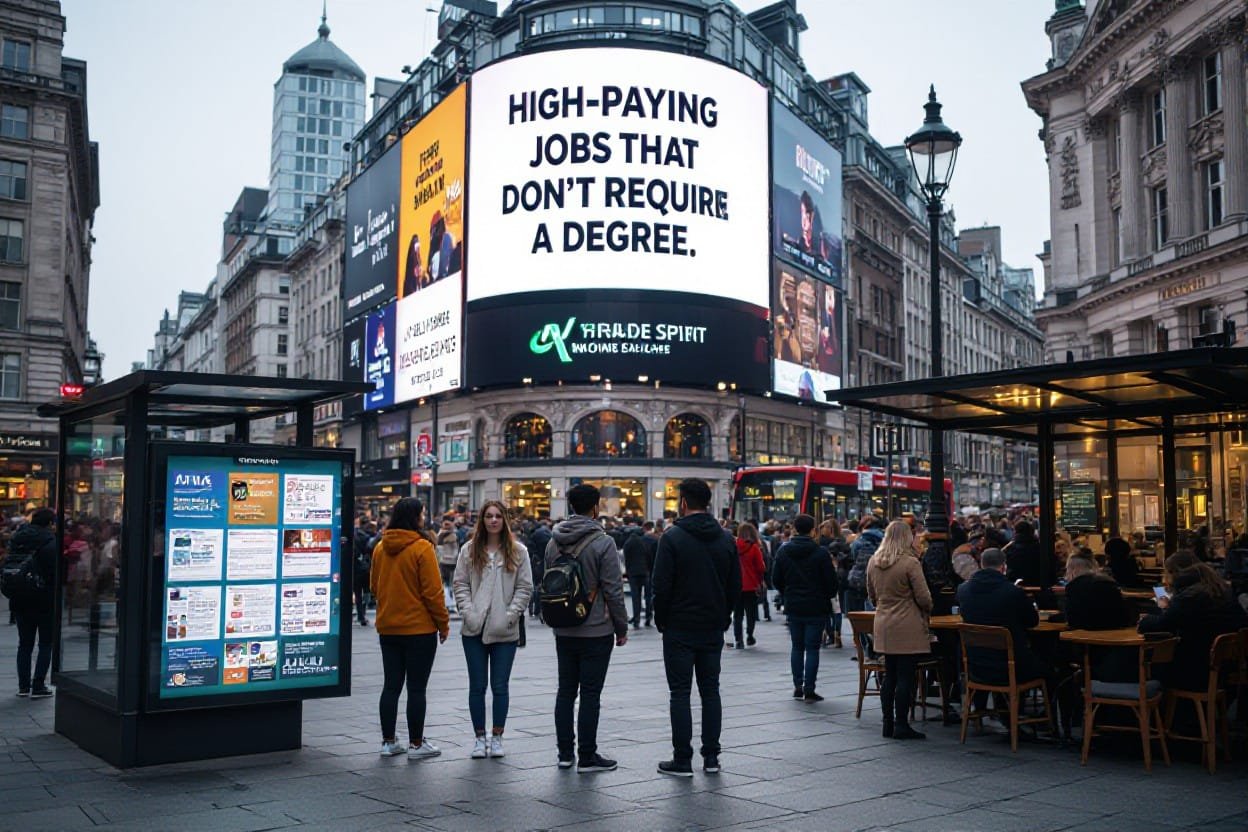
What’s Stopping You?
Fear of making the “wrong” move usually hits harder than any tuition bill. I get it – your parents, your feeds, your coworkers all push the 4-year track like it’s the only safe bet. But when I look at cities like Austin or Phoenix where six-figure trades, tech sales and small businesses are thriving, I see something different: data that says you can build your own playbook and Your Career Place is here to back you when you do.
Breaking the Stigma Around Skipping College
There’s still this weird shame around skipping college, even though the numbers don’t really support it anymore. In Miami, for example, over 40% of small-business owners don’t have a bachelor’s degree, yet they’re hiring, scaling, buying real estate. I want you to see that as proof, not an exception, and at Your Career Place I try to treat “no degree” like a starting line, not a red flag on your resume.
Alternatives to Traditional Education
In every city I looked at, I kept running into the same pattern: people stacking skills through nontraditional routes. Think $8,000 coding bootcamps in Austin that place grads into $75k junior roles, 12-week HVAC programs in Phoenix feeding into union jobs, or Oklahoma City apprenticeships that pay you while you learn. That’s the lane Your Career Place wants you in – lower cost, faster ROI, way more flexible.
So when I talk about “alternatives,” I’m not just tossing out cute buzzwords. In Salt Lake City, tech bootcamps report 70%+ job placement within 6 months, and many grads only studied for 4 to 6 months before landing help desk or QA roles. Phoenix community colleges run certificate programs in logistics or medical billing that run under $4,000 total, and local employers actually recruit straight from those cohorts. You could stack a Google IT Support certificate, a short sales training, then jump into a remote role out of Miami – that layered approach is what I push at Your Career Place because it keeps your downside low and your upside wide open.
Finding Your Path Without the Degree
Once you accept that you’re not broken for skipping college, the next question hits fast: “Okay, so what do I actually do?” I usually tell people to reverse-engineer from the lifestyle they want in a specific city. Want Austin-level income with more freedom? You might target tech sales or high-ticket service work. Prefer Oklahoma City’s lower costs and steady checks? Skilled trades or logistics management could be your lane, and that’s where Your Career Place can help you map it out step by step.
What works best is treating your path like an experiment instead of some one-shot decision you’re stuck with forever. You can test a 3-month real estate assistant role in Phoenix, pivot into property management if you like it, or jump to solar sales if you want higher commissions. You might start in an entry-level support job in Salt Lake City, then use evening classes to slide into cloud roles that cross $90k in a couple of years. At Your Career Place, I always push you to track income, skills, and network growth every 6 months, so your “no-degree” story turns into something way more interesting: a career you actually chose on purpose.
My Top Tips for Thriving Without a Degree
One big shift I’m seeing right now is employers caring way more about what you can do than where you went to school, and that’s exactly where you can win. At Your Career Place, I coach people to treat their career like a scrappy startup: test, iterate, double down on what works. Assume that if you keep stacking skills, relationships and small money wins in the right city, you’ll end up beating a lot of degree-holders on pure momentum.
- Pick a city where non-degree roles regularly pay $60,000 to $90,000.
- Stack 2 or 3 high-value skills that actually show up in local job postings.
- Network weekly: 3 new DMs, 1 coffee chat, 1 event or webinar.
- Use certs and micro-courses instead of traditional college debt.
- Reinvest early income into savings, courses and side hustles.
Networking Like a Pro
In cities like Austin and Miami, I’ve watched people double their income in 18 months simply by being known in the right circles. You don’t need 10,000 LinkedIn connections, you need 20 people who’d happily vouch for you. Assume that every meetup, Slack group or coworking chat is a potential “shortcut” to your next job, client or business partner if you show up prepared and follow up fast.
Skills You Should Focus On
When I scan job boards in Phoenix or Salt Lake City, the same patterns keep popping up: employers want tech-lite, operations and money-making skills, not fancy credentials. I’d prioritize sales, basic data skills, digital marketing and project coordination, because those show up across industries from construction to fintech. Assume that if a skill can either save a company time or help it make more revenue, it’s worth your energy.
To get specific, I see non-degree hires landing $70,000-plus roles after stacking skills like CRM management, Google Analytics, basic SQL, social media ad buying and workflow tools such as Trello or Asana. At Your Career Place, I often tell people to pick one “power skill” that pays (like sales or analytics) and pair it with one platform skill employers actually search for (like Salesforce, HubSpot or QuickBooks). The key is to practice in real life: volunteer to manage ads for a local shop, build dashboards for a friend’s side hustle, help a contractor tighten their bids, then use those results in your portfolio.
Resources to Help You Get Ahead
With so many low-cost resources out there now, skipping a degree doesn’t mean skipping education, it just means you’re not paying $30,000 a year for it. I lean heavily on tools like Coursera, Google Career Certificates and city-specific workforce programs that quietly fund training in tech support, logistics and trades. Assume that if a resource helps you build a portfolio project you can show a hiring manager this month, it’s worth far more than a line of vague coursework on your resume.
What I’ve seen work best for Your Career Place readers is a layered approach: start with free YouTube deep dives to test interest, then move into $50 to $300 focused courses, and finally tap into local incubators, SBDC offices or chamber of commerce programs for real-world connections. In Oklahoma City or Miami, for example, small-business development centers will sit down with you to map out a side hustle or micro-business at no cost. Pair that with online communities on Reddit or specialized Slack groups and you’re basically recreating the “college network” on your own terms, just without the lifetime of student loan payments.
How to Make the Most of Your Money in These Cities
What happens after you finally land that solid paycheck in Austin, Miami or Phoenix? I focus on getting really intentional with every dollar: tracking my income by city, negotiating pay based on local averages, and channeling raises straight into savings or investments instead of lifestyle creep. In places where a $60,000 to $80,000 income stretches far, you can fast-track yourself into the 20 percent by stacking multiple income streams, using employer benefits aggressively and keeping fixed costs low so your opportunities stay wide open.
Budgeting Tips That Actually Work
Which money habits actually move the needle when rent in Austin or Miami can gobble half your paycheck? I like a super simple 60-30-10 rule: 60 percent to needs, 30 percent to wants, 10 percent to debt and savings, then I adjust based on each city’s cost of living and your income. This keeps things flexible yet structured so your paycheck actually pushes you toward upper-class goals instead of drifting away in random spending.
- Use a zero-based budget so every dollar in Oklahoma City or Phoenix has a job before the month starts.
- Cap housing at roughly 30 percent of take-home pay, even when Miami rents tempt you higher.
- Automate transfers to savings and investment accounts the day you get paid, not at month-end.
- Track 3 key numbers weekly: total spending, savings rate, and debt payoff progress.
- Use separate checking accounts for bills and fun money so you never “accidentally” overspend.
- Leverage city-specific perks, like cheaper transit in Salt Lake City, to keep transportation costs lean.
- This simple system is exactly what I use at Your Career Place when I map out realistic money plans for readers in different cities.
Investing Your Earnings Smartly
What if your paychecks in these growth markets could quietly work overtime for you? I start with boring-but-powerful stuff like a 401(k) match, then add a low-cost index fund in a Roth IRA, which historically has averaged about 7 percent annual returns over the long term. This turns even $300 a month into potentially six figures over a couple decades, especially when you combine it with real estate or small business opportunities that pop up in cities Your Career Place has been highlighting.
Instead of chasing the hottest crypto in Miami or the flashiest startup in Austin, I treat those as tiny “fun money” bets and keep 80 to 90 percent of your investing in broad stock market index funds. Because volatility hits harder when you’re new to wealth building, I like setting simple targets: maybe 70 percent in stocks and 30 percent in safer assets if you’re just starting out. In a city like Phoenix where median home prices have been rising, I’d also watch for house hacking opportunities – renting out one room or a duplex unit – so your tenants help cover the mortgage while your equity grows. By stacking workplace retirement accounts, Roth IRAs and one or two smart local plays like real estate or a small side business, you create a money engine that doesn’t depend on a degree, just on your consistency.
Saving Hacks for Young People
How fast could you actually stack cash if you really leaned into the advantages these cities give you? I’m talking specific, unsexy moves like finding roommates to slash rent in Austin, using public transit in Salt Lake City, and grabbing employer health benefits so surprise medical bills don’t wreck your savings. This lets you redirect hundreds a month into high-yield savings accounts and short term goals instead of bleeding it all into day to day costs.
In your 20s, small moves compound like crazy, especially in cities where wages are rising but costs haven’t fully caught up. I like automating tiny transfers, like $10 a day into a separate “freedom fund” account, because that’s $300 a month without feeling brutal, and in a year you’ve got $3,600 that can seed a business, cover moving costs or fund a certification. Side gigs that tap into local demand – think food delivery in Phoenix suburbs or freelance design for Austin startups – can add another $500 to $1,000 a month, and I tell readers at Your Career Place to treat that extra as untouchable savings, not lifestyle money. Over a few years, those boring habits quietly turn into a hefty safety net that gives you the courage to make bigger, higher paying moves in these cities.
The Role of Online Learning and Certifications
In cities like Austin or Phoenix, you can skip the dorm life and still keep leveling up your skills, because online courses and certs let you move just as fast as the local job market. While some leaders are debating traditional higher ed – like in this article, Blue-city mayors urge colleges to stand up to Trump – you and I can quietly stack credentials that actually pay. At Your Career Place, this is exactly the lane we help you run in.
Why Online Courses Can Change the Game
Instead of dropping $80,000 on a degree, you can grab a $59 course that gets you billable skills in 30 days, sometimes less. In tech-heavy spots like Salt Lake City and Miami, hiring managers care way more about your GitHub or portfolio than your campus. That means you can pivot quickly, test new paths, and double down on what actually lands interviews and freelance clients.
Certifications that Boost Your Job Prospects
In the cities I’ve been talking about, the right cert can move your pay from $22 an hour to $40-plus, without you ever stepping into a lecture hall. Think CompTIA A+ for entry IT, Google IT Support for help desk roles, AWS Cloud Practitioner for cloud gigs, or a real estate license in Phoenix where housing is exploding. At Your Career Place, I’m always steering readers toward certs that directly match local job postings, not just what sounds fancy on paper.
For example, in Austin and Miami, I consistently see postings that bump candidates with AWS or Azure certs into the $75,000 bracket, while un-certified applicants cap out at $55,000. In Oklahoma City, a basic CDL plus a logistics or forklift certification can push you into overtime-heavy roles that crack $90,000 a year. You don’t need ten letters after your name – you just need the 2 or 3 that show you can do the work employers are desperate to fill right now.
My Top Picks for Online Learning Platforms
When I’m helping readers map out a non-degree path at Your Career Place, I usually start with a simple stack: Coursera or edX for structured, name-brand programs, Udemy for cheap, tactical deep-dives, and YouTube for all the filler and practice. If you’re tech-leaning in a city like Salt Lake or Austin, toss in freeCodeCamp or Codecademy, then use project-based platforms like Scrimba to build a portfolio that proves you can actually ship stuff.
What really matters here is how you use these platforms, not which logo is on your account. I tell people in Miami or Phoenix to reverse-engineer job posts first, then hunt for courses and certs that match those exact skills. For instance, if 70% of local postings mention SQL or Excel pivot tables, you should be lining up a focused Coursera or Udemy course, knocking it out in 3 to 6 weeks, and then immediately applying that in a small freelance project or side hustle so it’s not just “I watched some videos” on your resume.
What’s Next?
So where do you go from here if Austin, Miami or Phoenix are already on your radar? I’d start by mapping your current skills to what these cities actually pay for right now – construction, logistics, SaaS sales, real estate, blue-collar trades pulling in 80,000 dollars plus. At Your Career Place, I use this data-first approach to help you decide whether you should move, double down where you are or build a remote-first skill set that works in any of these markets.
Future Job Trends: What You Should Know
Ever wonder which jobs in these cities will still be hot 5 or 10 years from now? In Austin and Salt Lake City, tech-adjacent roles like sales engineers, project coordinators and implementation specialists can clear 90,000 dollars without a degree. Miami is leaning into fintech, e-commerce logistics and content studios, while Phoenix is scaling solar installations and fulfillment centers. At Your Career Place, I track BLS data and local job boards so you can align your next move with where the money is actually flowing.
Preparing for Changes in the Job Market
What if your current skills don’t quite match what these cities are hungry for yet? You can pivot faster than you think by stacking short, targeted skills like Salesforce admin, project management or CDL training that pay off in under 12 months. I’ve seen people jump from 18 dollars an hour to 30 or more just by layering one in-demand certification on top of existing experience. Your Career Place exists to help you spot those tiny skill shifts that lead to very non-tiny paychecks.
In practical terms, I’d break it into 3 moves: pick a lane (trades, tech-adjacent, logistics, real estate), grab a 3-6 month skill booster that fits that lane, then start applying in cities where starting wages are already inflated by growth. For example, a rookie electrician in Phoenix or Oklahoma City can hit 60,000 dollars within a couple years, and pairing that with basic property investing can push you toward six figures faster than a traditional degree route. With Your Career Place, I’m constantly updating playbooks like this so you’re not guessing which skills will actually move the needle.
My Predictions for the Next Big Cities
Which cities might quietly become the “next Austin” for people skipping college? I’m watching places like Raleigh, Nashville and Tampa, where population growth, rent increases and startup activity are all trending up together. Raleigh already posts tech support and QA roles in the 55,000 to 75,000 dollar range without degree requirements, while Nashville’s construction and hospitality-adjacent jobs are climbing fast. At Your Career Place, I look for that combo: rising wages, business-friendly policies and room to buy property before prices go wild.
Based on the data I’ve pulled, I think smaller metros with under 2 million residents and strong inbound migration will quietly mint the next wave of non-degree millionaires. Cities like Boise, San Antonio and Columbus are pulling in remote workers, logistics hubs and manufacturing expansions, which usually means more 25 to 35 dollar an hour roles for people who are willing to learn on the job. If you use Your Career Place as your guide, you can start scouting these markets early, get in while rents are still semi-reasonable and ride that wage-and-real-estate wave as it builds instead of trying to chase it once it peaks.
To wrap up
Taking this into account, I think the wildest part is that your upper-class life might be hiding in a city you haven’t even considered yet, not in another degree program. If you’re in Austin, OKC, Miami, Salt Lake City or Phoenix, you’ve basically got home-field advantage for building wealth without a diploma, and at Your Career Place I want you to actually use it – not just daydream about it.
I’m not saying skip college automatically, but I am saying you’ve got options, and Your Career Place is here to help you squeeze every drop out of them.
Thank you for visiting Your Career Place. Please review these related articles.